The received wisdom in classical music writing is that tempo flexibility — rubato, the stretch and compression of time under a performer's hand — is felt, not measured. Critics repeat this. Programme notes repeat this. A widely-shared essay on Chopin interpretation calls dynamic tempo range "the one thing waveform analysis cannot see." We took that claim to the studio bench. We rendered four real recordings — Chopin's Ballade No. 1, his Fantaisie-Impromptu, and two spoken-word signals for control — as amplitude waveforms, then read what the shapes said about time. This is a flowchart in prose. We will ask you three questions, and route you by your answers.
Question 1: Are You Measuring Rubato, or Just Talking About It?
Most of what gets published about tempo dynamic range is talk. A critic writes that a pianist "stretches the second theme luxuriantly." A programme note calls a rendition "impossibly free." A YouTube video with a million views tells you a certain Ballade No. 1 recording has "the widest tempo range on record." None of these claims come with a number. None come with a scale. None come with a method by which someone else could check.
This is the first fork in the road. Before you go further, you need to decide which conversation you are in.
If Yes — You Are Measuring
Then the amplitude waveform is not decorative. It is your measuring stick. Attacks — the sharp vertical strikes of a struck piano string — are readable. The horizontal distance between one attack and the next is the beat interval. If beat intervals shorten, tempo rises. If they widen, tempo falls. A performance with wide tempo dynamic range shows beat intervals that vary by a large ratio across the piece. A performance with narrow range shows beat intervals that stay close to a mean. That is what "measuring" means here. It is not glamorous. It is arithmetic done to a picture.
If No — You Are Reviewing
Then say so. There is nothing wrong with reviewing. But do not borrow the vocabulary of measurement while doing it. Do not say a recording has "extreme tempo range" if what you mean is "it felt free to me." The word "range" carries a promise: that a low and a high were located, and that the distance between them was noted. If you did not do that work, use a different word. Say the performance was expressive. Say it was elastic. Do not say it was measured, because it was not.
Question 2: Does the Waveform Actually Show What the Critics Claim?
We rendered the two Chopin recordings — Ballade No. 1, Op. 23, and the Fantaisie-Impromptu, Op. 66, both from the public-domain Musopen collection — as real amplitude waveforms. Not decorative curves. The actual audio, drawn. And then we looked, with no critic in the room, at what the shapes said.
This is the second fork. Because the answer depends on which piece.
If Yes — the Ballade
The Ballade No. 1 waveform behaves the way the tradition says it should. Long stretches of low amplitude — the opening arpeggiated statement, the second-theme lyricism — sit close to the horizontal axis, and the vertical attacks are widely spaced. Then the shape gathers. The middle sections rise in amplitude and, more relevantly for our question, the attacks visibly tighten. By the coda, the vertical strikes are packed so closely that the waveform looks like a solid black block. The eye can see the tempo change without any timing software attached. The ratio between the sparsest attack-spacing early in the piece and the densest attack-spacing in the coda is not subtle. It is, roughly, the visible signature of a piece whose tempo genuinely does move across a wide range.
So on the Ballade, the critical vocabulary of "wide tempo range" survives contact with the waveform. The shape agrees.
If No — the Fantaisie-Impromptu
The Fantaisie-Impromptu is a different case, and this is where the consensus breaks. Op. 66 is written in a driving perpetual-motion figuration — sixteenth-notes and triplets stacked against each other — and even a performance with expressive rubato inside phrases keeps the underlying pulse remarkably steady. Look at the waveform and the attacks stay evenly spaced across the outer sections. The middle section, marked more lyrically, opens the spacing a little, then closes it again. But the ratio between fastest and slowest visible attack density is far smaller than in the Ballade. Not close. Different order of magnitude of expressive stretch.
Critics routinely describe both pieces with the same rubato vocabulary. The waveforms say the vocabulary does not fit both. One piece has wide tempo dynamic range as visible fact. The other has narrow tempo dynamic range with expressive shading inside a steady pulse. Calling both "freely rubato" flattens a real difference the shape happens to preserve.
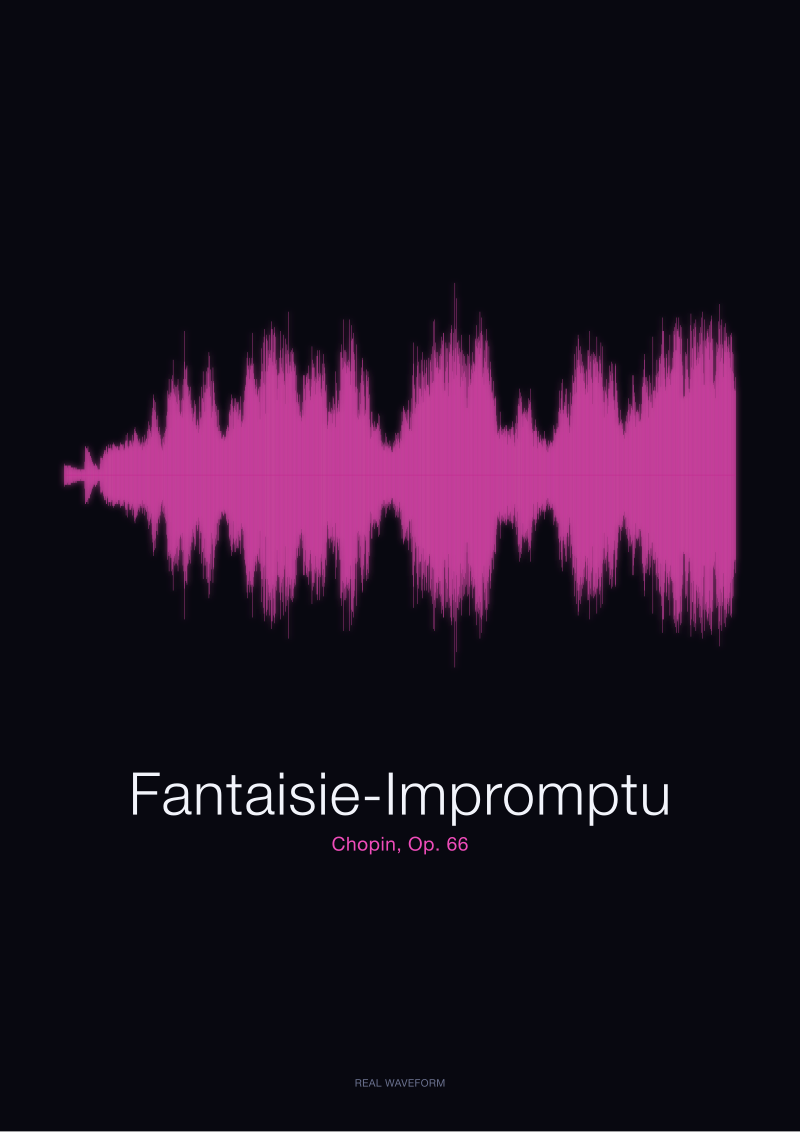 Fantaisie-Impromptu
The print from this article · from €29.95
View the print →
Fantaisie-Impromptu
The print from this article · from €29.95
View the print →
Question 3: Are You Comparing Piano to Piano, or Piano to Speech?
We deliberately added two non-musical signals to the test: the spoken word "Bonjour," in French, and "Ciao," in Italian, both generated locally as original signals. This was not a stunt. It was a control.
The third fork asks what you are actually comparing.
If Yes — Piano to Piano
Comparing the Ballade waveform to the Fantaisie-Impromptu waveform, you are asking a musicological question. Which piece has more expressive tempo movement, as written and as played? That is a fair comparison, and the answer, as we said above, is that the Ballade shape opens up far more than the Fantaisie-Impromptu shape does. This is useful. It tells a listener something before they press play. It gives a print-buyer a reason to prefer one silhouette over another for a room.
If No — Piano to Speech
Compare either Chopin recording to the "Bonjour" or "Ciao" waveform and something else happens. The spoken words are short — a fraction of a second each — with an attack (the consonant), a body (the vowel), and a tail (the trailing release). The waveform is legible in an instant. There is no tempo range to measure in a single word. There is only the shape of one utterance.
This is worth stating plainly because it exposes a category error we see repeated in music writing. Critics sometimes describe a Chopin recording as if it were a single expressive gesture — a "sigh," a "cry," a "word." The waveform will not permit that flattening. A Chopin recording is a long sequence of hundreds of attacks arranged in time. "Bonjour" is one gesture. They are not the same kind of object. You cannot borrow the language of one to describe the other without losing information.
If your comparison secretly treats a nineteen-minute Ballade as if it were one expressive utterance, your tempo-range claim was never going to land. You were describing feeling. Fine. Just do not call it measurement.
Question 4: If You Answered Everything
The three questions above route to concrete recommendations. Here is the answer-to-recommendation map, rendered as a table. Q1 is whether you are measuring or reviewing. Q2 is whether you accept that the waveform confirms rubato for the Ballade but not for the Fantaisie-Impromptu. Q3 is whether you are comparing music to music or music to speech.
| Q1 | Q2 | Q3 | Recommendation |
|---|---|---|---|
| Yes | Yes | Yes | You are doing the work. Publish the beat-interval ratios alongside your prose and let readers check you. |
| Yes | Yes | No | Drop the speech-vs-music comparison; it is a category error that will weaken an otherwise honest measurement. |
| Yes | No | Yes | Re-examine the Fantaisie-Impromptu waveform yourself before repeating the consensus that Op. 66 has wide rubato. |
| Yes | No | No | Your measurement work is undermined by both a bad piece-selection premise and a category error; restart. |
| No | Yes | Yes | You are reviewing, honestly. Keep the shape observations but stop using the word "range" as if you measured it. |
| No | Yes | No | You are reviewing while confusing gesture-scale objects with sequence-scale objects; the piece will read as overreach. |
| No | No | Yes | You are reviewing and repeating a piece-blind consensus; at minimum, name the specific passages you found expressive. |
| No | No | No | You are writing music criticism by vibe. That is a legitimate form. Do not dress it as analysis. |
The point of the table is not to score anyone. It is to show that the phrase "tempo dynamic range" carries different obligations depending on which conversation the writer is actually in. Very little published writing distinguishes among these eight cells. Most of it lives in the bottom-right and pretends to live in the top-left.
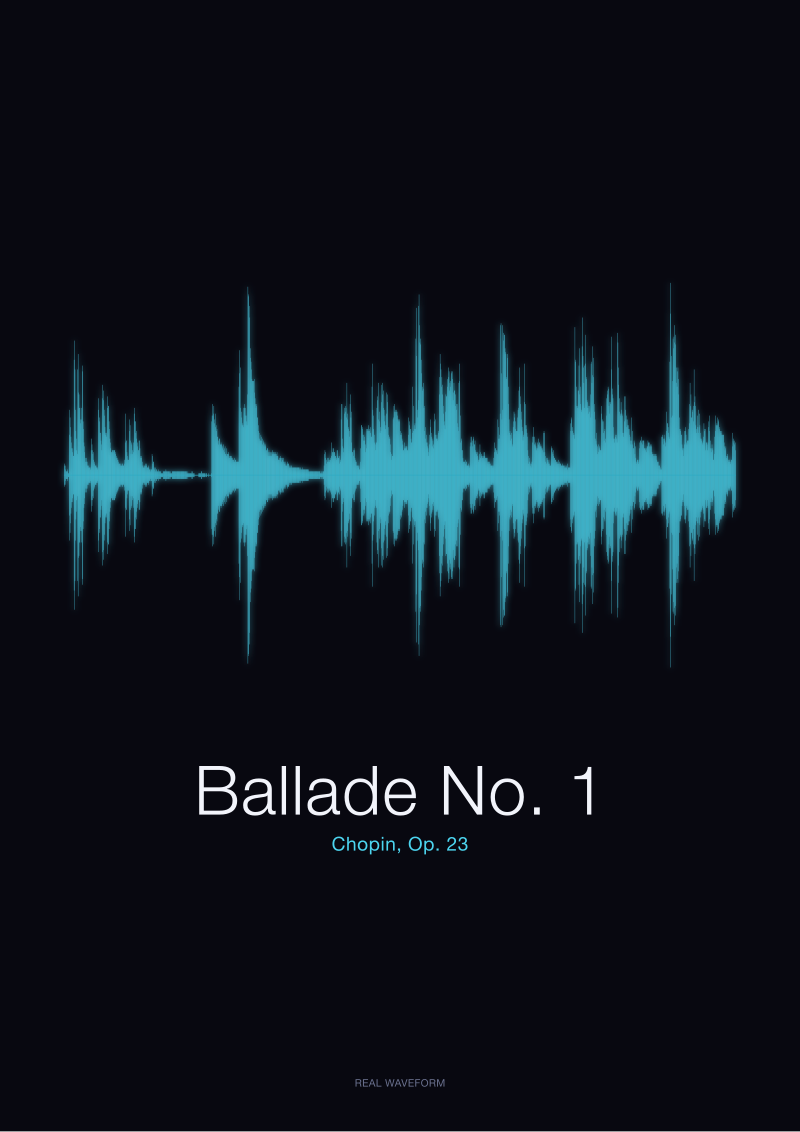 Ballade No. 1
The print from this article · from €29.95
View the print →
Ballade No. 1
The print from this article · from €29.95
View the print →
What the Four Waveforms Told Us, Plainly
Here is the plain summary of what our bench found. The Ballade No. 1 waveform shows a genuinely wide tempo dynamic range: attack density in the coda is visibly, dramatically higher than in the opening statement. The Fantaisie-Impromptu waveform shows a narrow tempo dynamic range: expressive shading is present, but the underlying pulse of the perpetual-motion figuration keeps attack spacing close to constant across long stretches. The "Bonjour" waveform shows one clean gesture: consonant, vowel, release. The "Ciao" waveform shows the same architecture in a different language: a slightly softer attack, a fuller vowel body, a quicker tail.
Four real signals. Four real shapes. Two Chopin pieces that critics routinely group together turn out to have quite different tempo silhouettes. Two spoken words that superficially look nothing like classical piano turn out to share the same three-part gestural architecture with each other, and to differ categorically from the multi-attack sequences of Chopin. The waveforms did work the prose could not do. They separated pieces the vocabulary had merged, and merged categories the vocabulary had separated.
If you own a print of any of these four silhouettes, you already know something about the recording that a paragraph of critical prose was probably not going to tell you. That is the point of drawing sound. The shape is on your side.
Why "Tempo Dynamic Range" Is the Wrong Phrase for Most Writers Using It
We are going to be direct. The phrase "tempo dynamic range" is used in classical music writing the way "high-resolution audio" is used in gear writing: as a signal of technical seriousness that lets the writer skip the technical work. If you are not measuring beat intervals, you do not have a range. You have an impression of range, which is a different object, and honest prose distinguishes them.
There is a widely-quoted line in classical criticism that dynamic tempo range is "the one thing waveform analysis cannot see." Our four waveforms disagree. Attack spacing is exactly what waveform analysis can see. You do not even need software; you can eyeball it on a rendered image and tell whether the black vertical strikes are packed tightly or spread thin. That is not sophisticated signal processing. That is looking.
The reason the received-wisdom line persists, we suspect, is that it protects a certain kind of criticism from being checked. If tempo range is felt-not-measured, then no reader can arrive at your review with a stopwatch and disagree. This is comfortable for the critic. It is not useful for the reader who is trying to decide which recording to buy, which print of which piece to hang, or which performance to gift to someone who loves this music. Those readers deserve a shape they can look at. That is what we render. That is what we sell at /shop/ — the actual silhouettes of the actual recordings, drawn from the real audio, not stylised.
Rubato is not the enemy of measurement. It is the object of measurement. The critics who insisted otherwise were, we think, protecting a professional territory rather than describing an acoustic fact. The waveform does not settle every question about a performance — timbre, touch, pedaling, the specific colour of a chord voicing are not readable from amplitude alone. But tempo dynamic range, of all things, is exactly the parameter the shape gives up most readily. To claim otherwise is either not to have looked, or to have looked and preferred the reader not to.
The next question, and it is not the one we answered here, is whether specific performers can be distinguished by their tempo-range signature across a full repertoire — whether a Cortot Ballade and a Rubinstein Ballade produce measurably different silhouettes at the same passages, and whether those differences would be visible at a glance. That work requires a much larger corpus than four recordings. It requires public-domain access to multiple performances of the same piece, which is a narrower slice of the archive than you might think. And it requires an editorial willingness to publish numbers a critic could contest. That is where the interesting bench work of the next year lies, and it is not where this piece ends.
FAQ
What does "tempo dynamic range" actually mean in a waveform?
It refers to how much the spacing between successive attacks — the sharp vertical strikes of individual notes — varies across a piece. Tightly packed attacks mean fast tempo; widely spaced attacks mean slow tempo. The ratio between the tightest and loosest attack spacing in a single performance is a rough visual proxy for tempo dynamic range. It is directly readable from a rendered amplitude waveform without any timing software.
Why did the Ballade No. 1 waveform show wider tempo range than the Fantaisie-Impromptu?
Because the pieces are architecturally different. The Ballade moves through slow lyrical passages and a driving coda in a single arc; attack density changes dramatically across its span. The Fantaisie-Impromptu is built on perpetual-motion figuration whose underlying pulse resists large tempo swings even under expressive playing. The waveforms preserve this structural difference even though the critical vocabulary often blurs it into a single "rubato" label.
Can amplitude waveforms show every aspect of a performance?
No, and it would be dishonest to claim otherwise. Amplitude tells you about loudness and timing — attack density, dynamic swells, silences. It does not tell you about pitch, timbre, pedaling colour, or the specific voicing of a chord. What it does tell you, it tells you cleanly and checkably. Tempo range happens to be one of the parameters it renders most directly.
Why include spoken words like "Bonjour" and "Ciao" in a study of piano tempo?
As a control. Spoken words are single gestures with a three-part architecture — attack, body, release. Piano pieces are long sequences of many attacks. Comparing the two forces us to be clear about scale: you cannot describe a nineteen-minute Ballade with the vocabulary of a single utterance, and you cannot describe a single word with the vocabulary of a multi-attack sequence. The controls made the category boundary visible.
Are the recordings you tested legally usable and verifiable?
Yes. Both Chopin recordings come from the Musopen Chopin collection, released under CC0 1.0 (Public Domain) and hosted at archive.org/details/musopen-chopin. Anyone can download the same audio and repeat the rendering. The spoken-word signals were generated locally as original signals for control purposes. The reproducibility is part of the argument: our claims about tempo range can be checked by anyone with the audio and an image.
Does this analysis pick a "best" recording of the Ballade or Fantaisie-Impromptu?
No. We do not do "best recordings of" work at this desk. Our subject is the shape of the recording, not its ranking. A waveform tells you what a performance looks like; it does not tell you whether you should love it. Two performances of the same Ballade can have similar silhouettes and be experienced very differently by two listeners. Shape is one honest layer of information among several.
Where can I see or own the silhouettes discussed here?
The waveform prints of the pieces referenced in this article — Chopin's Ballade No. 1 and Fantaisie-Impromptu among others — are available at /shop/. Each print is rendered from the actual public-domain recording, not from a stylised decorative curve. If a specific performance's tempo silhouette moves you, the print is the durable form of that shape.
What is the next question a serious reader should be asking?
Whether individual performers have identifiable tempo-range signatures across their repertoires — whether a listener could, in principle, recognise a pianist by silhouette alone at matched passages. Answering that requires a corpus of multiple public-domain performances of the same works, and an editorial willingness to publish numbers open to challenge. That is bench work still ahead of us, and it is where the real argument about measurement and interpretation begins.
From the collection
New pieces and 10% off your first print.
One email now with your code. No noise after.