We spent a week rendering the same twelve-second voicemail four different ways — different sample rates, different vertical scales, different aspect ratios — and the shape kept changing. That is the practical problem with turning a voice recording into a keepsake: the waveform is a drawing of decisions, not only of air. What follows is the flowchart the studio uses when a WAV file arrives with the question, what should this become. Three forks. Each one narrows the field. By the end, the recording in hand should have a shape, a size, and a reason to exist as an object — or a clear reason not to become one at all.
Question 1: Does the Recording Already Exist, or Does It Still Need to Be Captured?
This is the fork that quietly determines the entire project. A recording that already exists is a document — it has a room in it, a microphone position that cannot be changed, a background noise floor that is now part of the object. A recording that has not been made yet is a set of decisions still available to you. The two paths ask different things of the person planning the keepsake, and they produce different-looking waveforms even when the sentence spoken is identical.
We keep two reference files on the studio wall for exactly this reason: a rendered waveform of the French word *bonjour* and one of the Italian *ciao*, both generated locally with clean synthesis. Their silhouettes are surgically neat — flat baseline, one clean attack, one clean decay, no ambient bleed. Real voicemails look nothing like that. They have a cough two seconds before the sentence starts, a fridge hum that thickens the baseline, a phone-line compression that clips the peaks. Neither shape is better. But you have to know which one you are drawing.
If Yes — the Recording Already Exists
You are working with a fixed document. The waveform is going to show whatever the recording actually contains, including the things you did not notice while listening. Before anything else, listen to the file on headphones from start to finish, timestamp any dead air longer than a second, and decide whether you want that silence in the final render or trimmed out. Silence is white space on the print, and a lot of voicemails have more of it than the emotional memory suggests.
Ask what you have. Voicemail export from a carrier is often 8 kHz, mono, heavily compressed — the waveform will look softer, less spiky, because the high frequencies were thrown away in transit. A phone-recorded voice memo is usually 44.1 kHz or 48 kHz and will draw a sharper, more detailed silhouette. Neither is a defect; they are just different documents. Send the highest-fidelity version you have. Do not re-record the voicemail by pointing a second phone at the speaker — you are drawing the room now, not the voice.
If No — the Recording Still Needs to Be Captured
You have the rare gift of choosing what the shape will be. Record close to the mouth (four to six inches), in the quietest room in the house, with the phone laid flat rather than held (hand tremor shows up as low-frequency wobble in the baseline). Ask the person to say the sentence three times, back to back, with a small pause between takes. This is how professional studios work, and it costs nothing at home.
Decide what the sentence is *before* you press record. "I love you" spoken cold is a short, symmetrical shape. A four-word phrase said the way that specific person says it — with the pause, the laugh at the end, the small breath before — draws a much more specific silhouette. If the recording is for a person who is still with you, ask them what they would want to say to the future. If it is for a person who is gone, the shape is likely already in a voicemail somewhere; go back to the Yes branch.
Question 2: Is the Clip Under Ten Seconds, or Does It Run Longer?
Duration is the axis nobody plans around and then everyone regrets. A waveform is time on the horizontal, amplitude on the vertical. A two-second clip stretched across a 24-inch print produces a silhouette with room to breathe — you can see individual syllables, the attack of each consonant, the pocket of quiet between words. The same 24-inch print asked to hold a two-minute clip compresses everything into a dense wall of shape, closer to a texture than a drawing. Both can be beautiful. Only one is legible from six feet away.
The ten-second threshold is not magic — it is where most home-print aspect ratios stop being able to resolve individual words at typical viewing distance. Below it, you get phonetic architecture. Above it, you get a mood.
If Yes — Under Ten Seconds
This is the sweet spot for legibility. A three-to-eight-second clip — a single sentence, a laugh, a nickname — renders as a recognisable phonetic shape. You will be able to point to the print years later and say, that hump is when she said my name. The words are visible as discrete events on the timeline. This is what people usually mean when they picture a "voice waveform" as an object.
At this length, small production choices become visible. A recording with a one-second lead-in of silence and a one-second tail will draw a shape that sits in the middle of the frame with margins on either side — usually the most balanced composition. Aggressive trimming right up to the first consonant makes the shape feel like it is falling off the left edge of the paper. Trim, but leave breathing room.
If No — Longer Than Ten Seconds
You are now in the territory of *shape as impression* rather than shape as sentence. A forty-second grandparent voicemail, a two-minute lullaby, a five-minute wedding toast — these render as dense forests of amplitude with a distinctive overall silhouette but no individual words legible. The keepsake stops being a transcription-you-can-see and becomes a portrait of pacing: this person's cadence, this person's pauses, the arc of the story they told.
Two practical consequences. First, aspect ratio matters more — a very wide, short print (say 30 inches by 8) will resolve more detail than a square. Second, the emotional weight of the object is different. A short-clip print is about a specific thing said. A long-clip print is about the fact of the voice itself, the way it moves through time. Neither is more sentimental than the other; they are different arguments about what matters about the person.
Question 3: Will the Keepsake Live on a Wall, or in a Drawer?
We think of prints as wall objects by default, and often they should be. But a meaningful percentage of voice-recording keepsakes in this studio end up in drawers, in the inside pockets of jackets, folded into books. That is not a failure of the object. That is a category of keepsake with different rules. The last question is about intent: is this thing meant to be seen constantly, or held rarely?
The wall version is public within the household. Everyone who walks past it sees the shape every day, and the sentence behind the shape becomes something shared. The drawer version is private. The person who owns it might look at it four times a year, on specific dates. The design considerations are almost inverse.
If Yes — on a Wall
Design for repeated viewing. This means: neutral typography beneath the waveform, a paper stock that will not yellow in indirect sun, a size proportional to the wall it will hang on rather than to the emotional weight of the recording (grief does not scale linearly to inches). If the person who made the recording is still living and you are giving the print as a gift, consider that the recipient will be looking at this shape for years, possibly decades. Simpler compositions age better than dense ones. A single sentence, cleanly rendered, mounted with a wide mat — this holds up.
Wall pieces also have a room-context problem worth naming. The waveform of a laugh will read very differently on a nursery wall than in a home office. Match the emotional register of the recording to the room it will occupy. If you cannot, choose the room first and work backwards to which recording belongs there.
If No — in a Drawer
Design for occasional, deliberate handling. This is a smaller-format object: card stock or heavy paper, a size that fits in a hand or a book, an accompanying date or short caption written on the back rather than typeset on the front. The waveform can be denser, more detailed, because the viewer will be close to it. Silence-heavy compositions work well here in a way they do not on walls; the emptiness reads as intimate rather than sparse.
A drawer object is often the right answer when the recording is grief-adjacent — a final voicemail, a last message. Some things are not meant to be seen every day. Making them wall-sized can turn a private artifact into a room-tone you did not intend to set. Trust the impulse if it says: this belongs somewhere I can choose to open.
If You Answered Everything: The Combinations, Mapped
Eight paths through the three forks. Each recommendation is a starting posture, not a rule. The point of the table is to make the decision fast enough that you can spend your attention on the recording itself.
| Q1: Exists / Capture | Q2: Under 10s / Longer | Q3: Wall / Drawer | Recommendation |
|---|---|---|---|
| Exists | Under 10s | Wall | Trim to phrase, lead-in intact, wide mat, mid-size print with the sentence typeset small below. |
| Exists | Under 10s | Drawer | Card-format, high resolution close-read, dated on the back, no typeset caption on front. |
| Exists | Longer | Wall | Panoramic aspect ratio, dense silhouette as portrait of cadence, minimal typography, larger scale. |
| Exists | Longer | Drawer | Small dense-format print in a folder or book; treat it as a document, not a display piece. |
| Capture | Under 10s | Wall | Record three takes close-mic, pick the cleanest, render at studio scale with generous margins. |
| Capture | Under 10s | Drawer | Capture a whispered or intimate phrase, print small on heavy stock, keep it as a private object. |
| Capture | Longer | Wall | Record a whole story or song, render wide-format, accept illegible words in exchange for arc. |
| Capture | Longer | Drawer | Consider whether print is the right medium at all — a long capture may live better as audio itself. |
The last row deserves a small note. Not every recording needs to become an object. Some voices are better preserved as files, backed up in three places, listened to on the anniversaries when listening is the point. A print freezes one interpretation of a shape. Occasionally that interpretation is a diminishment of what the recording actually is. The honest studio position is that the decision tree can end at *no print* and that ending is not a loss.
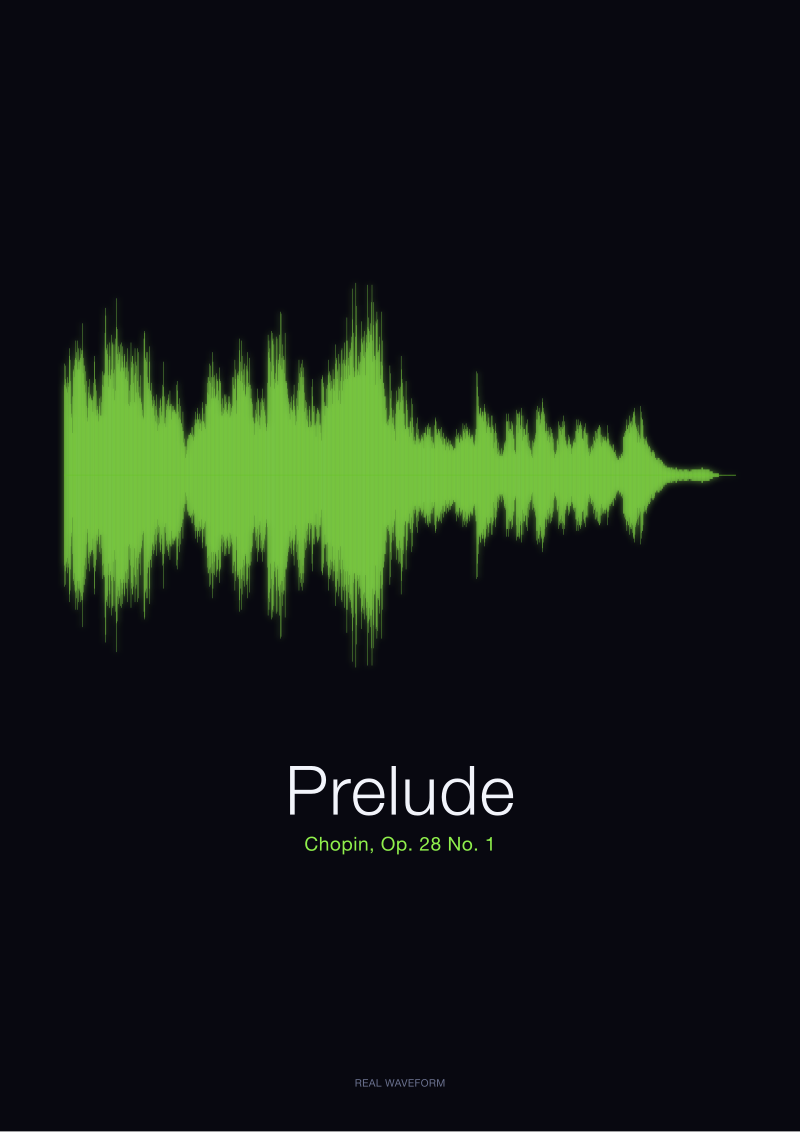
For those who do want the sentence rendered — the same discipline the studio uses on Chopin's *Ballade No. 1* and the *Fantaisie-Impromptu*, drawn directly from the actual amplitude of a real recording rather than a decorative curve, is the discipline we bring to a voicemail. That work, and examples of it, lives at the studio's see the Ballade No. 1 print.
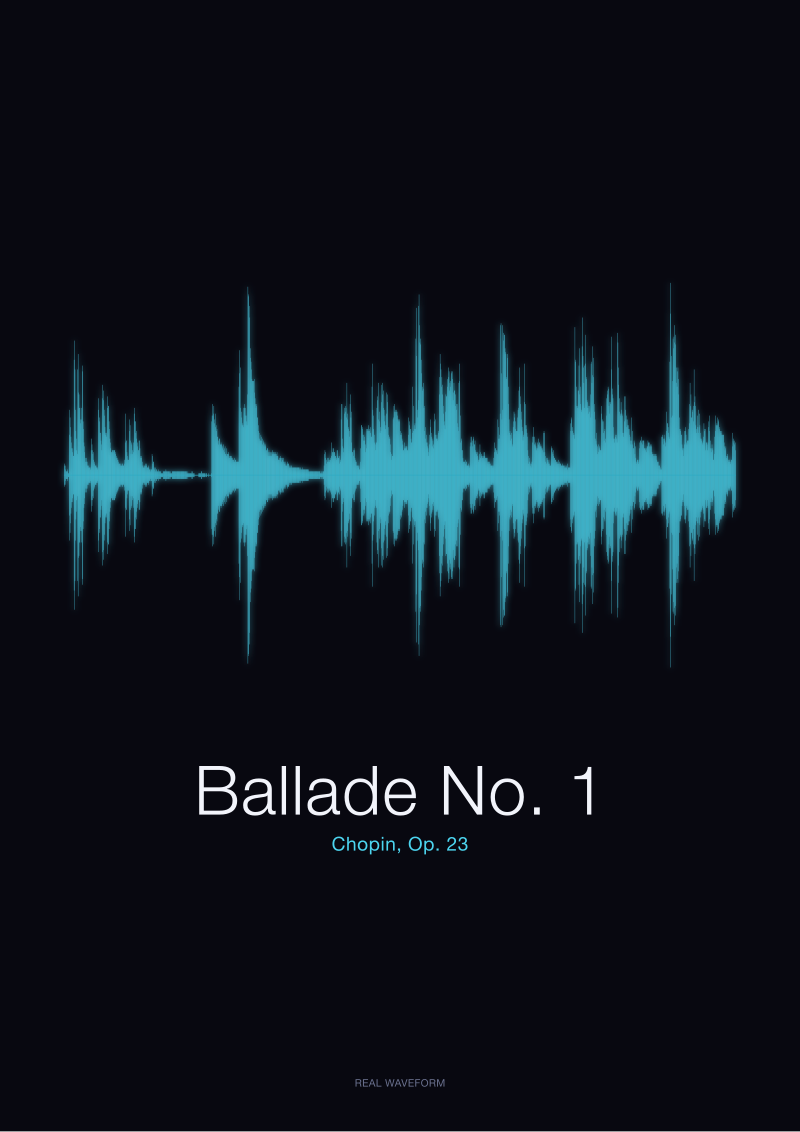 Ballade No. 1
The print from this article · from €29.95
View the print →
Ballade No. 1
The print from this article · from €29.95
View the print →
FAQ
What is the shortest recording that still makes a good print?
Around two seconds — a single word, a laugh, a name spoken once. Below that, the silhouette starts to feel like a single stroke rather than a phrase, which can be beautiful but no longer reads as speech. The *bonjour* and *ciao* reference files we keep on the studio wall each sit under two seconds and produce clean, phonetically legible shapes. If the source clip is a sub-second sneeze or word, expect an abstract mark rather than a transcript.
Does the recording need to be studio quality?
No, and often it should not be. Voicemails, phone memos, WhatsApp voice notes all render legibly, even at 8 kHz phone-line compression. Compressed audio simply produces a softer, less spiky shape — the high-frequency detail is absent, so consonants look rounder. This is honest to what the recording actually is. What you want to avoid is re-recording the recording (pointing one phone at another's speaker); that adds a second room on top of the first, and both draw themselves into the waveform.
Can we render a recording of someone who has died?
Yes, and this is a substantial portion of the work. The studio treats these files with the same fidelity discipline as any other — the shape shown is the shape the microphone actually captured, not a smoothed or beautified curve. Before rendering, we recommend the person commissioning the print listens to the full clip once, on headphones, so that any background sounds (a television, a nurse, a car passing) are a conscious choice to include or trim rather than a surprise seen later on the wall.
What sample rate is best for a voice keepsake?
Whatever the original recording is. Do not upsample a phone voicemail to 96 kHz thinking it will produce more detail — the detail is not in the file, and interpolation invents information that was never there. If you are capturing a new recording specifically for a print, 44.1 kHz or 48 kHz mono is standard and produces a clean, detailed silhouette. Anything higher is engineering theatre for a print use case.
Should the print show the words underneath the waveform?
Usually yes, in small typography, but only if the clip is a specific sentence rather than a long stretch. For a short phrase — under about ten seconds — a typeset transcript below the waveform anchors the shape to meaning. For longer clips where the shape is a portrait of cadence rather than a transcription, typeset words below can feel redundant; the shape is the point. Ask which the print is arguing for.
Is there a case for keeping the recording as a file rather than making a print?
Yes. If the recording is very long, or if you know you will want to hear the voice more than see it, a print is the wrong medium. A print freezes one visual interpretation; audio preserves everything the microphone caught. Some recordings — long voicemails, whole conversations, phone calls with several minutes of ambient content — belong on backed-up drives, not walls. The decision tree above can honestly end at *no keepsake object*.
How do we choose which sentence to record when the person is still living?
Ask them a question they can answer in one breath. Not "say something to remember you by" — that produces the worst version of anyone's voice. Better: "what did your mother used to say to you at bedtime", "how do you answer the phone", "tell me your full name and where you were born". Specific prompts produce natural cadence, which produces waveforms with character. Generic prompts produce flat, self-conscious shapes that do not survive years of looking at.
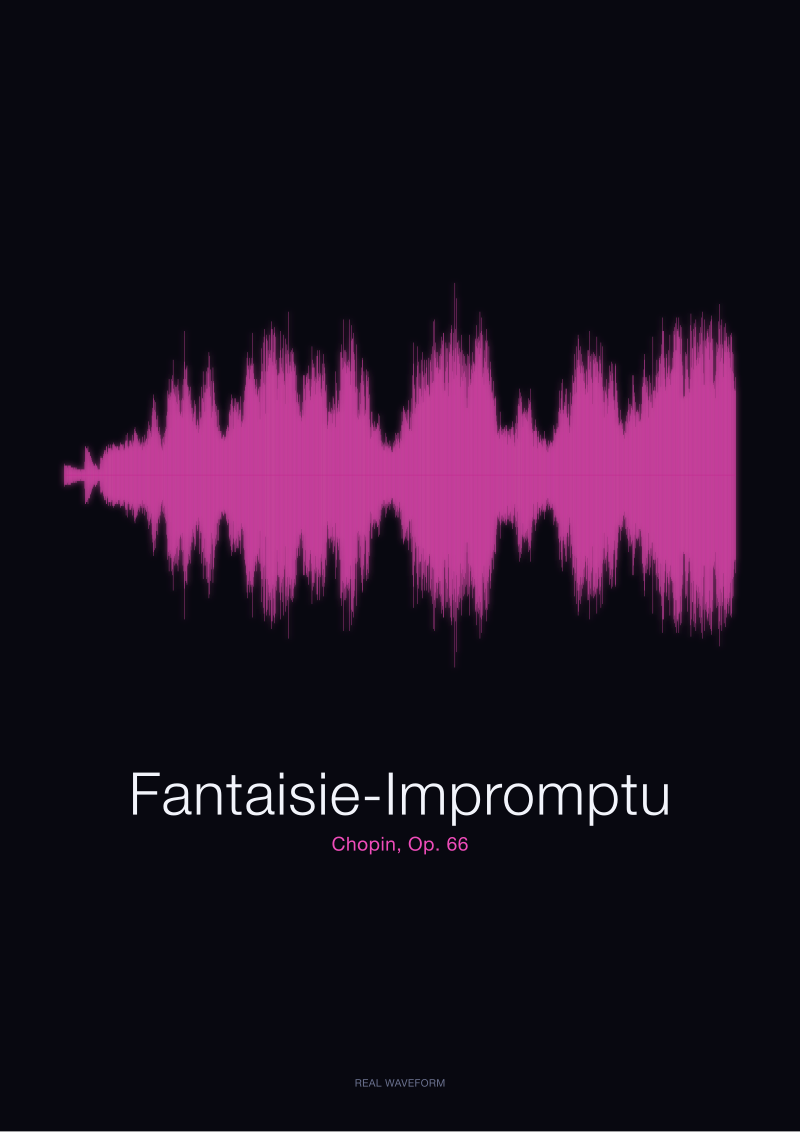 Fantaisie-Impromptu
The print from this article · from €29.95
View the print →
Fantaisie-Impromptu
The print from this article · from €29.95
View the print →
From the collection
New pieces and 10% off your first print.
One email now with your code. No noise after.