The word "Bonjour", spoken once into a microphone and rendered as its real amplitude waveform, is roughly the shape of two soft hills leaning into each other. The "B" is a low, blunt onset. The consonant cluster in the middle pulls the line down before the vowels open it out. The final "r" fades to a thread. A single spoken word — a few seconds of moving air — becomes a drawing perhaps eight centimetres wide at print scale. That drawing is, physically, what the voice did on the day it was recorded. When families write to us about a voicemail from someone who has died, this is the object they are describing without knowing the vocabulary for it.
What the Numbers Actually Say
A waveform is a plot. The horizontal axis is time. The vertical axis is amplitude — how far the air was pushed and pulled by the sound, sample by sample, at whatever rate the microphone captured. That is the entire definition. Everything decorative that people associate with the shape — the elegance of it, the way it looks like a landscape or a heartbeat — is a consequence of what a human voice does inside those two axes, not something added afterwards.
Take the two spoken-word signals in our own reference set. "Bonjour", the French word, generated locally through macOS speech synthesis, is roughly a second of audio. "Ciao", the Italian, is shorter — a syllable and a half, closer to eight-tenths of a second when spoken at conversational pace. Neither is a musical performance. Neither is a Chopin Ballade. They are, technically, tiny signals: a few tens of thousands of amplitude samples, plotted in order.
And yet, side by side, they draw different pictures. "Bonjour" has that two-hills shape — the plosive front, the nasal vowel opening, the trailing consonant. "Ciao" is a rising slope with a long fade: the affricate "ch" fires first as a burst of noise, then the diphthong "ao" opens and closes across the rest of the word. Two words. Two shapes. Both real, both drawn from the actual audio, both reproducible by anyone who runs the same waveform-rendering pass on the same file.
What the numbers say, then, is prosaic: a voice recording is data, the same as any other recording. It is not more sacred than a Chopin Ballade in the file system. The Fantaisie-Impromptu, Op. 66, is a longer file with more samples, denser peaks, a wider dynamic range. A voicemail is a shorter file with fewer samples, narrower amplitude, a more human silhouette. In the plotting stage, they are treated identically. The waveform does not know it is looking at a person.
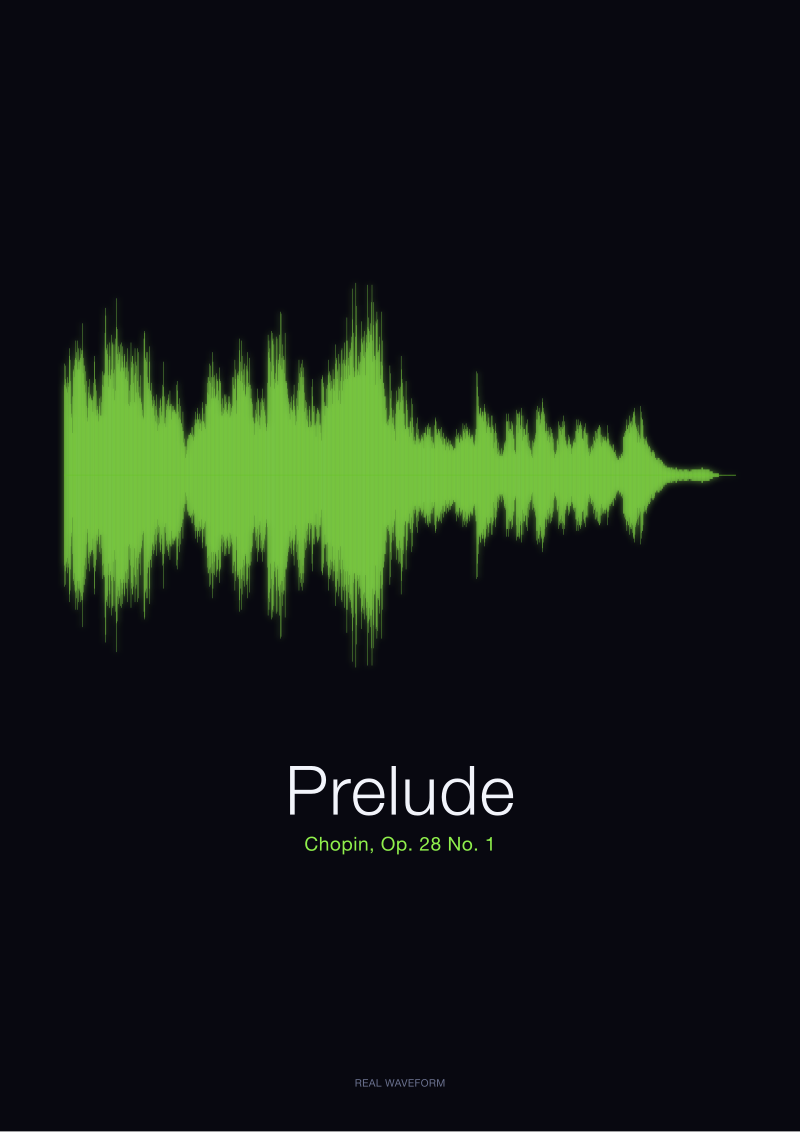
The receipt, in other words, is that a printed waveform of a voice is not a metaphor. It is the same object we render when we print the Ballade No. 1 — same code path, same amplitude reading, same physical relationship between the ink on the paper and the movement of air that produced the sound. The difference is only what the sound was.
What Nobody Mentions
What nobody mentions — not in the emails we receive, not in the requests, not in the conversations families have with each other before they decide to write to us — is that the specific visual character of a voice on paper is largely determined by things the speaker was not thinking about at the time. Microphone distance. Room acoustics. Whether the phone was held to the ear or on speakerphone. Whether the recording was compressed by the voicemail carrier before it was saved. Whether the file was later re-encoded when it was moved between phones.
None of those choices were made deliberately. They are consequences of ordinary life. A voicemail left from a car, a kitchen, a hospital corridor is shaped as much by the room as by the voice. The waveform records both. That is why two recordings of the same person, saying the same thing, on two different days, do not produce the same drawing. The silhouette is not the person. The silhouette is the person, filtered through everything that happened between their mouth and the microphone.
This matters when families send us a file and ask what it will look like before we render it. The honest answer is that we do not know until we plot it. We can describe the range of shapes typical of a short spoken phrase — the leading onset, the vowel opening, the trailing consonant fade — but the exact silhouette of the specific recording depends on how it was captured. A ten-second voicemail from 2011, saved as an .amr file at a low sample rate, will render at a different level of visual detail than a two-second WhatsApp voice note from last year. Both are legitimate waveforms. Both are drawings of air. They just have different resolutions of the same underlying event.
The second thing nobody mentions is silence. A spoken message is mostly quiet. The active audio — the moments when the voice is actually pushing the air — is a fraction of the total duration. Between words, between breaths, at the start before the person began speaking, at the end before they hung up, the waveform is close to a flat line. On paper, this reads as white space. Families sometimes ask, worried, whether the flat sections are a mistake in the file. They are not. They are part of the recording. They are what the room sounded like when the voice was not speaking. In a printed waveform, silence is not absence. It is the interval that lets the sound have a shape at all.
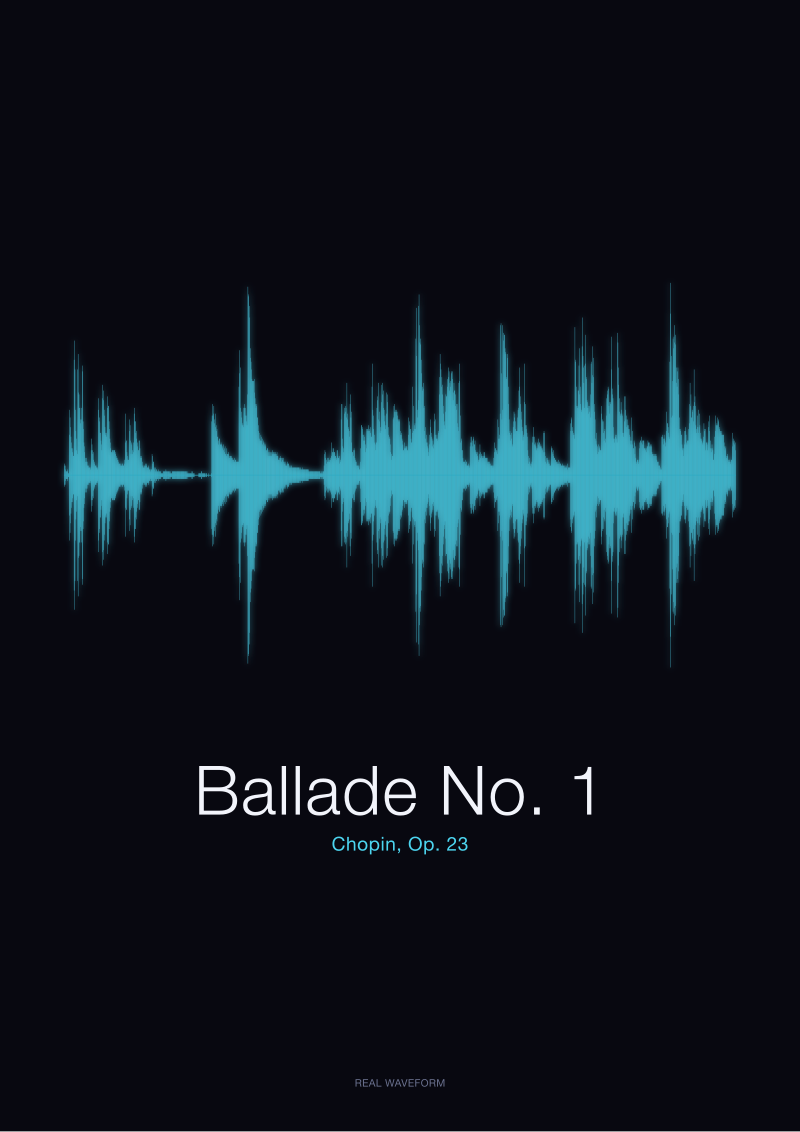 Ballade No. 1
The print from this article · from €29.95
View the print →
Ballade No. 1
The print from this article · from €29.95
View the print →
The Real Cost
The cost of turning a voice recording into a printed waveform is not, primarily, a financial figure. It is a decision about what to preserve and at what scale.
At the physical level, the pipeline is finite. The audio file is decoded to raw samples. The samples are downsampled to whatever horizontal resolution the print requires — a print eight centimetres wide at the sharpest reasonable printing resolution needs roughly a few thousand horizontal positions, each of which summarises a small window of the original audio. The amplitude of each window is drawn as a vertical mark. The result is a single continuous line, or a filled shape, depending on the rendering choice. That is the whole cost, in engineering terms: decode, window, plot.
The real cost is editorial. A voicemail is often longer than the useful section. Someone says hello, pauses, delivers the message, pauses again, says goodbye, and hangs up. If the whole file is rendered at print width, each individual word becomes a small feature in a long horizontal band, and the shape reads as a series of small events surrounded by long stretches of quiet. If a shorter segment is chosen — a specific phrase, a name, a single sentence — the same audio produces a very different drawing. More detail per centimetre. The consonants become visible. The individual vowels have their own hills.
Neither is more honest than the other. The full file preserves the whole moment as it happened, including the silences before and after. The clipped segment preserves the specific fragment the family wants to remember, at a scale where its internal structure is readable. The choice is not a technical one. It is a decision about what the print is for. A drawing of the whole voicemail is a drawing of a call. A drawing of a single sentence from that voicemail is a drawing of a phrase. Both are the same underlying signal, sampled from the same file, plotted through the same code. What changes is the window.
Length also has a physical consequence on the shape. A three-second phrase, printed at the same width as a one-minute recording, will have peaks that appear roughly twenty times taller relative to the flat sections. Not because the sound was louder — the sound was the sound — but because the horizontal axis has been compressed less aggressively. This is why we ask families, when we can, whether there is a specific sentence within a longer recording that matters most. The answer changes the drawing.
And there is a further cost that is worth naming plainly: a printed waveform is a still object. It is the shape of the sound, not the sound. It does not play. It is a silhouette on paper, framed and hung, that says: this movement of air happened, on this day, from this person. For some families, that stillness is exactly the point. The recording still exists on the phone or the drive. What the print offers is the shape of it, made visible and permanent, in a form that does not require an app to open. For other families, that is not what they want, and the honest response is to say so. Not everything belongs on a wall.
If You Only Remember One Thing
A waveform of a recorded voice is a drawing of what the air did in the room where the recording happened. It is not a symbol. It is not a decorative curve. It is a plot of amplitude over time, rendered from the actual samples of the actual file, the same way we render the Ballade No. 1 or the Fantaisie-Impromptu from their public-domain audio. The only thing that changes between a Chopin recording and a voicemail is what was making the sound.
If you have a recording that matters — a voicemail, a message, a short phrase in a language spoken by someone who is not there to say it again — the waveform of it is already an object, whether it is ever printed or not. It exists inside the file. Rendering it to paper does not add anything to the recording. It only makes visible, at a scale you can hang on a wall, the shape a voice already had. Whether that visibility belongs in your home is not a question we can answer. It is worth thinking about before you write to the shop.
This piece did not address the audio-restoration question — what to do with recordings that are damaged, clipped, or heavily compressed by carrier voicemail systems. That is a separate craft, and one we do not perform in-house. It did not address the legal and consent dimensions of printing a voice belonging to someone else — a spouse, a parent, a grandparent — which vary by jurisdiction and by family. And it did not address the specific question of what to write on a print of a voice: whether to include the words spoken, the date, the name, or nothing at all. Each of those is its own decision, and none of them are technical.
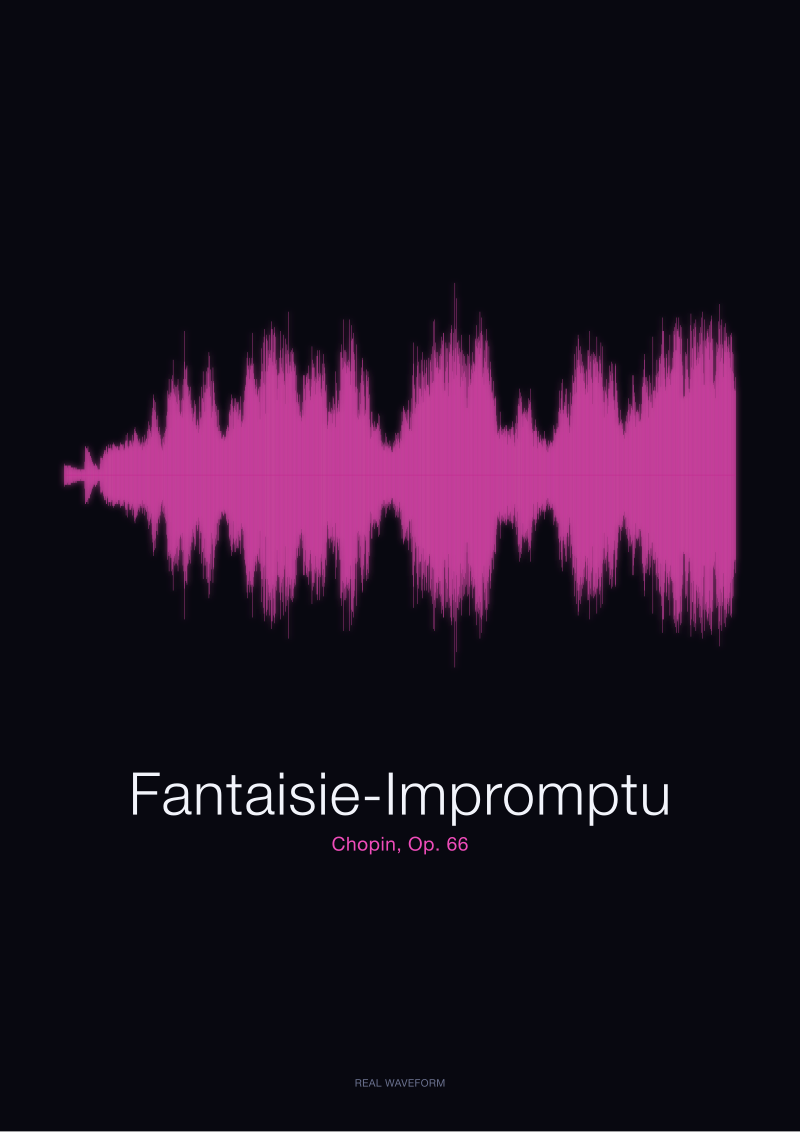 Fantaisie-Impromptu
The print from this article · from €29.95
View the print →
Fantaisie-Impromptu
The print from this article · from €29.95
View the print →
FAQ
What file formats do you need to render a voice recording as a waveform?
Any common audio format works — WAV, MP3, M4A, AMR, OGG, the .opus files WhatsApp produces for voice notes. What matters is not the container but the source. A file that has been re-encoded several times, or forwarded through multiple messaging apps, will have already lost some amplitude detail. If the original recording still exists on the phone or drive where it was captured, that copy will render at higher fidelity than a version that has been passed through cloud backups.
Will the printed waveform sound like anything if I scan it?
No. A printed waveform is a still image of the amplitude over time — the drawing of the sound, not the sound itself. There are experimental optical-audio techniques that attempt to reconstruct signal from printed patterns, but they require specialised equipment and produce very low-fidelity output. The recording itself remains on your phone or drive. The print is the silhouette of it, framed as an object.
How long a recording can you turn into a print?
There is no strict limit, but there is a practical one. A ten-second phrase printed at a hand-width scale renders individual consonants and vowels visibly. A three-minute recording printed at the same width compresses each word into a small feature, and the shape reads more as a landscape of a conversation than as a single utterance. We generally ask whether there is a specific sentence, name, or phrase within a longer file that matters most. The answer determines the window.
Does the waveform look different if the person spoke loudly or softly?
The relative shape of the word — the sequence of peaks and dips corresponding to consonants and vowels — is largely preserved. The absolute height of the peaks depends on how the recording was made, not just how loudly the person spoke. A quiet voice captured close to the microphone can produce taller peaks than a shout captured across a room. Waveform amplitude reflects the signal the microphone received, filtered by distance, gain settings, and any automatic level adjustment the recording device applied.
Can two people's voices produce identical waveforms?
No. Even the same person saying the same word twice produces two different waveforms, because the exact air movement is never repeated. The general silhouette of a spoken word is shaped by the phonemes — a "Bonjour" will always have its rough two-hills structure, a "Ciao" its rising-and-fading slope — but the fine detail of any specific utterance is unique to that moment, that room, and that recording. This is why two waveforms of the same voicemail, if separately re-recorded, are related but never identical.
Is silence in the recording a problem when it prints?
No — it is part of the recording. Between words and after the voice stops, the waveform is close to a flat line, and that reads as white space on the page. Silence is not a failure of the file; it is the interval that gives the sound its shape. A print with visible silences before and after the spoken portion tends to feel more like the original moment than one that has been cropped tightly around the voice.
Do you keep a copy of the audio file after the print is made?
Our rendering pipeline does not require us to retain the source audio beyond the time needed to generate the waveform. For voice recordings supplied by families, we treat the file as sensitive by default and do not archive it. If you would like written confirmation of deletion after the print ships, ask when you place the order and we will confirm the step in writing.
Can the print include the words that were spoken?
Yes, though we would ask you to think carefully about it. A waveform alone reads as a shape; adding the transcribed words underneath turns it into a caption for the shape. For some families this is the whole point — the sentence, drawn as sound. For others, the print is stronger without the words, because the silhouette carries the memory and the text would be an explanation of what does not need explaining. There is no default. It is a decision that belongs to whoever the print is for.
From the collection
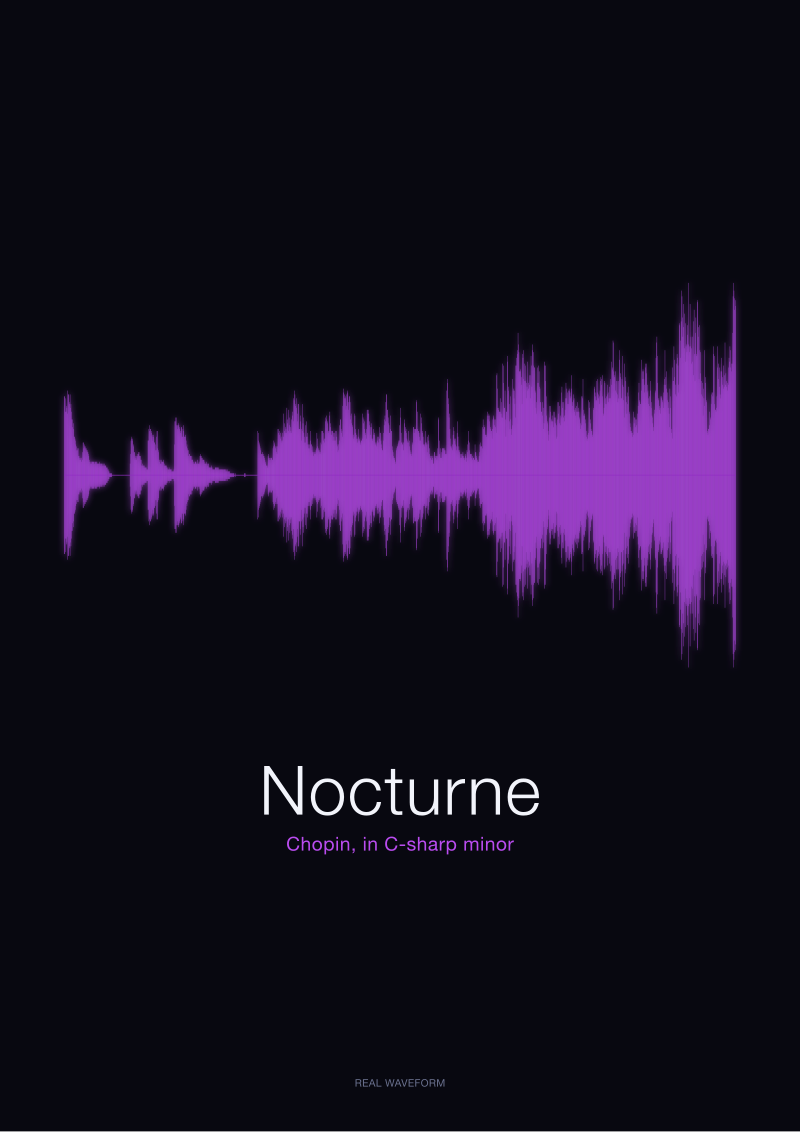
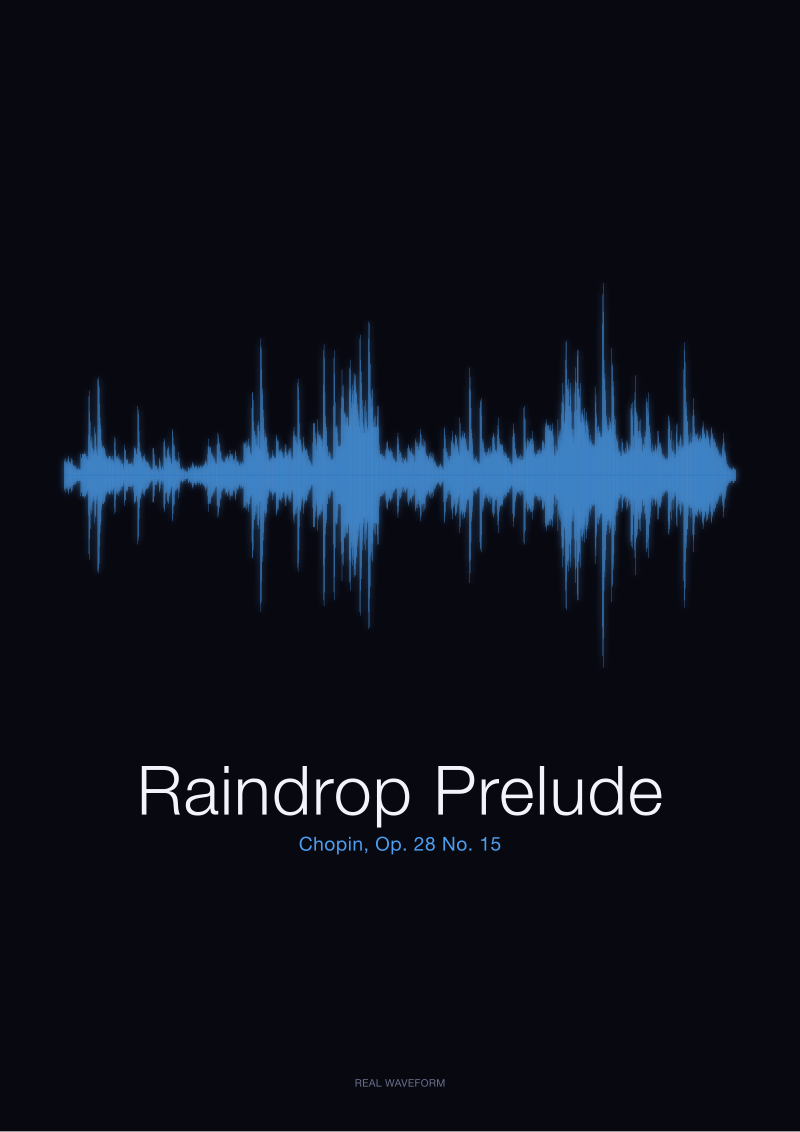
New pieces and 10% off your first print.
One email now with your code. No noise after.