The honest answer to which recording becomes the right anniversary print is: it depends. It depends on whether the song in question is a three-minute pop record with a chorus everyone in the room can sing, a spoken phrase in a language only two people share, or a Chopin Ballade that was quietly on in the background of a decade of Sunday mornings. The shape on the paper changes accordingly. To make the choice concrete rather than sentimental, we will walk through three composite scenarios — imagined couples, real recordings from the studio's catalogue — and look at what the waveform actually does in each case.
Each scenario is a composite. We have not met these people. They are illustrative — an assembly of the kinds of questions we are actually asked by clients choosing anniversary prints, matched to the recordings we actually render. The recordings are real; the couples are stand-ins for a decision you may be making.
Scenario 1: The First-Dance Couple Turning Ten
Picture a couple approaching a tenth anniversary. Let us say they married on a Saturday in early autumn, and the piece that closed the ceremony and opened the reception was Chopin's Fantaisie-Impromptu, Op. 66. Neither of them plays piano. One of them heard it in a film at nineteen and never forgot the middle section, the long lyrical melody the right hand sings while the left hand keeps folding underneath. When it came time to choose a first dance, they picked it half as a joke — they knew they could not dance to it in any recognisable sense — and then they danced to it anyway, badly, and it became the piece.
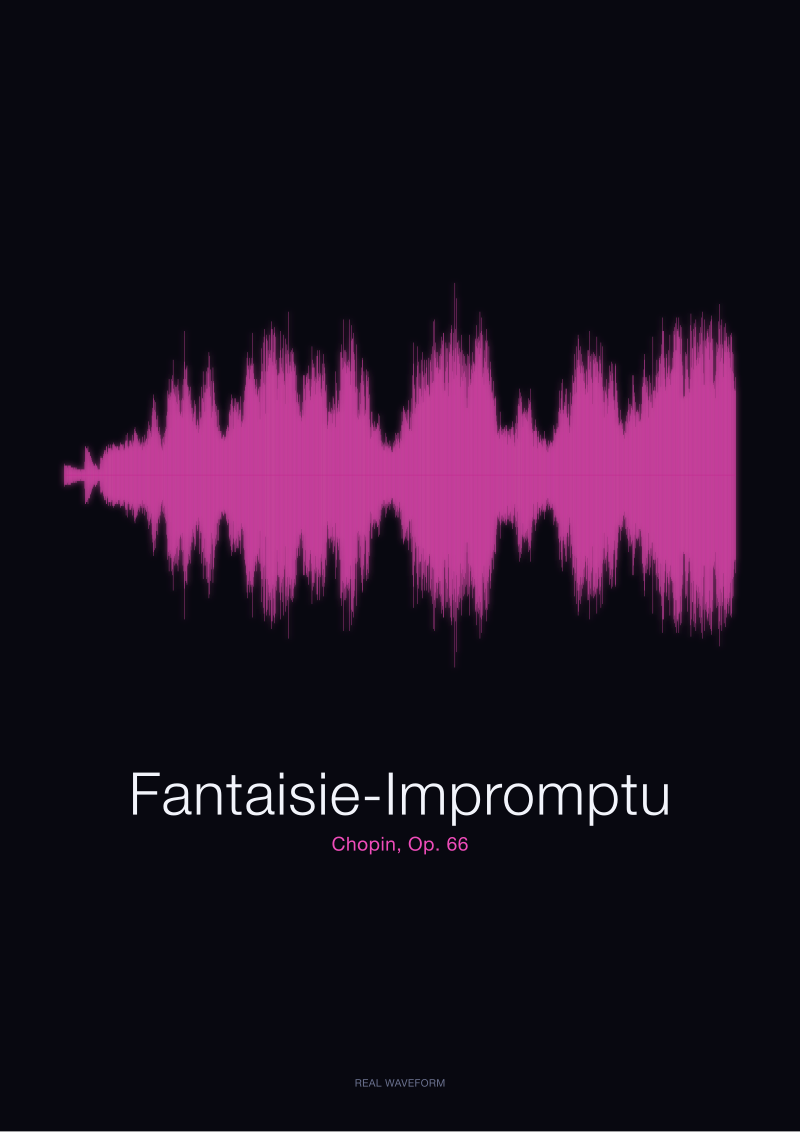
Ten years later, the question is what to put on the wall. A photograph from the wedding is one answer, and a good one. A waveform of the Fantaisie-Impromptu is a different answer, and it does something a photograph cannot. The Op. 66 amplitude waveform from the public-domain recording in the studio's Chopin collection has a very particular signature. The outer sections are dense — a wall of sixteenth notes at the top of the piano, rendered as a thick, almost continuous band of amplitude. The middle section, the melody, opens up. The waveform thins. You can see the phrasing. Rubato — the pulling and pushing of tempo Chopin lived inside — becomes visible as the intervals between peaks stop being metronomic.
For the ten-year couple, the useful thing about this shape is that it is not decorative. It is not a curve someone drew to look like music. It is the exact amplitude, sample by sample, of the recording their marriage was set to. If they stand in front of it in ten more years, the middle section will still be the calmest part of the drawing, because that is what the recording does. The shape and the memory are the same object.
The one caveat we always give this couple: the Fantaisie-Impromptu is roughly five minutes long. A five-minute waveform, at a print size that fits above a mantelpiece, will be dense. Every peak is small; the overall silhouette is what carries the piece. If they want the middle section to read as a distinct event on the page, they should ask for a print oriented and scaled to let that quieter passage breathe, not one that compresses the whole work into a uniform band.
Scenario 2: The Long-Distance Anniversary and a Spoken Word
Imagine now a different couple. They met on a work assignment in Milan; one of them stayed, one of them went back. The relationship survived on messages, video calls, and one shared word: *ciao*. Not the flat English *ciao* that means hello-or-goodbye and nothing more, but the way she said it — long on the first syllable, softer at the end, the version he could pick out of any crowded room. Their first anniversary is coming up. They are still in different cities.
For a couple like this, a piece of music can feel oversized. The relationship is not scored to Chopin. It is scored to a single spoken word said several thousand times over eighteen months of video calls. This is where the studio's spoken-word waveforms do something the musical prints cannot. The catalogue includes *Ciao* — the Italian spoken word, generated locally, rendered from the actual audio — and *Bonjour*, in French, produced the same way. Both are short signals. Both have shapes you can read at a glance.
*Ciao* on paper is a two-syllable event. The initial *ch* — a soft affricate — shows up as a short, dense burst of amplitude, higher-frequency and narrow. Then the vowel opens: *ao* is a broad, sustained region, taller in amplitude and considerably longer in duration than the consonant that launched it. Then decay. The whole word is over in less than a second, and the drawing has a very specific silhouette: a small spike, a swell, a tail. It looks nothing like a piece of music. It looks like a word.
For the long-distance couple, the print becomes a physical object of something otherwise entirely digital. The relationship lived on servers. The word lived in earbuds. On the wall, the word takes up space in the room. It is small, it is quiet on paper, and it is theirs. The same logic applies to *Bonjour* for a francophone pair, or to any spoken phrase they might commission. The point is not the music. The point is the specificity of a signal only two people fully hear.
 Fantaisie-Impromptu
The print from this article · from €29.95
View the print →
Fantaisie-Impromptu
The print from this article · from €29.95
View the print →
Scenario 3: The Silver Anniversary and a Piece That Was Always Playing
Let us say a third couple is approaching twenty-five years. They do not have a first-dance song. They eloped, quietly, on a Wednesday, and the wedding was over in fifteen minutes. What they have is a piece of music that was on the record player in the flat they moved into that week — Chopin's Ballade No. 1 in G minor, Op. 23 — and that has stayed on, in various forms, through every kitchen and every winter of a twenty-five-year marriage. Neither of them can play it. They cannot even hum the middle section reliably. But they know the arc of it. They know it starts almost tentatively and ends at a full sprint.
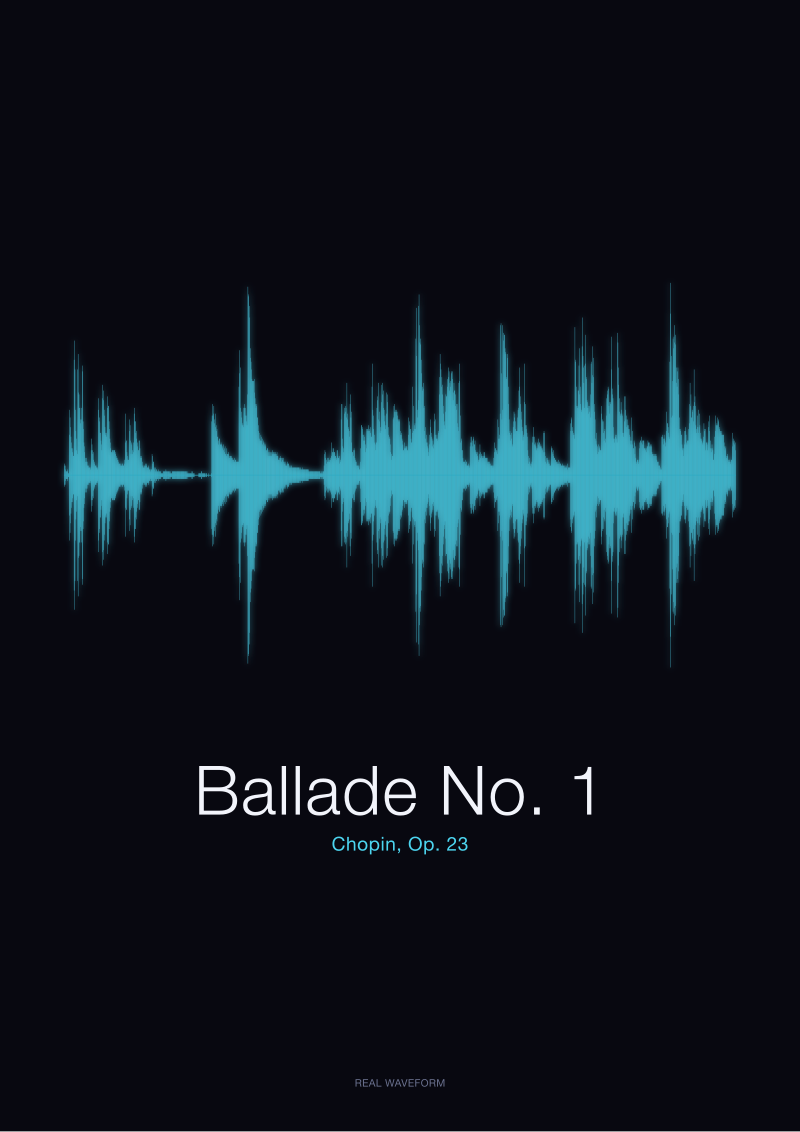
The Ballade No. 1 waveform, rendered from the CC0 recording in the studio's Musopen Chopin collection, is one of the most legible pieces in the entire catalogue. It is roughly nine minutes long, and its silhouette moves. It opens quietly — the opening bars are barely present on the page, a thin trace along the horizontal axis. The waveform grows in stages. Each of the piece's main sections corresponds to a visible plateau of amplitude. The final coda — the fast, headlong ending — sits on the right of the page as a dense, tall block of sound. If you know the piece, you can point to where it happens on the paper.
This is the version of the anniversary print that suits couples whose relationship has more time than event in it. There was no single dance. There is no single word. There is a piece that was always on, and its shape happens to be a nine-minute crescendo from silence to full weight. For a silver anniversary, that shape reads almost autobiographically — a quiet start, a long, uneven middle, a coda that is louder and more assured than anyone expected. We do not need to insist on the metaphor. The drawing does it without help.
The scale advice here is the reverse of Scenario 1. The Ballade earns a larger print, precisely because the piece needs the horizontal room to let the opening bars be quiet on the page. If the whole nine minutes is compressed into a modest width, the ending steamrolls the beginning, and the arc is lost. Length on the page is length in the recording. Give it room.
What All Three Share
The three scenarios choose different recordings for different reasons, but the underlying decision is the same in each case. It is not "which piece is our favourite" and it is certainly not "which piece is the most impressive." The decision is: what signal, when rendered as a shape, is going to still be legible to us in ten years, twenty years, at a glance across a room.
That test rules out a surprising amount. It rules out songs whose meaning depended on the lyrics rather than the sound — the waveform does not show the words, only the acoustics. It rules out recordings the couple loves but has no shared history with; a shape without a memory attached is a wall decoration, not an anniversary object. It rules out pieces where the emotional peak of the recording is the same amplitude as everything else, because those waveforms read as an undifferentiated band and lose the moment.
What survives the test is what all three of our composites picked. The Fantaisie-Impromptu has a visible middle section that thins out. *Ciao* has a two-syllable silhouette that reads as a word. The Ballade has a nine-minute crescendo that reads as an arc. Each recording, on paper, carries a shape that maps to something the couple already knows. The print is not adding a story. It is drawing one that was already there.
 Ballade No. 1
The print from this article · from €29.95
View the print →
Ballade No. 1
The print from this article · from €29.95
View the print →
Which Scenario Is You
If you have a single, specific piece of music tied to a single, specific day — a first dance, a ceremony, a walk down an aisle — you are Scenario 1. Look for the recording that was actually played, and expect a dense but shaped waveform whose interesting features are internal.
If your relationship is defined more by a repeated, small, private signal than by a public piece of music — a word, a phrase, a language only two of you share — you are Scenario 2. A spoken-word waveform will feel more accurate to the relationship than any song would.
If the piece you would put on the wall was not chosen for a moment but accumulated through years — background music that became foreground by repetition — you are Scenario 3. Choose the longer work, give it a wider print, and let its arc do the talking.
Our full catalogue of rendered recordings, including the pieces described above, is at see the Fantaisie-Impromptu print. Every print is drawn from the actual audio of the actual recording; nothing on the page was invented for decoration.
From the collection
New pieces and 10% off your first print.
One email now with your code. No noise after.