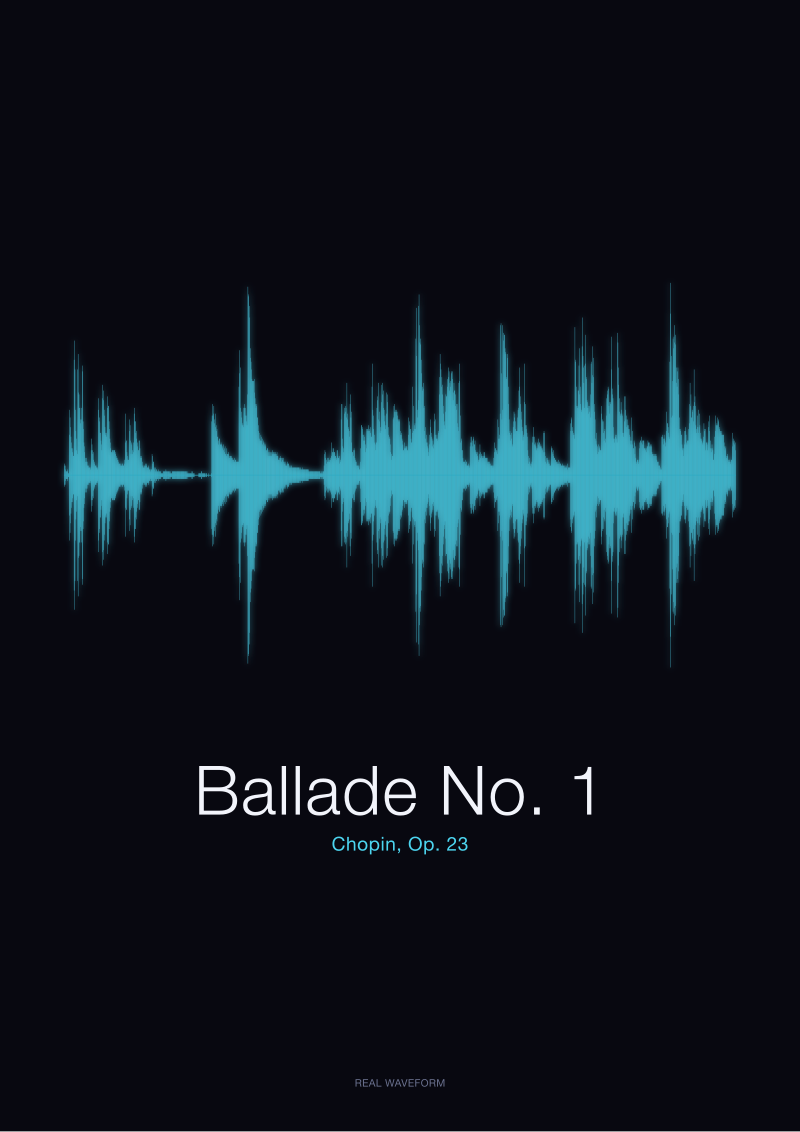
At 14:07 on a Tuesday, a rendered waveform of Chopin's Ballade No. 1 sits on the studio bench, printed from a public-domain take in the Musopen Chopin collection. Read it as a shape, not a piece: tight ridges, capped peaks, a floor that stays near zero between phrases. That silhouette is what happens when a piano is close-mic'd, edited across takes, and mastered to a commercial loudness floor. A live capture of the same nine minutes would not draw itself the same way. Same notes. Same opus. Different silhouette. This piece is about the difference, and about what the shape gives away before a single note is heard.
Before any of it means anything, hold the two silhouettes side by side. Five visible dimensions do most of the work of telling them apart, and none of them require you to know the piece. What follows is the desk's working shorthand for reading a waveform cold — the shape first, the label second.
| Dimension | Studio Silhouette | Live Silhouette | Visible Where |
|---|---|---|---|
| Dynamic range | Compressed, ridges of similar height | Wide, tall peaks over quiet valleys | Full-length overview |
| Silence between notes | Near-zero flat floor | Textured floor, room tone | Between phrases |
| Peak symmetry | Even, edited-across-takes | Uneven, one-shot performance | Repeated passages |
| Transient attack | Sharp vertical rise, close-mic | Softer rise, hall bloom | Onset of each note |
| Reverb tail | Clipped, dry cut | Long trailing decay | End of phrases, final chord |
| Overall envelope | Rectangular, flat top | Arched, breathing | Zoomed-out silhouette |
The five rows below are the sections that follow. The table names the dimension; the section explains what the row cannot. Read the ridges after the argument, and the argument reads back.
Dynamic Range: Compressed Studio Floor vs Wide Live Envelope
Dynamic range is the vertical distance between the loudest sample and the quietest audible sample in the file. On a waveform print, it is the difference between the tallest ridge and the visible floor of the wave. Studio classical recordings, even when marketed as "audiophile" or "natural," are almost always mastered to a target loudness that flattens the top of that ridge. The peaks arrive at a ceiling and stop.
Look at the Ballade No. 1 print from the Musopen CC0 take. The opening Largo — a bare unison in bass octaves — sits well above the printed floor, not because Chopin wrote it loud, but because studio mastering has raised the quiet passages toward the loud ones. The famous Presto con fuoco coda, which in a hall should tower over the introduction, is only modestly taller on the page. The vertical distance between the softest legato and the loudest chord has been narrowed. On paper, that reads as ridges of similar height across nine minutes.
A live capture of the same work draws differently. The opening is genuinely quiet — a shallow ripple against the visible floor — and the coda is a spike that eats vertical space. The silhouette breathes: it rises and falls across the piece the way the performer intended, without a mastering pass equalizing the distance.
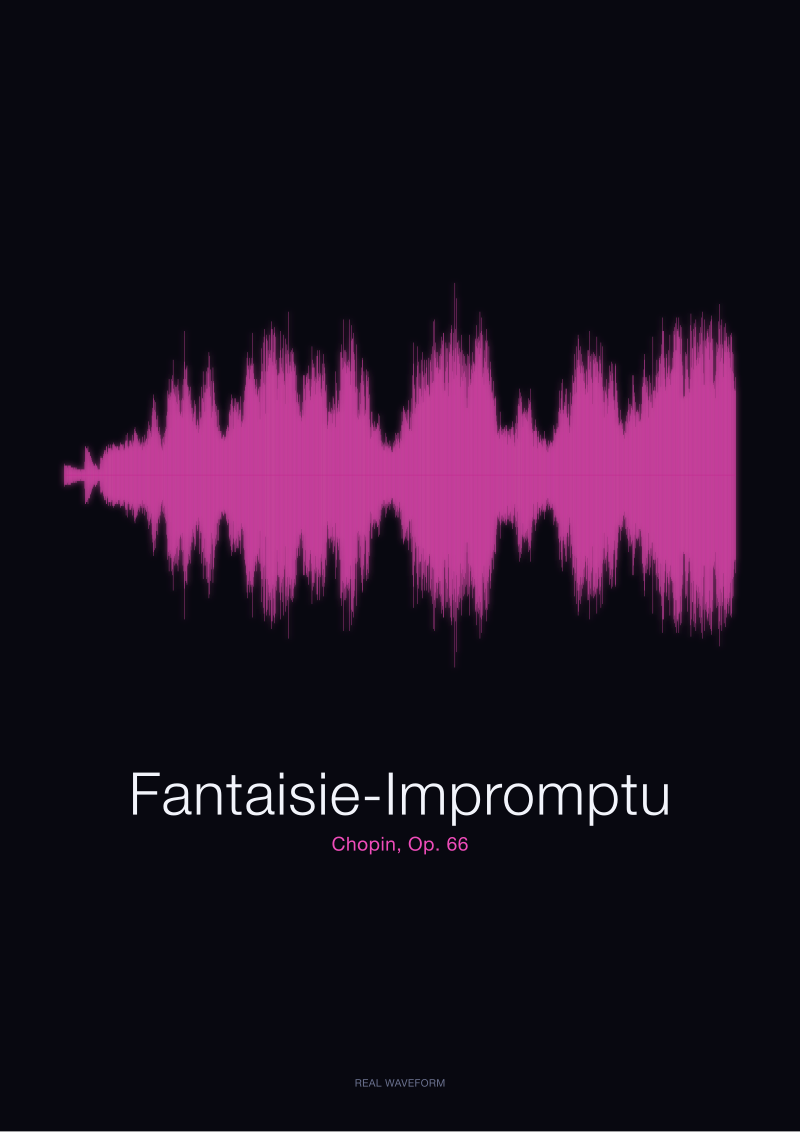
The visible test is simple. If the waveform's tallest ridges are within a hair of the file's ceiling and the softest passages are still clearly readable at eye level, the file is compressed. If the print has genuine tall spikes over long stretches of near-invisible wave, it is a live envelope. The Fantaisie-Impromptu print is a useful control: its Allegro agitato passagework should visibly out-tower its Moderato cantabile middle section. When it doesn't, mastering has done its job — and studio's job has always been to make loud rooms and quiet living rooms sound like the same room.
Silence Between Notes: Digital Zero vs Room Tone
Between phrases, a waveform either goes to a mathematical floor or it doesn't. That distinction is one of the fastest tells on a print.
A studio take, edited across multiple session passes and cleaned in post, will show intervals of near-perfect zero. The floor between phrases is a flat horizontal line — no visible thickness, no texture, no ripple. When engineers gate the noise floor, subtract HVAC hum, and stitch across takes, the result is silence that is literally silent. Digital zero draws itself as an empty band.
A live recording of Chopin — even in a good hall with quiet audiences — cannot produce that band. The floor between phrases has thickness. It carries seat creak, distant HVAC, the pianist's breathing, a cough at ninety feet, the amplifier of the recording chain itself. On paper, this reads as a fuzzy horizontal ribbon rather than a hairline. Zoom in and the ribbon has micro-ridges. That is the room. It is not damage; it is testimony.
Test the Ballade No. 1 print against the Bonjour print for a control. Bonjour is a single spoken word, synthesized locally with nothing before or after it — the CC0 signal contains no room and no post-processing artefact. The floor before and after the syllable is genuinely and mathematically empty. When a classical studio recording draws its inter-phrase floor the same way Bonjour draws its pre-utterance floor, the recording has been through the same kind of subtraction — no room, no seat, no breath.
For the desk, the practical consequence is that the "silence" in a print is diagnostic. A print of a studio take is quieter between the notes than any live take can be, and that quiet is not a virtue or a flaw — it is a signature of the process that produced it. Readers who want the felt presence of a room in their print ask for live captures. Readers who want the piece isolated from context ask for studio. Both are honest silences; they are just not the same silence.
 Ballade No. 1
The print from this article · from €29.95
View the print →
Ballade No. 1
The print from this article · from €29.95
View the print →
Peak Symmetry: Edited Takes vs Continuous Performance
Chopin repeats. So does every composer with a formal ear. The Fantaisie-Impromptu returns to its opening material after the middle section; the Ballade No. 1 restates its principal theme with amplification. A waveform of a studio recording will show those repetitions as visually near-identical peak clusters — the ridges line up, the height matches, the internal spacing repeats.
That is not because the performer played them identically. It is because they didn't have to. In a studio session, the take that produced the second statement may be a different physical performance than the take that produced the first. A producer selects, edits, and crossfades. The waveform ends up with peak clusters that pass a symmetry test the human hand cannot pass twice in a row.
A live recording fails that symmetry test on purpose. The performer's second statement will always be slightly louder, slightly softer, faster, or more hesitant than the first. On the print, the repeated ridges will be visibly asymmetric — same shape family, different exact geometry. The louder-second-time-around is one of the most reliable live signatures: a hall performer, riding audience energy, tends to open up the recapitulation, and the waveform tells on them.
Look for it in the two-lobe passages of Fantaisie-Impromptu. If the first and third statements share a millimetre-perfect skyline, the file is edited. If the third is a hair taller and slightly wider in its central spike than the first, the file is a single unedited pass — or a very lightly edited one.
The desk's rule of thumb: identical twins on paper are almost never a performance decision. They are an editorial one.
Transient Attack: Close-Mic Sharpness vs Hall Bloom
A transient is the onset of a note — the moment amplitude climbs from the floor to its peak. On a waveform, transient shape is drawn as the vertical steepness of that climb. Studio close-mic'd piano produces near-vertical transients. Live piano captured from mid-hall produces sloped, bloomed transients.
Physics does the work. Close mics sit inside the near-field radius of the strings, catching the strike itself with almost no room delay. The waveform records a hammered attack that arrives in a small handful of samples — a rise so quick it prints as a nearly straight vertical line at the edge of each ridge. Hall mics, at a distance, receive the strike braided together with early reflections from the hall's surfaces. Those reflections arrive milliseconds after the direct sound, and the transient's rise is smeared over more samples. On paper, the ridge starts with a diagonal ramp, not a wall.
The Chopin Ballade No. 1 print is instructive here. The bass octave attacks that open the piece rise almost vertically from the floor — a close-mic signature. In a live hall, the same attacks would print as short ramps: still fast, but visibly angled. The desk sometimes calls this "hall bloom": the softening of the leading edge of every note by the room's early reflections.
For the print buyer, the practical read is that close-mic'd studio takes give a graphically sharper waveform — cleaner ridges, more architectural. Live takes give a softer, more organic silhouette. Neither is objectively more accurate to what a listener in the hall heard; only the live take approximates it. But the studio take is more accurate to what the composer wrote on the page, note for note, without the hall in the way. The paper choice is between the piece and the performance of the piece.
 Fantaisie-Impromptu
The print from this article · from €29.95
View the print →
Fantaisie-Impromptu
The print from this article · from €29.95
View the print →
Reverb Tail and Decay: Dry Cut vs Long Trail
Every note ends. The way it ends is the last dimension the waveform gives away. Studio classical recordings, especially those close-mic'd and lightly reverb-processed, print short decays: a note's amplitude falls back toward the floor within a compressed horizontal span. Live recordings print long trails: the amplitude falls slowly, riding hall reverberation, and the wave visibly extends past the physical end of the note.
The final chord of a Chopin ballade is where this is most visible. In a studio take, the chord's amplitude climbs to its peak, decays with the natural fall of a piano string, and then meets a dry cut — often engineered — that returns the file to floor within a second or so. In a live take, the same chord rings into the hall. The waveform draws a slow diagonal downward slope that can extend for many seconds. On paper, it looks like an exhale.
The Fantaisie-Impromptu ends quietly, on a fading Db-major arpeggio. The public-domain studio take prints that ending as a short, controlled decline. A live capture of the same ending would print a longer, thinner tapering trail — the last audible amplitude of the piano string against the sustained air of the room. Some listeners buy prints specifically for that trailing shape; others prefer the crisp studio silhouette that ends where the note ends.
There is no correct answer, only a visible one. The presence or absence of a long tail is not a matter of quality — it is a matter of what was captured. Live captures are prints of a room and a piece together. Studio captures are prints of the piece with the room subtracted.
Which Dimension Actually Matters Most
None of the five dimensions above is dispositive on its own. A skilled engineer can compress a live recording toward studio flatness; a naïve engineer can bake so much reverb into a studio take that it looks live. What matters, when the desk decides which recording to render for a print, is which dimensions the buyer is buying.
For most classical print buyers, the answer is peak symmetry and silence between notes. Those two dimensions read strongest at wall-hanging distance. A print with genuinely asymmetric peaks and a textured floor announces itself as a document of a specific evening — a captured event, gifted as an object. A print with edited-symmetric peaks and a hairline floor announces itself as the piece itself — the composition abstracted from any one performance, drawn cleanly. Both are legitimate purchases. They are not the same object.
Studio takes are what the studio's shop currently renders for the Chopin pieces above, because the CC0 recordings available for lawful public rendering are studio takes. The desk is candid about that: a live rendering of Ballade No. 1 in the same catalogue would draw itself differently, and would be a different gift. Which silhouette to send someone depends on whether you are giving them the piece or the night the piece was played.
FAQ
Why does a studio classical recording look flatter than a live one on a waveform?
Studio classical recordings are typically edited across multiple takes and mastered to a target loudness. That process narrows the vertical distance between the softest and loudest passages, so the ridges on the printed waveform end up closer in height. A live recording preserves the performer's original dynamic range, so its silhouette breathes — quiet passages sit near the floor, loud passages rise as tall spikes. The compressed studio floor is a signature of process, not of the piece itself.
Does a "quieter" waveform floor mean the recording is better quality?
Not necessarily. A near-zero floor between phrases usually means the recording has been noise-gated, edited, and cleaned in post — a studio process. A textured floor means the recording preserved room tone, seat noise, and the performer's breathing — a live capture. Neither is better. One is the piece isolated; the other is the piece plus a specific room on a specific night. The choice is about what the print is meant to memorialise.
Can you tell the difference between studio and live without knowing the recording?
Yes, from five visible signatures: dynamic range, inter-phrase silence, peak symmetry across repeated passages, transient sharpness at the leading edge of notes, and the length of the decay after the last note. Two out of five is suggestive; three or more is a confident read. A skilled engineer can disguise any single dimension, but disguising all five requires deliberate work that most catalogues do not do.
Which Chopin recordings does the studio actually render?
The desk renders from lawful public-domain sources. For Chopin, the Musopen CC0 collection at archive.org/details/musopen-chopin is the primary catalogue. Ballade No. 1 (Op. 23) and Fantaisie-Impromptu (Op. 66) are among the pieces available under CC0 1.0 Public Domain and used for the studio's Chopin prints. All rendered waveforms come from the actual audio of those recordings — never from decorative curves drawn to look like a waveform.
Why do transient onsets look sharper in studio recordings?
Close mics sit inside the near-field radius of the piano strings and capture the strike almost instantaneously — the resulting waveform ridge rises nearly vertically. Hall microphones, placed further from the instrument, receive the strike braided with early reflections from the room's surfaces, which arrive milliseconds later and smear the onset over more samples. On paper, that smearing draws as a diagonal ramp rather than a vertical wall. The desk calls this softening effect "hall bloom."
Does a longer reverb tail mean the print will look more dramatic on a wall?
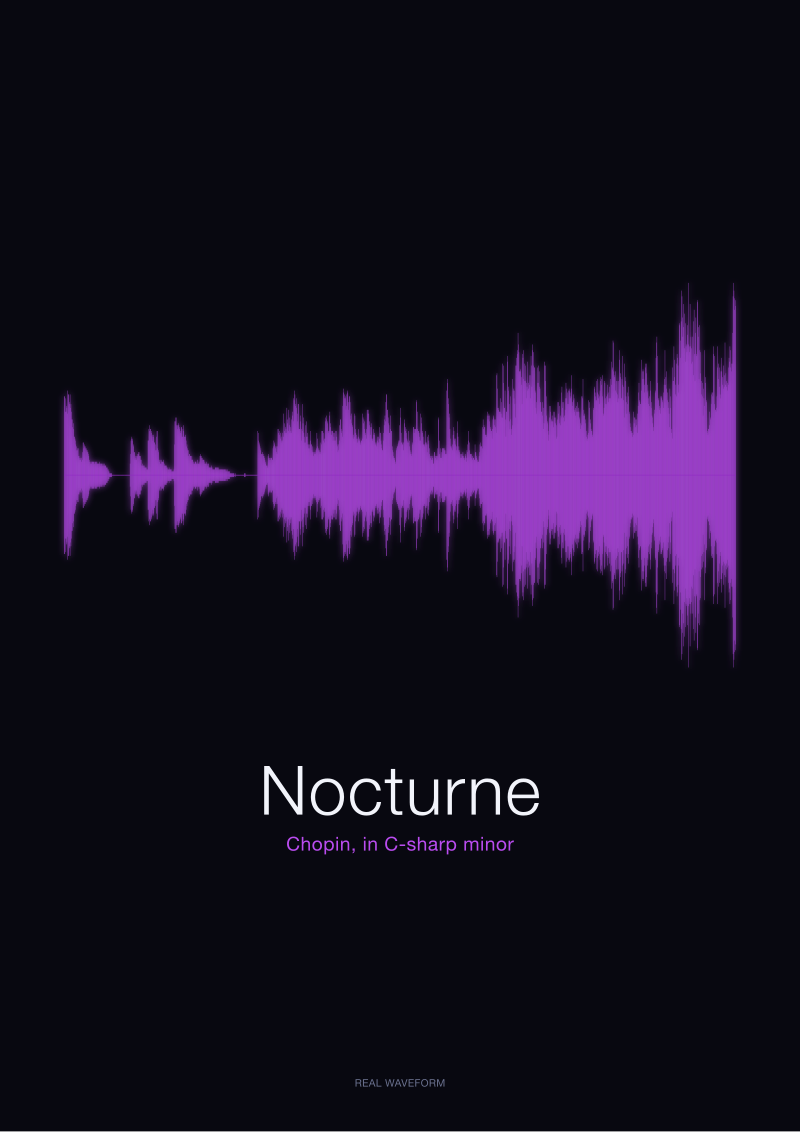
Longer tails visibly extend the wave past the end of each note and give the print a more organic, exhaled silhouette — the piece appears to linger. Shorter tails give a crisper, more architectural print with cleaner right-hand edges to each phrase. Neither is more dramatic in the abstract; drama depends on the piece and the buyer's eye. A Chopin nocturne's long tail reads differently than a Chopin étude's clipped one.
Is the Ballade No. 1 print in the shop the studio version or a live version?
The current Ballade No. 1 print is rendered from the CC0 studio recording in the Musopen Chopin collection at archive.org/details/musopen-chopin. That is the recording available for lawful public rendering. Buyers who want the specific silhouette of a live performance of the same piece are looking at a different object — one that would print with wider dynamics, a textured floor between phrases, and a longer decay after the final chord. The desk does not currently render that alternative for this opus.
From the collection
New pieces and 10% off your first print.
One email now with your code. No noise after.