The most-played piece Chopin wrote is one he asked to be destroyed. The Fantaisie-Impromptu in C-sharp minor, composed in 1834, was never published in his lifetime, never given an opus number by his hand, and — by the terms of a written instruction left to his executor Julian Fontana — was meant to be burned along with every other manuscript he had not sanctioned for print. Fontana ignored the instruction. In 1855, six years after Chopin's death, the piece appeared as Op. 66. The story of how it survived is stranger, and less romantic, than the piece itself.
The Order That Was Disobeyed
The instruction is unusually blunt for a composer as fastidious about his catalogue as Chopin was. In the note his family and executors worked from after his death in October 1849, Chopin asked that all manuscripts he had not himself prepared for the engraver be burned. Not archived. Not consulted. Burned. He did not ask for editorial judgement to be applied later; he asked for the material to cease to exist.
We tend to read this, at a distance of nearly two centuries, as false modesty. It was not. Chopin treated publication as a threshold — the point at which a piece became him, publicly, and could no longer be redrafted. What sat in his portfolio unpublished sat there because he had decided, for reasons he did not always record, that it should not cross that threshold. The Fantaisie-Impromptu had sat there for fifteen years by the time he died. That is not an oversight. That is a decision, held.
What Chopin Wrote in 1834
The piece dates to 1834, when Chopin was twenty-four and roughly two years into his Paris life. It carries all his early-Paris signatures: the two-hand cross-rhythm, the long right-hand filigree over a rocking left, the sudden interior slowing into a lyrical middle section in a distant key. It is, on paper, exactly the kind of piece that made his salon reputation.
He did not, however, treat it the way he treated pieces he intended to publish. There is no known correspondence in which he tries to place it with an editor. There is no clean fair copy, prepared for engravers, of the sort he produced obsessively for pieces he was ready to release. The autograph that survives is a working document, not a finished one. Whatever the piece was for — a gift, a private study, an unfinished experiment — it was not for the shop window.
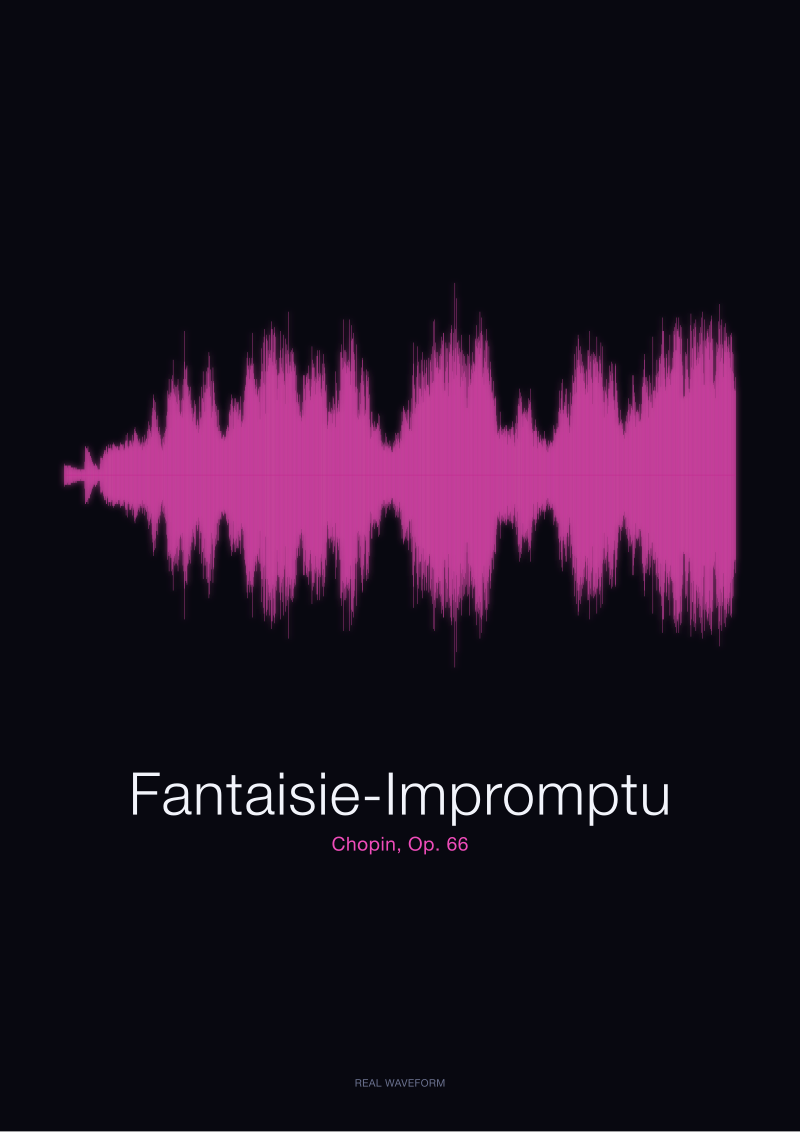 Fantaisie-Impromptu
The print from this article · from €29.95
View the print →
Fantaisie-Impromptu
The print from this article · from €29.95
View the print →
The Moscheles Problem
The most persistent theory for why Chopin suppressed the piece is what pianists refer to as the Moscheles problem. Ignaz Moscheles, the older Bohemian pianist-composer Chopin knew and respected, had published an Impromptu whose opening figuration bears an audible family resemblance to Chopin's Fantaisie-Impromptu — similar contour in the right hand, similar harmonic gesture. Whether Chopin heard the Moscheles piece before or after drafting his own is not settled. What is reasonably settled is that Chopin, once he registered the resemblance, would not have wanted the piece released under his name.
This is not plagiarism in any modern sense. The resemblance is at the level two pianists trained in the same tradition might arrive at independently. But Chopin's professional identity was built on a distinct compositional voice, and even the suggestion that he was echoing an older contemporary would have been intolerable to him. Suppression was the cleaner solution than explanation.
Julian Fontana and the Posthumous Decision
Julian Fontana was a Polish pianist and composer, a school friend of Chopin's from Warsaw, and one of the small circle of people Chopin trusted with practical business — copying manuscripts, negotiating with publishers, sitting in on lessons. After Chopin's death he inherited the role of literary executor for the unpublished material, and immediately faced the contradiction the instruction created.
Fontana, on his own authority, decided the instruction was wrong. He worked through the portfolio, selected pieces he believed had musical value, edited them into publishable shape, and released them across the 1850s as a posthumous series. The Fantaisie-Impromptu was among them. His editorial hand is present in the version the world has played ever since — questions about barring, pedalling, and a handful of pitch decisions in the middle section all trace to Fontana's judgement, not to a Chopin autograph the composer signed off on.
Opus 66: A Number Assigned After Death
Chopin's own opus catalogue stops at 65, the Sonata for Cello and Piano — the last work he saw through publication before he died. Everything after 65 is a number he did not assign. Op. 66 through the mid-70s are Fontana's posthumous ordering, applied to the pieces he chose to release. This matters more than it looks.
An opus number, in Chopin's hands, was an assertion: this is finished, this is mine, this is how I want it heard. An opus number applied posthumously, by an editor, over a piece the composer suppressed, is the opposite assertion — the executor overriding the composer's judgement and using the composer's own numbering system to legitimise the override. The Fantaisie-Impromptu carries Op. 66 not because Chopin decided it, but because Fontana decided the piece deserved to sit inside Chopin's numbered catalogue at all.
The Shape of a Suppressed Piece
Look at the piece as a waveform — the real amplitude trace of a full recorded performance, not a decorative squiggle — and its structure becomes visible in a way the score alone does not show. The outer sections are dense. The waveform reads as a thick, near-continuous band, because the right-hand semiquaver flurry never really stops and the left-hand pattern under it keeps refilling the amplitude. There is little white space in the first minute or so. The eye sees velocity.
Then, roughly a third of the way in, the shape changes completely. The middle section — the Moderato cantabile, the melody in D-flat that every listener remembers even when they cannot name the piece — reads as a narrower, quieter band with much more air around it. The waveform thins, sinks, and holds. It is one of the clearest before-and-after silhouettes in the Chopin catalogue, and it happens twice: dense, thin, dense again. The piece he suppressed has a visibly two-tempered shape.
Why the Suppression Story Sticks
The reason the suppression story has outlived every other piece of gossip attached to Chopin is that the piece keeps confirming it. Every generation of pianists hits the same paradox: the Fantaisie-Impromptu is technically demanding, structurally clean, memorable to the point of ubiquity, and by any commercial standard the most successful thing Chopin ever wrote. If a composer suppressed a piece like this, the reasoning must have been serious. Nobody hides a masterpiece for polite reasons.
That intuition — the piece is too good to have been suppressed on a whim — is what keeps the Moscheles theory alive, and what keeps concert audiences leaning forward when a programme note mentions the burning-order. The Fantaisie-Impromptu is inseparable from its own refusal-to-be-published now. The suppression is part of the listening experience. You cannot hear it, at this point in history, without hearing the fact that you are not supposed to be hearing it.
What the Waveform Tells Us the Manuscript Cannot
The autograph tells you what Chopin wrote. It does not tell you what a listener actually receives when the piece is played. The waveform does. Rendered from a real public-domain recording — the same CC0 source, from the Musopen Chopin collection, that we use for the Fantaisie-Impromptu print in the shop — the trace shows the exact ratio of noise to silence a performer negotiates every time they sit down with it. The middle section is not just marked slower; it is measurably thinner in the waveform. The return to the opening material is not just written louder; it is visibly fatter on the page.
The manuscript is a set of instructions. The waveform is a portrait of a decision made about those instructions, by a specific pianist on a specific day. This is why the shape of a suppressed piece matters. Chopin did not want the instructions released. What Fontana released, and what every recording since has released, is not really the manuscript at all — it is the accumulated body of decisions performers have made about a piece the composer never signed off on. The waveform is the drawing of those decisions. It is the piece as it actually reaches the ear, which is the only form it has ever reached anyone in.
FAQ
Did Chopin actually write the instruction to burn his manuscripts, or is that a myth?
The instruction is documented in the material his executors worked from after his death in October 1849. It was not a casual remark; it was a written wish addressed to the people who would handle his portfolio. The precise wording has been debated by editors, but the intent — destruction of everything he had not himself prepared for publication — is broadly accepted by scholars. It is the reason his posthumous opus numbers exist as a separate, editorially-assigned block.
If Fontana disobeyed the instruction, was that ethical?
It is the central ethical question of Chopin's posthumous catalogue and there is no clean answer. Fontana was a trusted friend acting on his own judgement about musical value. He believed the pieces would enrich the repertoire, and by any measure they have. But he also overrode a specific written wish of the person he was executing for. Every performance of Op. 66 sits inside that unresolved tension, and pianists are generally aware of it.
Why was the piece assigned Op. 66 specifically, and not another number?
Chopin's own opus catalogue stopped at 65. Fontana continued the sequence, assigning Op. 66 through the mid-70s to the pieces he selected from the unpublished portfolio for release in the 1850s. The numbering reflects Fontana's editorial ordering, not any wish of Chopin's. In that sense every opus number above 65 is best read as "chosen by Fontana", even though it looks continuous with the composer's own catalogue.
Is the Moscheles resemblance actually audible?
Yes, to a trained ear, though it is more a family resemblance in the opening figuration than a direct quotation. Two pianist-composers of the same generation, working in adjacent harmonic idioms, arriving at a similar right-hand contour is not surprising. Whether it was enough to bother Chopin depends on how sensitive he was to the appearance of derivation — and everything about his professional conduct suggests he was extremely sensitive to it.
Is the version we play today the same as the manuscript?
Not exactly. The Fontana edition, which shaped the standard performing text for over a century, contains editorial decisions — barring, pedalling, and a handful of pitches in the middle section — that cannot be traced to a fair copy Chopin approved. Twentieth-century editors have gone back to the surviving autograph material and produced revised editions, but the version most concert audiences recognise still carries Fontana's fingerprints. The piece the world knows is a collaborative artefact.
Why does the waveform of the piece look so distinct from Chopin's other works?
Because of its unusually clean two-tempered structure. The outer sections are relentlessly active in the right hand, which produces a thick, near-continuous amplitude band. The middle Moderato cantabile is much sparser texturally, which produces a visibly thinner band with more white space. Few Chopin pieces switch so cleanly and symmetrically between these two states, so few waveforms show the transition as legibly.
Are there other pieces Chopin suppressed that Fontana published?
The bulk of Op. 66 through the posthumous numbering — mazurkas, waltzes, nocturnes, songs — comes from the same portfolio Fontana worked through. Not all of them are as beloved as the Fantaisie-Impromptu, but all of them share the same status: Chopin did not release them, Fontana did, and every number attached to them is a posthumous editorial decision. The Fantaisie-Impromptu is the most famous case because it happens to be the most popular piece in the group.
Does the suppression story change how it should be listened to?
It changes what you are listening for. Once you know the composer did not want the piece released, the density of the outer sections and the sudden interior calm of the middle stop sounding like showpiece choices and start sounding like a private document — something drafted, set aside, and never returned to. That reading is not the only valid one, but it is available to anyone who knows the history, and it deepens the piece rather than diminishing it.
From the collection
New pieces and 10% off your first print.
One email now with your code. No noise after.