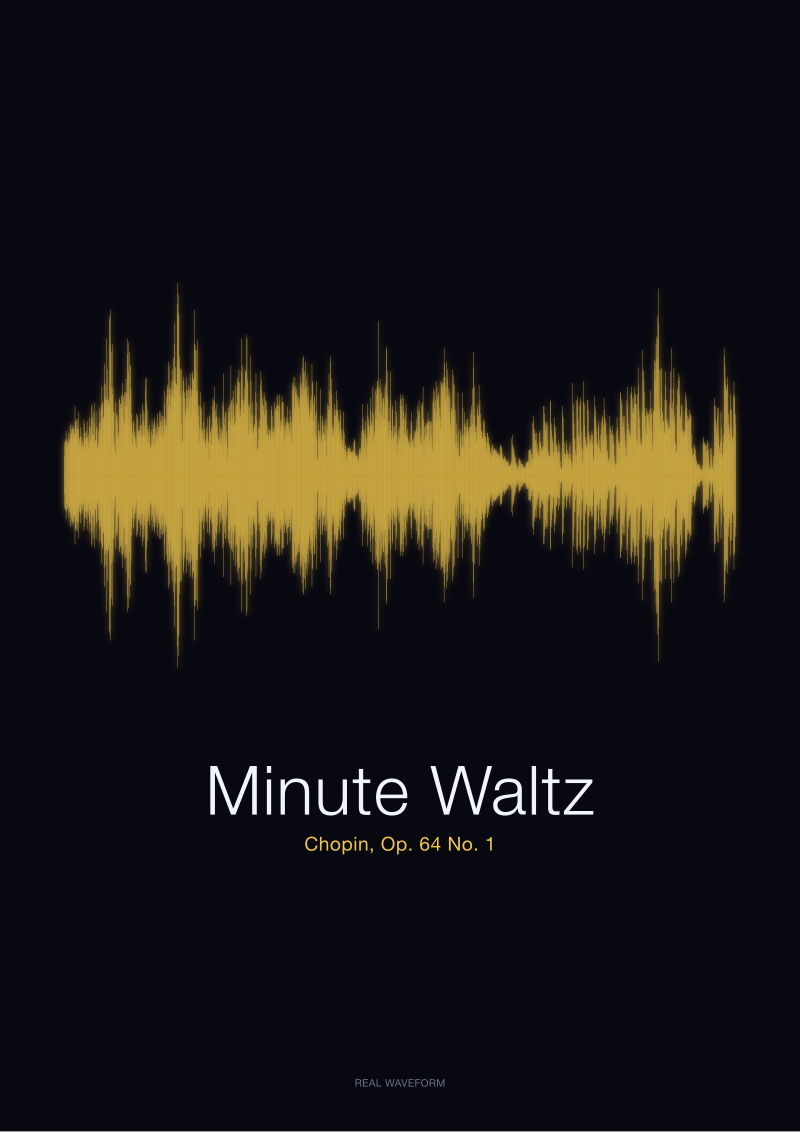
The "Minute Waltz" is not a minute long. It has never been a minute long. In the public-domain recording of Chopin's Op. 64 No. 1 that we render from the Musopen Chopin collection on archive.org, the waveform runs for roughly two minutes of continuous sound — a drawn silhouette of attack and release that no stopwatch reading of the title would ever predict. The mismatch is not a performer taking liberties. It is a mistranslation that hardened into a marketing line, and it still misleads listeners in 2026. The shape on paper tells a different story than the name on the label.
The Name Is a Mistranslation, and It Has Been for Almost 180 Years
The document trail is short and it points in one direction. Chopin's own subtitle for Op. 64 No. 1 was "Valse du petit chien" — the little dog's waltz, associated with Countess Delfina Potocka's terrier chasing its tail. When the piece crossed the Channel to English publishers, the French word "petit" — small — was translated as "minute." Both are correct English words for small. Both are spelled the same. Only one of them is read that way anymore.
The English word "minute" has two pronunciations that mean different things. "MY-noot," rhyming roughly with "cute," means very small, minuscule, of little consequence. "MIN-it," rhyming with "spinach," means a unit of time. The nickname refers to the first. Almost no one reads it that way now.
We do not know the specific desk at which the mistranslation hardened. But the confusion became load-bearing sometime in the early twentieth century, as sheet-music catalogues began printing the nickname without the subtitle, radio programmers wanted a searchable hook, and pianists discovered they could push the whole thing near sixty seconds if they treated it as a stunt. By the time the nickname was on record sleeves, the printed "minute" had lost its second syllable and its original meaning. What began as "the small waltz" was reinterpreted, without anyone deciding to reinterpret it, into a promise about the clock.
The receipt sits in Chopin's own hand: a small waltz for a small dog. The label got in the way.
What the Waveform of Op. 64 No. 1 Actually Looks Like
The public-domain recording in the Musopen Chopin collection on archive.org — CC0, no rights encumbrance, rendered here as a real amplitude waveform from the audio itself, not a decorative curve — runs for roughly two minutes of continuous sound. Not one minute. Not "close enough to one." Two.
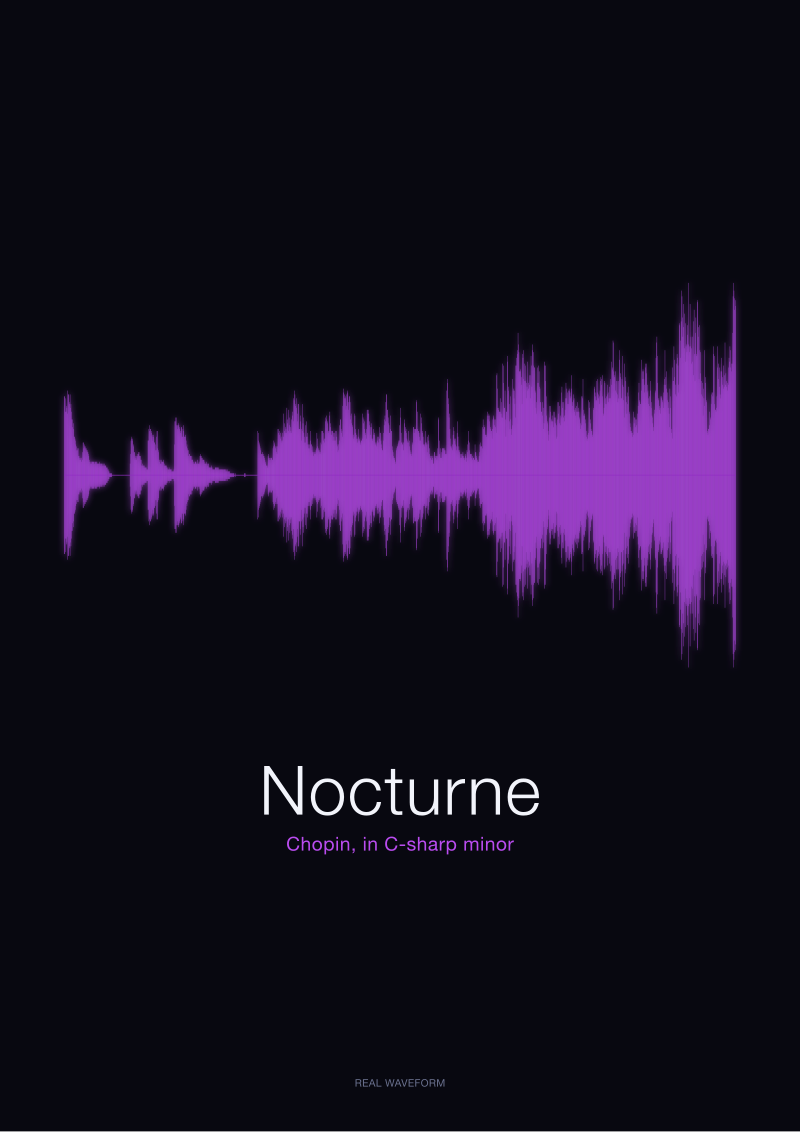
Rendered as a waveform, Op. 64 No. 1 looks unlike almost anything else in the Chopin catalogue. A nocturne is mostly quiet, punctuated by narrow swells; its silhouette on paper is a horizontal thread with occasional shoulders. The Minute Waltz does the opposite. From the first bar it fills the vertical space with a dense, uniform ribbon of amplitude. There are no long rests. There are no dramatic dynamic cliffs. The right-hand figuration — the running sixteenth-notes that give the piece its perpetual-motion feel — draws a busy, evenly weighted band that almost never dips to zero.
Look closer and the texture is not flat. Every group of notes has its own attack — the sharp vertical spike where the hammer strikes the string — followed by a shorter decay before the next attack overlaps it. The result is a densely packed sawtooth ribbon rather than a smooth curve. On a nocturne waveform, you can point to individual notes with your finger. On the Minute Waltz, the notes fuse into a river of attack-decay-attack-decay, and the river is almost the same width from bank to bank all the way through.
There is a middle section — a lyrical episode in the relative key — where the density drops perceptibly. The ribbon narrows. The eye reads it as a breath. Then the perpetual-motion figuration returns and refills the vertical space through to the final chords.
The whole silhouette is roughly two minutes long. On paper, at the scale at which we render our prints, that is a horizontal band about twice as wide as the nickname would imply. The receipt is dimensional. You can measure it with a ruler. The name and the object do not match.
 Minute Waltz
The print from this article · from €29.95
View the print →
Minute Waltz
The print from this article · from €29.95
View the print →
Why "Minute" Keeps Winning Against the Music
The mistranslation has survived nearly two centuries against a piece of evidence that anyone can time on a phone. That survival is not accidental. It follows a pattern we have watched in other domains where labels outlast their referents, and it is worth naming the pattern because once you see it once, you see it everywhere.
The first mechanism is the stunt. From at least the mid-twentieth century, pianists have been recorded attempting to play Op. 64 No. 1 in under sixty seconds. Serious performances tend to sit somewhere between about 1:35 and 2:15, depending on how much air the performer gives the middle section; the stunt versions push into the fifties. The stunt does not disprove the nickname — it reinforces it. Every time a pianist accepts the dare, the audience hears the title as a target rather than a mistranslation. The name becomes a challenge, and challenges are sticky.
The second mechanism is the catalogue. When a nickname is printed next to the opus number long enough, it starts to function as the primary key. "Op. 64 No. 1" retrieves nothing in a listener's memory. "Minute Waltz" retrieves something instantly. Publishers, radio stations, streaming platforms and playlist editors all have strong economic reasons to keep the retrievable name, even when they know the retrievable name is wrong. This is the same dynamic that keeps "Turkish March" attached to a Mozart movement that has nothing to do with Turkey, and "Moonlight Sonata" attached to a piece Beethoven never called that. Nicknames win because they are searchable.
The third mechanism, and the one worth flagging, is the compression. "Small waltz" is descriptive but useless as a promise. "One-minute waltz" is a testable claim that flatters the listener — you will hear something short, complete, containable. The mistranslation delivers a small hit of imagined efficiency, and small hits of imagined efficiency are exactly what marketing copy is engineered to produce. This is where the naming pattern crosses from harmless folk tradition into something worth reading with more care. Whenever a label promises a quantity — a duration, a percentage, a payout, a return — and the object cannot back the label, the label is doing work the object refuses to do.
What the Shape Tells You That the Title Never Will
The waveform of Op. 64 No. 1 will not sell you a promise. It cannot. It is a drawing of the actual air that moved when a real pianist sat down at a real instrument and played the piece the way Chopin wrote it. Its length is its length. Its density is its density. Its middle section breathes at a measurable position along the horizontal axis. You can point to the exact frame at which the final chord decays into room noise. Nothing about the shape can be re-marketed.
That is the quiet argument our studio has been making since we started rendering these prints: the waveform is a receipt. It is the object refusing to lie about itself. When the name says one minute and the waveform says two, the waveform is the source of truth. When a nocturne's title implies "gentle" and the shape reveals a sudden fortissimo in the second minute, the shape is the source of truth. When a polonaise is described as "stately" and the silhouette shows the visible shoulders of dotted-rhythm accents at metrical intervals, the silhouette is the source of truth. Names describe how a piece was sold. Shapes describe what the piece is.
This is why we render Op. 64 No. 1 in the studio shop the way we do — from the real CC0 audio, not from a decorative curve — with its full ribbon of continuous motion drawn to actual duration. The nickname stays on the label because two centuries of catalogue habit are heavier than any single correction. But the drawing above it does not carry the mistranslation. It carries only what happened when the hammer hit the string.
The next question is the interesting one. Which other pieces in your listening life are named for what a publisher wanted them to be, rather than what they actually are? The Minute Waltz is the loudest example because the lie is testable in seconds. The rest of the catalogue — the moonlit, the pathetic, the revolutionary, the raindrop — is quieter about it. That is where the real reading starts, and it is not where this piece ends.
 Nocturne
The print from this article · from €29.95
View the print →
Nocturne
The print from this article · from €29.95
View the print →
FAQ
How long is the Minute Waltz actually?
The public-domain recording of Chopin's Op. 64 No. 1 that we render from the Musopen Chopin collection on archive.org runs for roughly two minutes of continuous sound. Individual performances vary — some historic pianists have pushed under 1:40 as a virtuoso showcase, others sit closer to 2:15 at a more musical tempo — but almost no serious performance has ever been a single sixty-second minute. The nickname refers to the piece being "small," not to a duration.
Where does the name "Minute Waltz" actually come from?
Chopin's own subtitle was "Valse du petit chien" — the little dog's waltz, associated with a scene of Countess Delfina Potocka's dog chasing its tail. English publishers rendered "petit" — small — as "minute," using the pronunciation "MY-noot" that means minuscule. Over decades, the second pronunciation, "MIN-it," meaning a unit of time, took over in casual reading. The label survived; the original sense did not.
Can you actually play Op. 64 No. 1 in under sixty seconds?
Yes, but only as a stunt. Recordings under a minute exist and have been used as virtuoso showcases for over a century. At those tempos the piece stops being a waltz in any dance sense — the pulse blurs, the middle section loses its lyrical breath, and the perpetual-motion figuration turns into a continuous whir. The exercise proves manual dexterity. It does not prove that the piece was written to be heard that way.
Why does the waveform of the Minute Waltz look so uniform compared to a nocturne?
Because the piece is built on continuous right-hand figuration with almost no rests. A nocturne has long-held melodic notes over a spaced left-hand accompaniment — the shape on paper is thin and punctuated. Op. 64 No. 1 stacks attacks on top of each other from the first bar to the last, with a brief narrowing at the lyrical middle section. That construction fills the vertical amplitude space and draws a dense horizontal ribbon rather than a jagged skyline.
Is "Minute Waltz" the only Chopin nickname that misleads listeners?
No. Chopin's catalogue is full of nicknames he did not choose. The "Raindrop" prelude was named by others; the "Revolutionary" étude was labelled by a publisher; the "Heroic" polonaise picked up its adjective through use, not authorial intent. Our editorial position is that nicknames are useful catalogue keys but poor descriptions — the waveform of each piece will tell you more about how it actually sounds than any adjective attached to it in the nineteenth or twentieth century.
Does the recording you render count as authoritative?
The recording is a specific performance released under Creative Commons Zero via the Musopen Chopin collection on archive.org. It is authoritative in the sense that it is a real performance of the score, rendered here as a real amplitude waveform from the actual audio — not a decorative curve. It is not authoritative in the sense that every performer plays the piece identically. Different performances will produce different silhouettes. The nickname will be wrong about all of them.
From the collection
New pieces and 10% off your first print.
One email now with your code. No noise after.