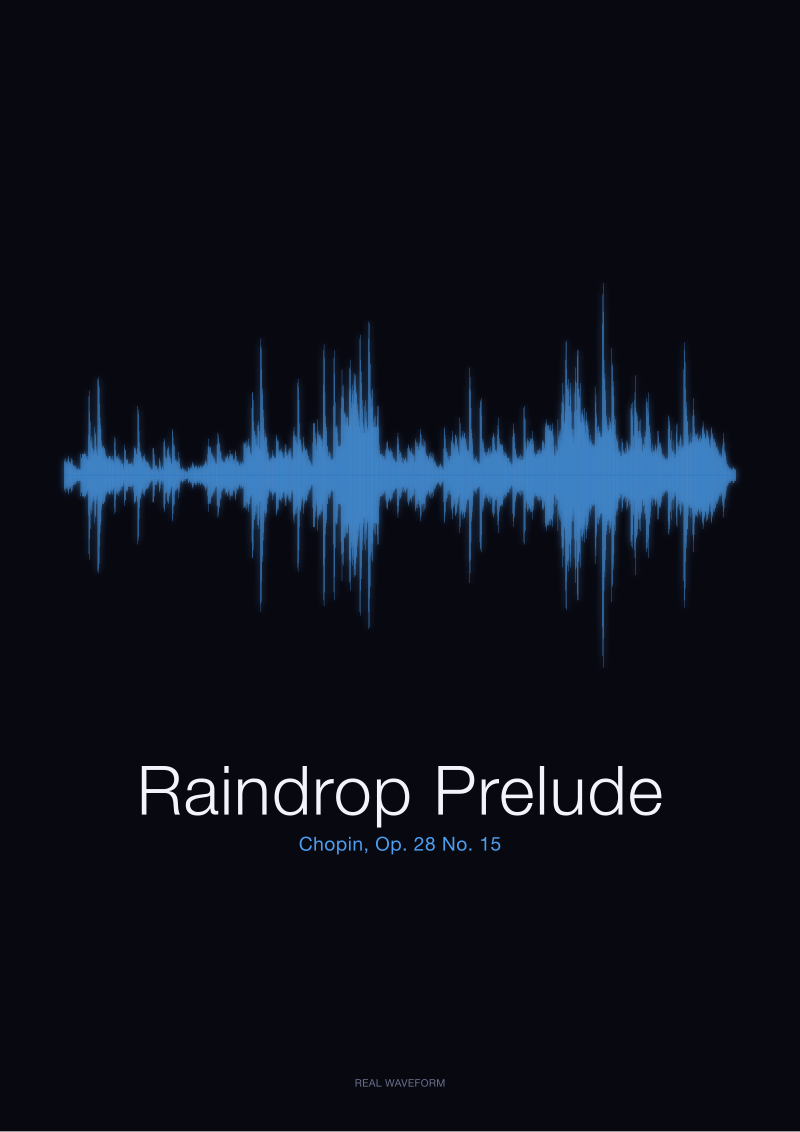
The Raindrop Prelude is not about rain. Hear us out. Chopin dismissed the picturesque nickname during his own lifetime, and the score — Op. 28 No. 15, in D-flat major — never names weather anywhere in its markings. What the piece actually contains is a single repeated pitch, held by one hand across nearly the entire prelude, while the other hand plays a melody, then a darker middle section, then the melody again. The waveform of any faithful recording shows the consequence of that construction: a low steady pulse beneath a curve that swells, deepens through the C-sharp minor middle, and returns. The rain is a story told about the shape. The shape came first.
November 1838: Chopin and George Sand Arrive in Majorca
The trip was medical in intent and literary in cover. Chopin was ill — the cough that would kill him in 1849 was already loud enough by 1838 to worry the people around him — and the plan, arranged in Paris that autumn, was to overwinter somewhere warm. Majorca was the destination. The writer Aurore Dupin, working under the name George Sand, brought her two children. Chopin followed with a Pleyel upright piano that had to travel by sea and would arrive weeks late.
They landed at Palma in November. What they found was not the mild refuge the brochures of the age suggested. The island's winter that year turned wet and cold. The rented house at Son Vent — the "House of the Wind," aptly named — offered damp walls and thin heat. When word spread locally that the foreign guest was consumptive, the landlord, fearing contagion and the cost of fumigating after them, effectively evicted the party. The piano, still in customs, had not yet reached the composer's hands.
None of this was the setting for a picturesque prelude about weather. It was the setting for a working composer without his instrument, in a country whose damp had already begun to punish his lungs. When later readers would hear rain in Op. 28 No. 15, they would be reading backward through a legend the composer never wrote. What Chopin was doing that November was moving, coughing, and waiting on a piano.
December 1838: The Move to the Valldemossa Charterhouse
They shifted inland, up into the hills, to a former Carthusian monastery at Valldemossa — a place whose monks had been expelled by state decree earlier in the decade and whose empty cells were being rented out. Chopin, Sand, and the children took a set of these cells: whitewashed rooms with vaulted ceilings, tile floors, and thick walls that held the cold rather than sheltered from it. The place is a museum now, and the room the party used has become one of the most photographed rooms in the history of romantic music. It was, at the time, a cold building emptied of its former life.
The Pleyel eventually arrived. Chopin had it hauled up to the charterhouse and installed in one of the cells. What that room contained after installation is the closest thing to the physical origin of the piece we are talking about: a small upright piano, a composer in worsening health, a stack of manuscript paper, and the Preludes he was refining into publishable form.
Sand later wrote about all of this in *Un Hiver à Majorque* — a memoir published in 1841, after the trip was over and after Chopin had left her side, though not yet her life. That book is where much of the picturesque mythology begins: the storm outside, the composer at the keyboard, the drops on the tiles. It was written years after the fact, by a novelist. Its accuracy on musical particulars was not, and was never claimed to be, forensic.
 Prelude
The print from this article · from €29.95
View the print →
Prelude
The print from this article · from €29.95
View the print →
January 1839: The Fever, the Storm, and the Repeated Note
Sand's account tells of an evening when she and her son returned to the charterhouse from a supply trip through wet, dangerous roads and found Chopin at the piano in a distressed state — feverish, half in a waking dream, playing something that seemed to her to have been shaped by the storm outside. In her telling, he pushed back at her when she said it. He did not want the piece to be about rain. She was inventing, he said, and doing it badly.
Two things worth separating: what she wrote, and what actually generated the music. The score itself is unambiguous about one thing. In the outer sections of Op. 28 No. 15, a single pitch is repeated almost without pause — a soft, insistent A-flat in the middle of the texture, held while the melody moves above or below it. In the middle section, when the key darkens to C-sharp minor (the same pitch class, respelled), that same repeated tone becomes a G-sharp, still there, now stern. A waveform of any careful recording shows this as a low, even substrate that never quite stops, with the melodic curve rising and falling on top of it.
Whether that substrate sounds like rain is a listener's question. Whether Chopin *wrote* it as rain is a documentary one, and the documentary answer is no.
Early 1839: The Op. 28 Preludes Are Completed at the Charterhouse
The twenty-four Preludes of Op. 28 are the great encyclopedic project of Chopin's shorter forms — one prelude in every major and minor key, laid out in a specific order, and clearly conceived as a set rather than a random gathering. Most of them were drafted before the Majorca trip. Some were finished, and a few possibly composed outright, in the charterhouse. Op. 28 No. 15 sits fifteenth in the sequence, and its length — the longest of the twenty-four by a wide margin — is one of the reasons it has always been discussed separately from its neighbors.
The formal outline is plain enough to describe without a score in front of you. There is an outer section in D-flat major, warm and sustained, with the repeated pitch under a lyric line. There is a middle section in C-sharp minor, considerably darker and heavier, with the same repeated pitch now positioned as a tolling weight instead of a soft heartbeat. Then the opening returns, briefer than before, and the piece closes.
That structure has consequences you can see. In the amplitude drawing of a faithful recording, the outer sections read as a gentle, undulating curve. The middle section reads as a taller, denser mass — more energy across a shorter stretch. The whole prelude has the silhouette of a small hill, a mountain, and a smaller hill. If you were shown that shape blind and asked to name the piece, the middle mass alone would give it away to anyone who knew Chopin's harmonic vocabulary. This is what we mean when we say a piece has a shape.
 Raindrop Prelude
The print from this article · from €29.95
View the print →
Raindrop Prelude
The print from this article · from €29.95
View the print →
September 1839: Publication in Paris, and the Nickname That Attached Itself Later
The party left Majorca in February 1839, sailed for Marseille, and spent the spring in the south of France recovering. Chopin was, at that point, badly weakened. The completed Preludes went to the Parisian publisher Catelin, and Op. 28 was issued in Paris in 1839, dedicated to the piano maker Camille Pleyel. In Germany, Breitkopf & Härtel issued the set the same year with a different dedicatee. Neither edition attached a title to No. 15. The score is silent on rain, on weather, on programme of any kind. There are dynamic markings, articulation, pedal instructions. There is no picture.
The nickname is a nineteenth-century accretion. Sand's memoir, published in 1841, planted the association. Later writers, editors, and program-note authors amplified it. By the second half of the century, the "Raindrop" label was in general circulation. It was never on the title page of a first edition. It was never in a letter of Chopin's endorsing it. It survives because the picturesque is sticky, and because a repeated soft pitch is easy to hear as a drop if that is what you have been told to listen for.
This is worth stating plainly because it changes what the piece is. Op. 28 No. 15 is a study in the psychological effect of a single unchanging pitch beneath a changing harmonic landscape — a kind of pedal-tone architecture that Bach used in the organ works Chopin studied closely. The genius of it is what the unchanging pitch does to the ear across five minutes: it holds you in place while everything else moves. Rain would be a distraction from that idea, not a description of it.
What It All Means: Reading the Shape Without the Story
The story is beautiful. A sick composer in a monk's cell on a wet island, working through his cough on a set of twenty-four small perfect objects. It is the kind of story musicians tell each other because it is worth telling. But the story is not the piece. The piece is a specific arrangement of pitches in time. Everything the ear finds moving about it — the ache of the return, the weight of the middle section, the strange calm of the closing bars — is generated by choices you can point to in the score, and by their consequence in the air.
The waveform is one way to see those choices without knowing how to read music. In a careful recording of Op. 28 No. 15, the substrate never disappears. It is the low, continuous pulse under everything: soft in the outer sections, heavier and more insistent in the middle. The melody swims above it. The dynamics rise into the middle mass and fall out of it. There is no line in the drawing that corresponds to rain, because rain was never in the compositional plan. What is in the plan is a pedal tone, a lyric line, a modulation to the parallel minor, a return.
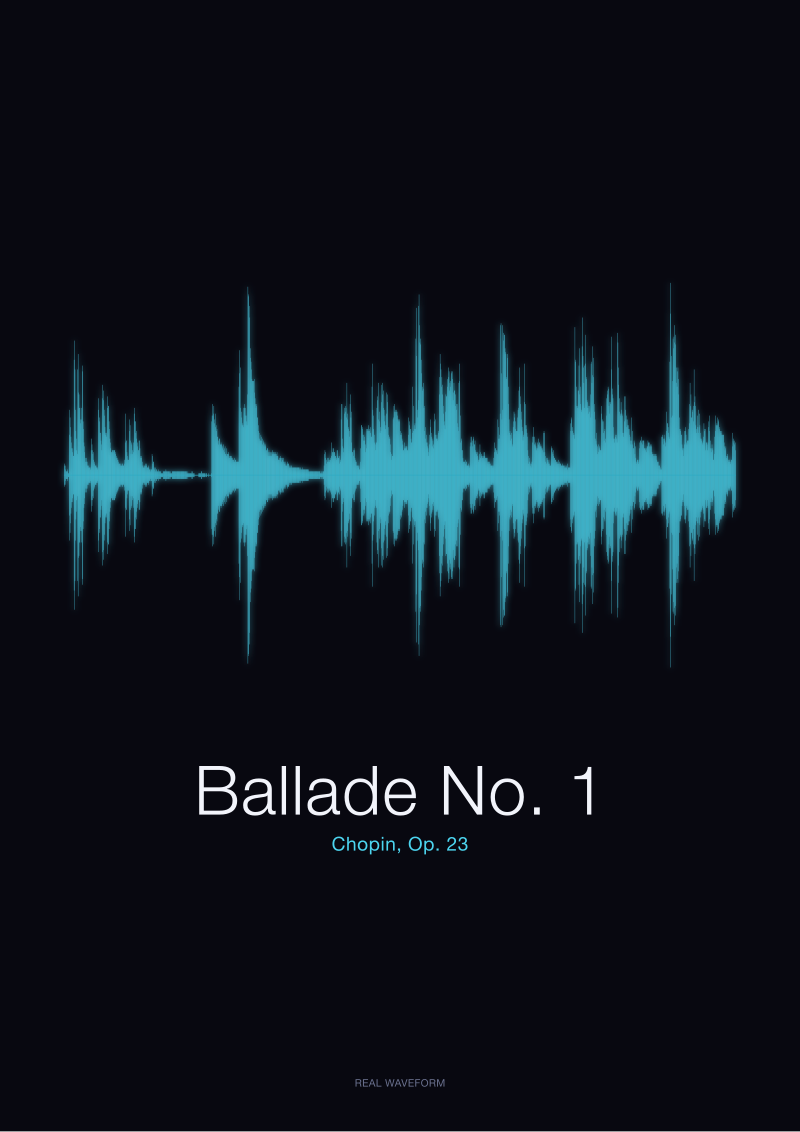
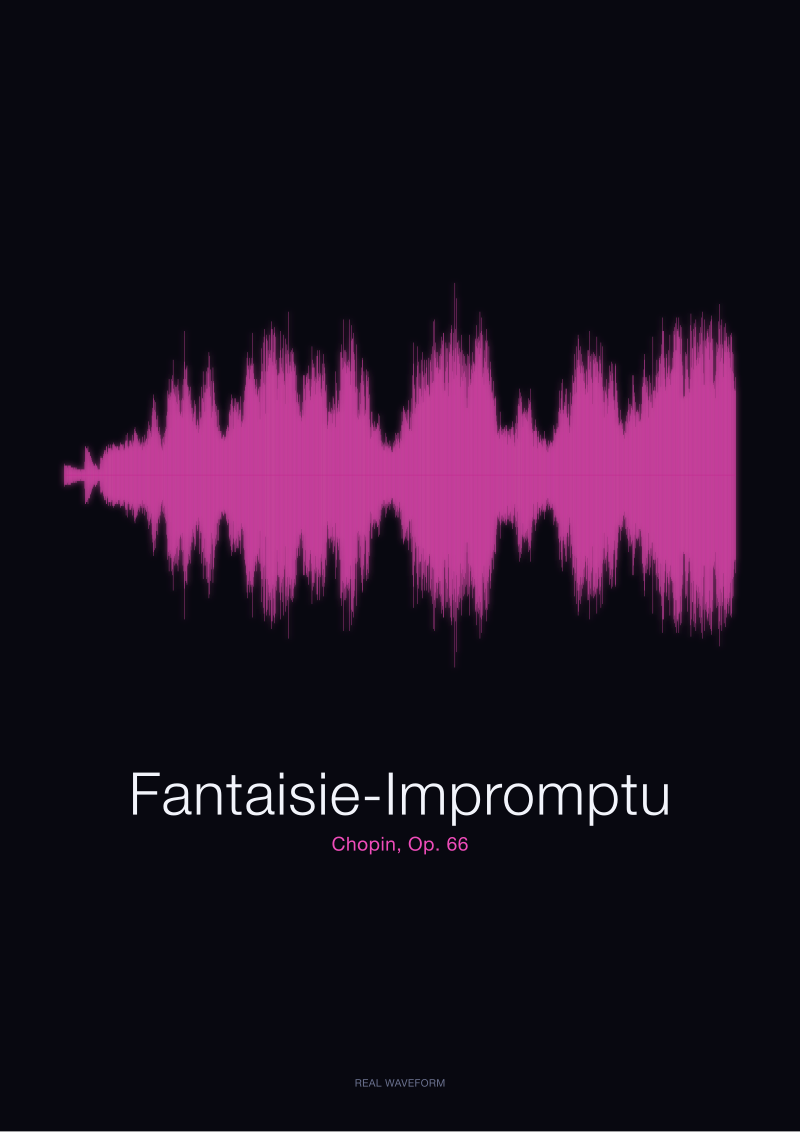
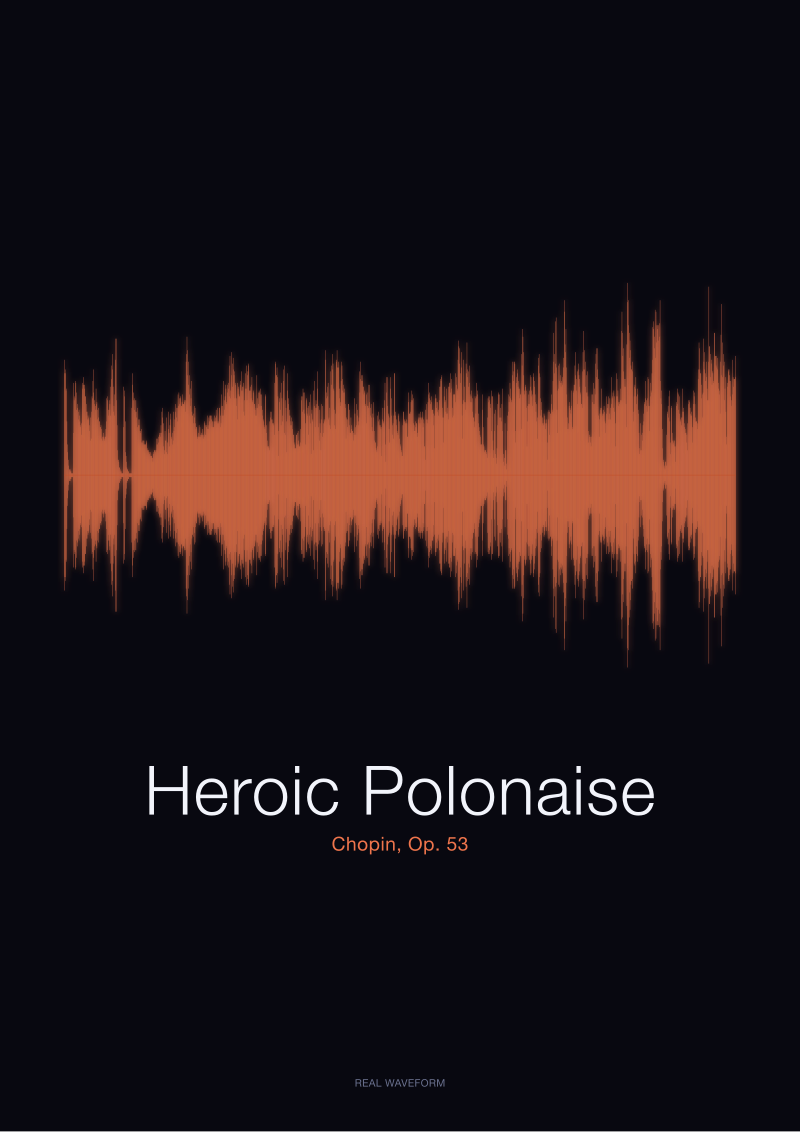
Our own studio does not currently render Op. 28 No. 15. Our Chopin catalogue at /shop/ carries the pieces we have found faithful public-domain masters for — the Ballade No. 1, the Fantaisie-Impromptu, the Heroic Polonaise, the Mazurka in A minor, the Minute Waltz, the Nocturne in C-sharp minor — each drawn from the actual amplitude of the actual recording, not a decorative curve. The Raindrop belongs to the same family of shapes: a Chopin silhouette, made of Chopin's specific decisions about time and pitch. Whether it belongs on a wall is a decision about what the shape means to whoever will look at it every day.
That question — what does a shape mean when you strip the anecdote off it — is where the honest listening starts. The nickname is a doorway; you use it to walk in and then, if you want the piece itself, you close it behind you.
FAQ
Did Chopin himself call the Prelude in D-flat major the "Raindrop"?
No. There is no evidence Chopin used the nickname or endorsed it. The score of Op. 28 No. 15 is untitled beyond its key and opus number. George Sand's 1841 memoir *Un Hiver à Majorque* is the origin point of the rain association, and her own account reports that Chopin objected to the picturesque reading when she offered it. The nickname is a nineteenth-century listener habit, not a compositional intention.
What is the repeated note in the Raindrop Prelude, exactly?
It is a single pitch — A-flat in the outer sections in D-flat major — held by one hand as a soft, continuous pulse under the melody. When the piece modulates to C-sharp minor in the middle, the same pitch is respelled enharmonically as G-sharp and takes on a heavier, more tolling character. The device is a pedal tone, borrowed from an older organ tradition Chopin knew well, and it is the structural spine of the whole prelude.
Why does the middle section feel so different from the opening?
Because it modulates from D-flat major to C-sharp minor — the same pitch class, respelled, but a completely different emotional world. The texture also thickens, the dynamics grow, and the repeated pitch shifts register. On a waveform of a faithful recording, this section reads as a taller, denser mass between two softer curves. That contrast is the piece's central architectural gesture.
Where was the Raindrop Prelude actually written?
The Op. 28 Preludes as a set were largely drafted before Chopin's Majorca trip and completed or refined during the winter of 1838–1839 at the former Carthusian monastery at Valldemossa. The composer worked there on an upright Pleyel piano in one of the vacated monastic cells. Which individual preludes were finalized on the island and which arrived already complete is a question musicologists still parse; the Prelude in D-flat major is one of the pieces most commonly associated with the stay.
When were the Op. 28 Preludes published?
The set was issued in Paris in 1839 by Catelin, dedicated to the piano maker Camille Pleyel. Breitkopf & Härtel published the German edition the same year with a different dedicatee. Neither first edition carried a nickname for No. 15, and no early edition supports the "Raindrop" title as anything other than a later listener's habit.
Is the Raindrop Prelude technically difficult to play?
It is not among Chopin's most virtuosic works in terms of raw finger difficulty, but it is considered one of the hardest to play well. The challenge is sustaining the repeated pitch at exactly the right dynamic — soft enough to sit under the melody, present enough to feel unbroken — across roughly five minutes without a single obvious break in continuity. Voicing the melody over that pulse, and shaping the transition into and out of the darker middle section, are the interpretive tests.
Does Waveform Prints render the Raindrop Prelude as a print?
The Raindrop Prelude is not currently in our catalogue. The Chopin pieces we render are drawn from specific public-domain masters that we can render faithfully as amplitude waveforms — currently the Ballade No. 1, the Fantaisie-Impromptu, the Heroic Polonaise, a Mazurka, the Minute Waltz, and the Nocturne in C-sharp minor. The Raindrop belongs to the same shape family and is a piece we are watching for a suitable master of.
From the collection
New pieces and 10% off your first print.
One email now with your code. No noise after.