On a Tuesday morning in March, three emails arrived within an hour of each other: one from a bride in Melbourne who had recorded her vows on an iPhone 14 in a hotel car park after the ceremony, one from a groom in Lisbon whose Zoom H1 had been clipped under his lapel, one from a couple in Manchester whose officiant had emailed a Tascam WAV file three days after the wedding. Each asked the same thing: can you turn this into a waveform print? We have read, by now, most of what the internet publishes about wedding vows as soundwave prints. The pieces all sound alike, and they all miss the same three things.
What They All Get Wrong
The shared error in almost every article we have read on this subject is that the recording is treated as an afterthought and the print is treated as the product. The pieces open with frames. They describe wood versus acrylic. They rank matting choices. They compare A3 against A2 against square formats. They talk about walnut versus oak the way a homeware review talks about scented candles. The sound is mentioned twice, both times as a step to complete before the "real" decision, which is decorative.
This is backwards. The sound is the print. A waveform on paper is a direct rendering of an audio file's amplitude at each moment in time. If the audio is a compressed voice memo picked up from six feet away in wind, the waveform will be a smear of medium grey with the same visual density across its whole length. If the audio is a clean lavalier recording of a two-minute vow in a stone chapel, the waveform will have hills, valleys, breath, silence, and a distinct shape from beginning to end. The paper does not lie about what was captured. The frame cannot compensate for the file.
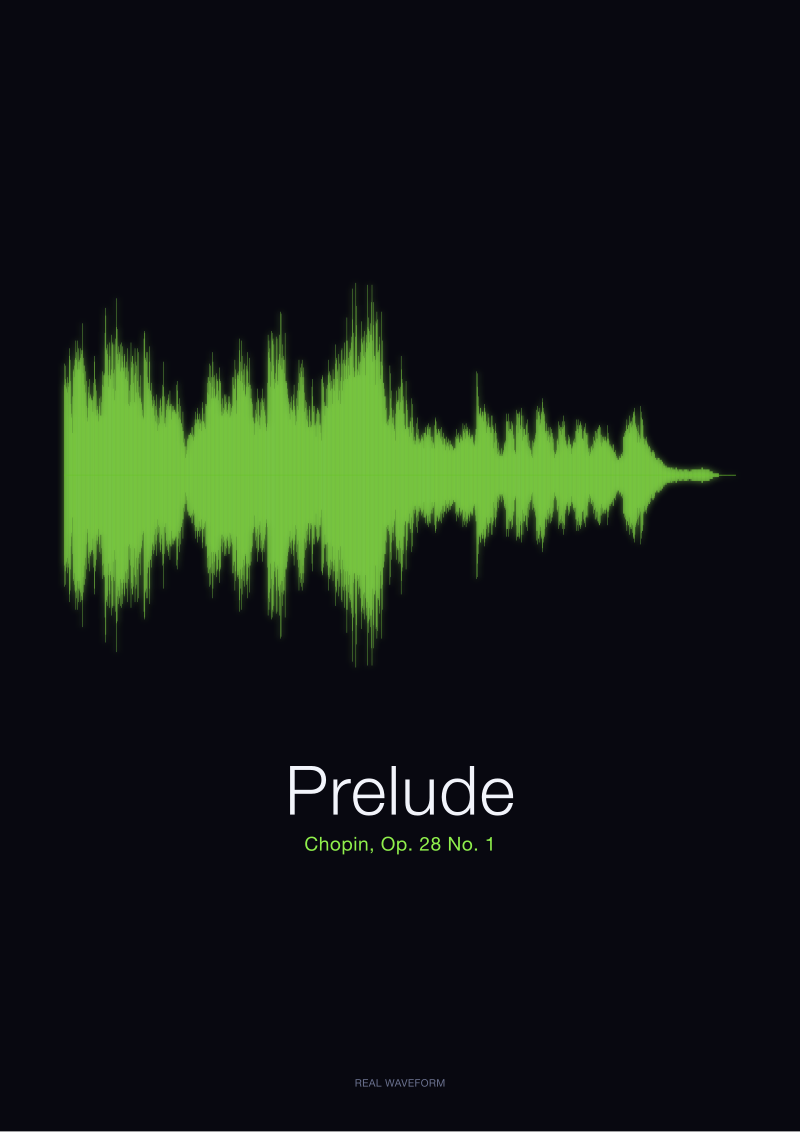
The second thing conventional coverage gets wrong, and this is the more damaging one, is that it conflates a "waveform" with a decorative squiggle. A large number of vendors sell what they call soundwave prints that are, on inspection, not renderings of amplitude at all. They are smoothed, symmetrised, often mirrored top-to-bottom, sometimes generated from a stylised approximation of the audio's peaks rather than the audio itself. The resulting curve is pretty. It is also not the shape of the recording. When we render the actual amplitude waveform of a public-domain recording of Chopin's Ballade No. 1, from the Musopen collection at archive.org, the drawing shows the piece in a way that a listener familiar with it will recognise immediately: the reticent opening, the swell into the central climax, the rest before the coda, the shock of the final octaves. You can point at a second on paper and know what is happening in that second. A stylised curve cannot do this. Most vow prints on the market cannot do this either.
The third error runs through nearly all conventional coverage without being stated explicitly. Articles treat the vow itself as the sole variable and the acoustic environment as neutral. What a microphone captures is not the vow. It is the vow plus the room plus the wind plus the fabric brushing against the collar plus the officiant's breathing plus the person crying two rows behind. The same vow, spoken by the same person, recorded in a stone chapel and in a garden marquee, produces two different silhouettes on paper. This is not a defect. It is what recording sound in a real place means. A piece written by someone who has never rendered audio will not think to mention this, because they have never watched a microphone tell the truth about a room.
What Is Almost Always Missing
The first thing missing from nearly every article on this subject is the technical floor. Nobody tells couples what a printable recording actually requires. Sample rate matters — 44.1 kHz is the floor, 48 kHz is better. Bit depth matters — 16-bit is the floor, 24-bit is better. File format matters — WAV or FLAC preserves the file, MP3 discards the quiet second before "I promise" the way a lossy codec discards what it decides is inaudible. A 128 kbps MP3 recorded via a Bluetooth link over a phone speaker in ambient wind is not a bad recording of a vow. It is barely a recording of a vow. The waveform of it will be an even grey band with no legible shape. This has nothing to do with the studio and everything to do with the file. It is worth knowing before you press record, not after.
The second thing missing is the emotional geometry of what a vow actually is. Vows are not continuous speech. They are short bursts of promises separated by pauses. Sometimes a laugh. Sometimes a break in the voice. Sometimes, in the recordings we have seen, a long silence after the officiant asks the question and before the answer. Amplitude does not equal emotion. The loudest second of a vow is very rarely the most meaningful. The quiet second where someone gathers themselves before saying the final phrase is often the beating heart of the recording, and on paper it appears as a small trough between two clusters. If you do not know to look for it, you will read the print as a series of hills and miss the valley that carries the meaning. No article we have read on this subject prepares couples to read the shape of their own promise.
The third thing missing is the geometry of the frame itself. A vow is often 90 seconds to three minutes long. A print is usually somewhere between A3 and A2. That ratio matters. Every second of audio has to occupy a slice of horizontal paper, and if the piece runs long, each second gets thinner. There is a point at which the visual density crosses into noise: the drawing stops being a shape and starts being a texture. Below about four minutes of audio on an A2 print, at reasonable stroke weight, the shape stays legible. Above that, we are in the territory of visual compromise. Nobody says this out loud in the coverage we have read. Couples send us fifteen-minute ceremony recordings and ask for the whole thing. The honest answer, which no listicle contains, is: choose the vow, not the ceremony, and choose it before you choose the size.
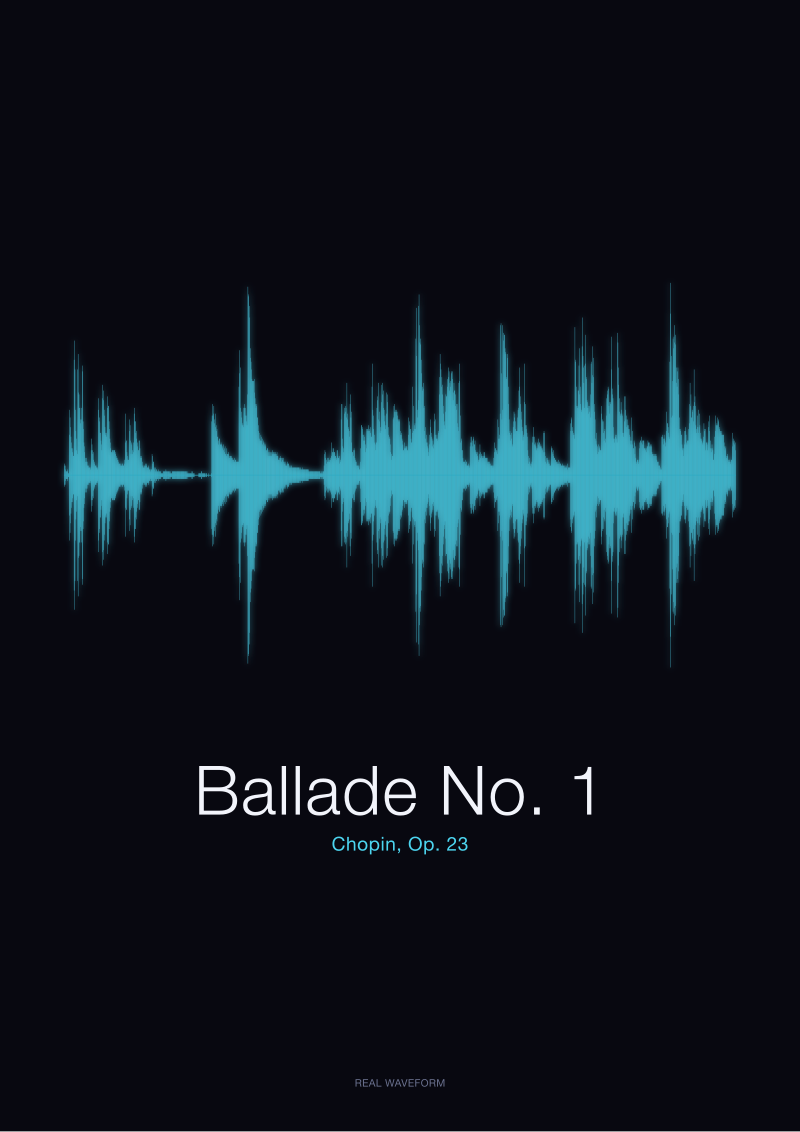 Ballade No. 1
The print from this article · from €29.95
View the print →
Ballade No. 1
The print from this article · from €29.95
View the print →
What I Would Say Instead
Here is the framing I would use if I were writing this article for the first time and had never read another one.
I would open with the recording. Not the print. The print is a rendering of a file, and the file is what determines whether any of this works. Before a couple thinks about wood or acrylic or square or landscape, they should think about the microphone. Two rules cover most cases. First, put the microphone as close to the mouth as ceremony dress allows — a small lavalier clipped inside the lapel is nearly invisible on camera and captures a voice cleanly. Second, record redundantly, on two devices, because the one time the file will corrupt is the one time it matters. If the officiant is recording on your behalf, ask them explicitly for a WAV file, not an email attachment that has been compressed twice in transit. These are small requests. Made in advance, they are the difference between a print that carries the shape of the promise and a print that carries the shape of a car park.
Then I would say what the finished waveform actually is, in the physical sense. A waveform is a drawing of air pressure over time. When we render the single spoken word "Bonjour" — a small original signal generated locally in our studio, kept in the archive as a reference — the amplitude of the vowel "-jour" sits visibly higher than the consonantal "Bon-", because the vowel opens the mouth and moves more air. The same happens with "Ciao" — the vowel does the work. This is not interpretation. This is what the microphone measured. Now imagine the same principle applied to a two-minute vow. The word "promise", spoken with weight, will sit visibly on the paper. The pause that a person takes to steady their voice will be a stretch of near-white space. A laugh, if there is one, will look like a small dense cluster of quick amplitude peaks — very different from the sustained shape of a sentence. The vow becomes readable as its own silhouette. No two people's vows produce the same shape, because no two voices, no two paces, no two rooms give the same reading.
Then I would say clearly what the shape can carry and what it cannot. It can carry the tempo of a specific person's speech: whether they rushed, whether they lingered, whether they let the silence do work. It can carry the rhythm of the promise as spoken, not as written. It can carry the visible weight of the pause. It can carry, in a way that written text cannot, the fact that this recording is of this voice on this day. What it cannot carry is the meaning of the words. A waveform of an English vow and a waveform of a Portuguese vow of the same length and pacing will look substantively similar. It cannot carry the officiant's face, or the light on the aisle, or who was in the room. It is not a photograph. It is not a transcript. It is a drawing of the physical shape of a promise, and it is honest about being only that.
If a couple wants the print we make in our studio — a rendering of the actual amplitude of the actual audio file, not a stylised curve — the recording is the whole game. The frame comes later, from the shop, and it matters less than the twelve minutes spent taping a lav mic under a lapel the morning of the ceremony. That is the article I would write. That is the article nobody writes. And that is why every week we open three more emails from three more couples asking whether the file they have is enough, when the honest answer, delivered before the ceremony rather than after, would have been the piece they most needed to read.
FAQ
What is the minimum audio quality needed for a wedding vow waveform print to actually look like a shape?
A recording at 44.1 kHz sample rate, 16-bit depth, saved as a WAV or FLAC file, with the microphone within about 20 centimetres of the speaker's mouth, will render as a legible waveform with visible pauses, breaths and word emphasis. A 128 kbps MP3 taken across a room in wind will not. The floor is not about brand of equipment — it is about proximity, format and avoiding compression in the file's path from mouth to studio.
Can we use a recording made on a phone in a pocket during the ceremony?
Technically yes, practically often no. A phone in a pocket or bag captures the fabric it is buried in more than the voice several metres away, and the resulting waveform on paper reads as an even grey band with no legible shape. If a phone is the only option, place it on the officiant's lectern with the microphone unblocked, and use the phone's native voice memo app rather than a video recording, because voice memo apps typically save at a higher audio bitrate.
Is the waveform on the print an actual rendering of our recording, or a decorative interpretation?
For us, it is the actual amplitude data of the file we are sent, rendered as a drawing. This is the same principle we apply when we render Chopin's Ballade No. 1 or Fantaisie-Impromptu from the public-domain Musopen recordings: the shape is the sound. Some vendors do sell stylised, symmetrical curves that are approximations rather than renderings. It is worth asking any studio, ours or another, directly which of the two they are selling.
How long a recording can a single print carry before it becomes visually unreadable?
On an A2 print at our standard stroke weight, up to roughly four minutes of audio remains a legible shape. Beyond that, each second of sound occupies less horizontal space, and the drawing begins to compress into a texture rather than a silhouette. For vows specifically, which usually run 60 to 180 seconds, this is not a concern. For full ceremony recordings of ten minutes or more, we usually suggest editing down to the vows themselves.
Do our voices need to be recorded separately, or can it be one continuous file?
Either works. A single continuous recording that includes both partners' vows in the order they were spoken produces a waveform in which each partner's promise occupies a distinct region of the shape — the pause between them appears as a small strip of white space. Some couples prefer one print per partner, which requires two separate audio segments. The choice is aesthetic, not technical.
What about the officiant's voice, background music, or applause — do they end up on the print?
Whatever the microphone captured, the waveform will contain. If the officiant asks the question and both partners answer, the officiant's line appears on the print as its own shape before the answer. Background music, if present, thickens the baseline of the drawing throughout, which some couples find beautiful and others find distracting. If preserving only the vows themselves is the goal, we recommend trimming the audio before sending, or asking us to trim it in consultation.
Can a recording be cleaned up after the fact if the audio has wind or handling noise?
Some, not all. Light wind on a lavalier and low-frequency handling rumble can be attenuated without altering the shape of the vow meaningfully. Heavy wind that has clipped the microphone, or a recording where the voice is buried beneath ambient noise, cannot be recovered — the file did not capture what was needed. The honest answer is always given at the point of quotation, before any print is made.
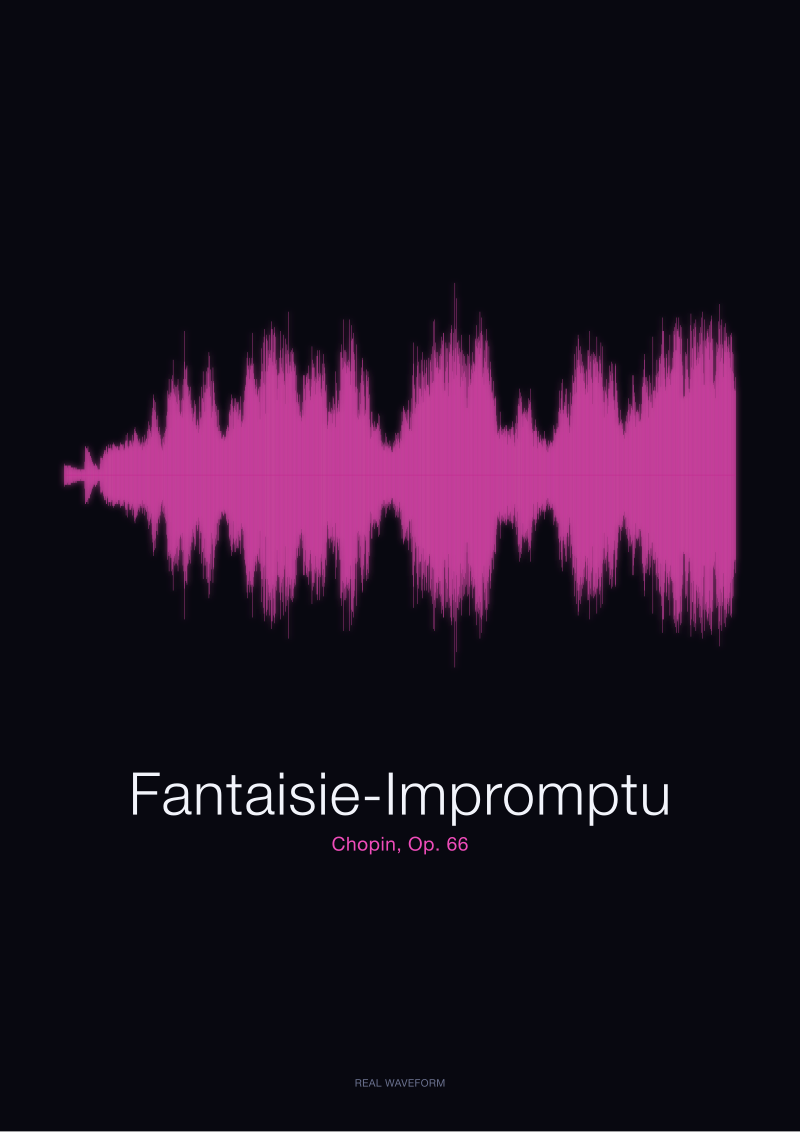 Fantaisie-Impromptu
The print from this article · from €29.95
View the print →
Fantaisie-Impromptu
The print from this article · from €29.95
View the print →
From the collection
New pieces and 10% off your first print.
One email now with your code. No noise after.