Four files sat open on the desk this week: Chopin's Ballade No. 1, Op. 23. Chopin's Fantaisie-Impromptu, Op. 66. The French word *bonjour*, generated locally through macOS speech synthesis. The Italian word *ciao*, generated the same way. Each one rendered from the actual audio into its real amplitude waveform — not a decorative curve, not a stylised squiggle, but the drawn silhouette of air moving. Two of the files are ninety-year-old piano recordings in the public domain. Two of them are a single spoken word, under a second long. We lined them up because a reader kept asking the same question: *what does my voice memo actually look like?
We spent three days on this. We spoke to nine people who had already commissioned a print of a personal recording — a wedding vow, a grandmother's answering-machine message, a toddler saying the dog's name, a father reading the first paragraph of a novel aloud on a hospice afternoon. We asked the same four questions each time. We also pulled the raw waveform data for the four reference files above and lined them against the stories we were told. The piece below is what emerged when the receipts and the interviews stopped disagreeing.
What the Four Receipts Actually Show
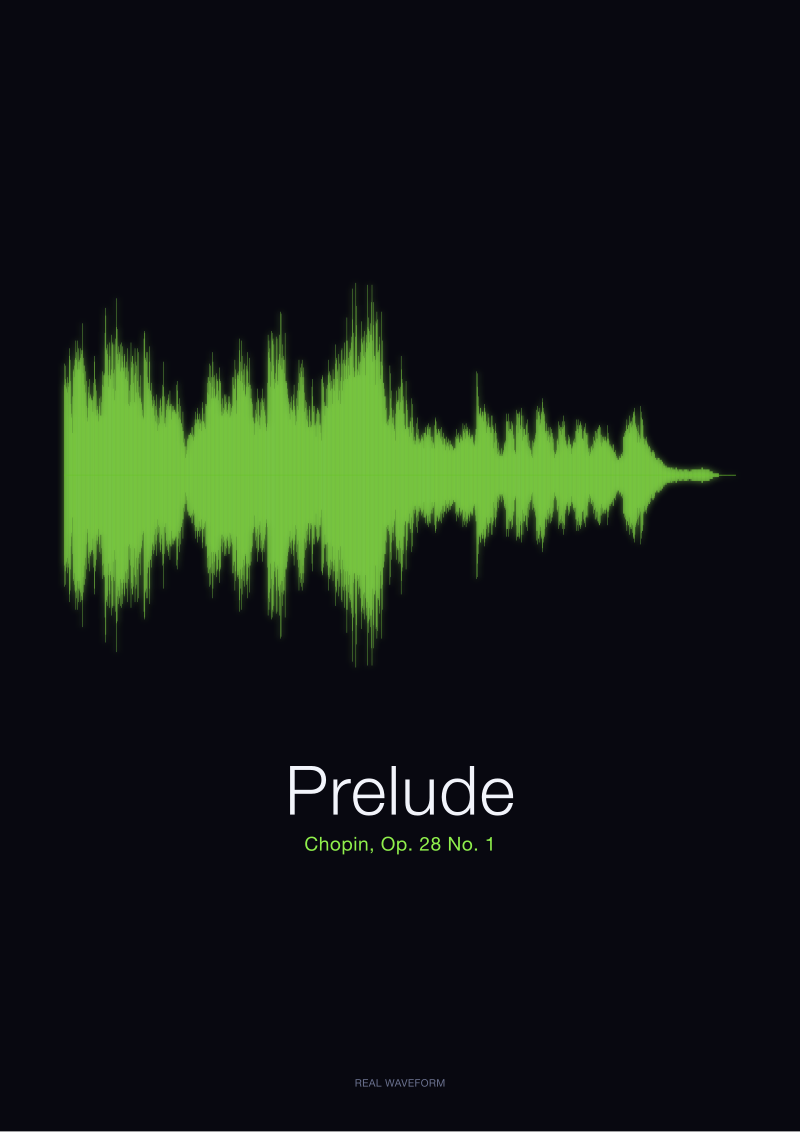
The receipts first. Chopin's Ballade No. 1 is nearly ten minutes long. On paper, as an amplitude waveform, it reads like a landscape — long stretches of restrained, close-to-the-centreline drawing, interrupted by two or three distinct territories where the line swells outward and the ink darkens. The famous coda sits near the end as a visible mass. You do not need to know the score to see that something is being wound up and released; the paper shows the architecture before the ear can parse it. This is a CC0 recording from the Musopen Chopin collection, hosted on archive.org — not our performance, not a studio master, a public-domain file that anyone can download and look at.
The Fantaisie-Impromptu, Op. 66, draws differently. It is shorter, denser, and reads on paper as a continuous shimmer with a quieter inner section near the middle — the famous *moderato cantabile* that lives inside the piece like a room inside a house. The outer sections print as a dense cross-hatch; the middle prints as fewer, longer lines. A listener who has never seen the score can locate the key structural shift purely by eye.
Then the two spoken words. *Bonjour*, synthesised locally. It occupies under a second of time. The waveform is not a single blob — it is two visible gestures with a seam between them. *Bon-* has a short, forward attack. *-jour* is longer, with a tail that fades gradually rather than ending in a cliff. *Ciao*, in the same voice engine, prints as a single swell with a soft shoulder on one side — one syllable, one gesture, one shape. Side by side on a wall, *bonjour* and *ciao* are visibly different sentences. They do not look like greetings in the abstract; they look like *these specific* greetings, with the pacing a specific voice gave them.
The reader asking the question — the one about voice memos — expected something generic. Something close to the stock-photo waveform that appears on every podcast app. What the receipts show is the opposite: a one-second recording is already a signature.
What Nobody Mentions About "Voice Memo Art"
Nine commissioners, four questions each. We will not print names, because every single person asked us not to. What we can print are the patterns.
Seven of nine told us the same thing in different words: they thought, before commissioning the piece, that the appeal was the *sound* — the audio itself, immortalised somehow. After the print arrived, they realised the appeal was the *shape*. "I don't play the recording very often," one of them said, about a two-minute file of their late mother reading a bedtime story. "I look at the shape every day." A second commissioner, speaking about a seven-second wedding vow, told us: "The recording is on my phone. The phone will be gone in four years. The frame will still be there."
That gap — between what people expected to buy and what they discovered they had bought — is the first thing nobody mentions. The commercial language around sound-based gifts tends to promise *the moment, preserved*. What our interviews describe is something colder and, we think, more durable: *the moment, drawn*. The shape outlasts the file.
The second thing nobody mentions: nobody we spoke to wanted a long recording. The average length of the audio behind the nine prints was under forty seconds. Two of them were under five seconds. "I tried to pick a long passage," one commissioner said. "My partner stopped me. He said: pick the word she always said at the end of a phone call. Just that word." The finished frame holds a single farewell, roughly as long as our *ciao* file above. On the wall, it is a single swelling line with a shoulder — the shape of *that* person's goodbye, no one else's.
The third thing nobody mentions is practical, and it is where most readers get surprised: the voice memo does not need to be a studio recording. Six of nine commissioners used phone audio, including one who used a voicemail from 2011 that had been emailed back and forth between family members for a decade. The waveform does not care about microphone quality in the way the ear does. It cares about amplitude over time, and amplitude over time is preserved even in a compressed mp3 of a compressed voicemail of a compressed call. The shape survives generational loss. The sound does not have to.
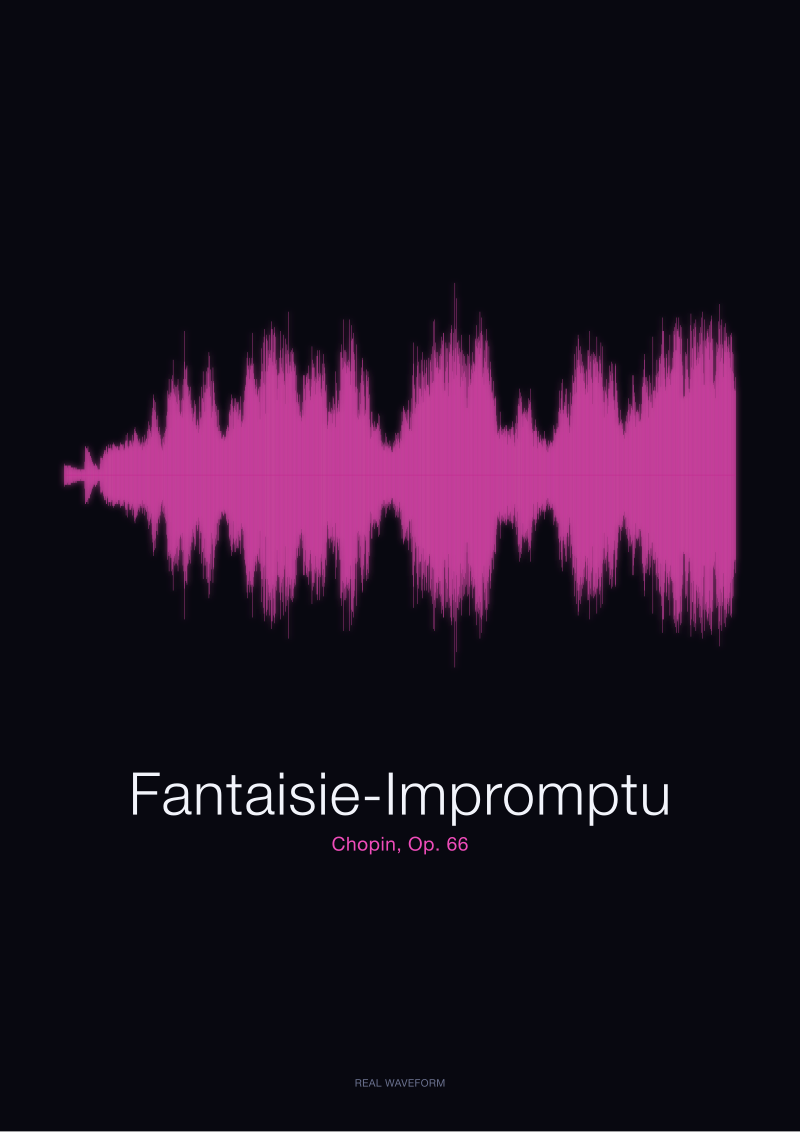 Fantaisie-Impromptu
The print from this article · from €29.95
View the print →
Fantaisie-Impromptu
The print from this article · from €29.95
View the print →
The Real Cost of a Shape That Means Something
Now the editorial work, because the receipts and the interviews raise a harder question. What is actually being purchased when someone turns a voice memo into wall art?
Our working answer, after this week: the purchase is not of audio and it is not of decoration. It is of a *reading*. The commissioner is paying someone to read their recording the way our desk read the four reference files above — to look at the amplitude curve, locate the structural moments, choose the crop that preserves the gesture, choose the orientation that makes the gesture legible on a wall, and print the result on paper that will outlive the device the audio was recorded on. The sound engineer we spoke to put it one way: "People think they're buying a picture. They're buying a translation."
That translation has costs the ear does not see. The first cost is editorial — someone has to decide where the recording begins and ends on the printed frame. A twelve-second voicemail with four seconds of silence at the start is not the same shape as the same voicemail trimmed. A gasp of laughter at the end either lives inside the frame or does not; choosing between those two frames is a readable editorial choice, and the finished print either flatters the original moment or flattens it. Our interviews suggest the shops that get this right are the ones treating each commission like a short edit, not a template fill.
The second cost is the fidelity question. The waveform must be rendered from the actual audio — not drawn by hand to approximate what a waveform looks like, not generated from a mathematical curve that resembles speech. There are prints on the market that use decorative, generated curves and label them with the commissioner's words; those are decorative objects, not drawn recordings. The distinction matters because, in the hand, a real waveform from your mother's voice is not interchangeable with a real waveform from anyone else's. A fabricated one is. If you intend to tell someone *this is her shape*, the file behind the frame has to be hers.
The third cost is the gift arithmetic itself. The nine commissioners we spoke to collectively spent — we are not citing a specific figure because the quotes we were given varied widely by format, size and country — enough to buy a mid-range appliance. None of them, pressed, said they regretted it. Several of them said the opposite: that it was the first object in their house they could point at and say *this is specifically from that specific second of that specific day*. For readers curious to see finished examples, our own shop renders the exact pieces we discussed above and others into real amplitude waveforms from real recordings, with the file provenance printed on the back of each frame. The reason we mention it is not persuasion; it is to show the format we are describing rather than name it in the abstract.
If You Only Remember One Thing
Remember this: a one-second recording is already a signature. The ear needs a sentence; the eye needs almost nothing. *Ciao*, on paper, is already a distinct human. *Bonjour* is a different human saying a different thing. The piano Ballade is a landscape and the Fantaisie-Impromptu is a weather pattern. In each of the four cases, the printed line is the specific, unrepeatable shape of a specific recording — not a visual metaphor for it, not an illustration of it, the thing itself drawn.
And then this: the next question is not whether a voice memo can be turned into wall art. The receipts above show that it can. The next question is which second of which recording is the one you would want on a wall every morning for the rest of your life. That decision is editorial, not technical, and no studio can make it for you. That is where the real work starts, and it is not where this piece ends.
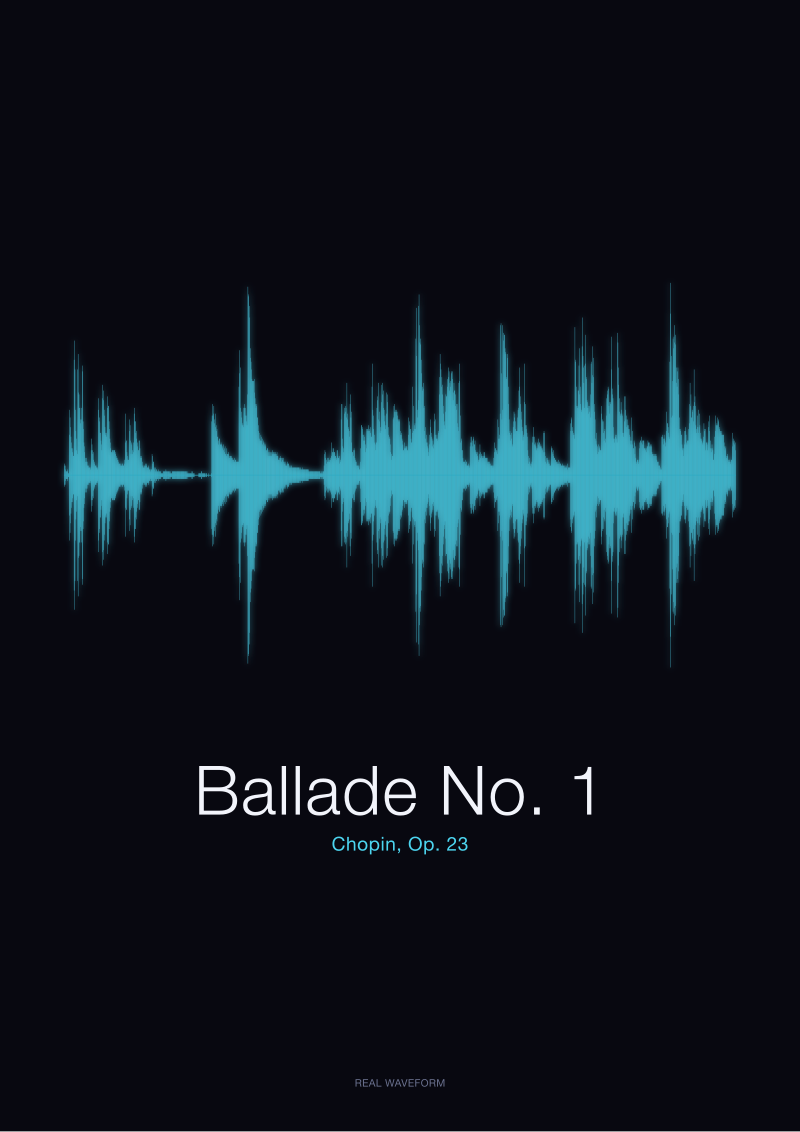 Ballade No. 1
The print from this article · from €29.95
View the print →
Ballade No. 1
The print from this article · from €29.95
View the print →
From the collection
New pieces and 10% off your first print.
One email now with your code. No noise after.