We have read most of what the internet has written about the shape of a Chopin nocturne on a waveform display, and the pieces converge on the same three or four errors. They mistake the drawing of the audio for a drawing of the notation. They confuse loudness with feeling. They treat the horizontal axis as if it were a bar line. And when they reach for the Nocturne in C-sharp minor — the one everyone eventually reaches for — they describe a shape that is not actually the shape of the recording. We render that recording. We look at it every day. The gap between the article and the waveform is wider than it should be.
We are going to name the errors in order, and then say what we would put on the page instead. The recording under discussion is the posthumous Nocturne in C-sharp minor — the one used in every documentary about Warsaw, in every film that needs to signal a private grief — drawn from the public-domain Musopen Chopin collection at archive.org/details/musopen-chopin, which is the recording that anchors the Chopin series in our shop at /shop/. Everything below comes from looking at that particular strip of amplitude, day after day, alongside articles that claim to describe it.
What They All Get Wrong
The first and most persistent error is the belief that the waveform is a graph of the music. It is not. It is a graph of the air the microphone measured. What the audience hears as a nocturne — the melody in the right hand, the arpeggiated left, the pedal, the register, the harmony — none of that is directly readable off the horizontal axis. The axis is time. The vertical is amplitude, which is a measurement of pressure variation, not of pitch and not of feeling. Articles about the Chopin nocturne routinely describe "the crescendo you can see" and "the melodic line rising" as if the shape drew the notes. It does not. It draws the loudness of the piano at every instant, summed across every string ringing at that instant, and it draws nothing else.
The second error follows from the first. Because the writer expects the shape to say what the music is doing, they read emotion into the amplitude. Loud becomes anguish. Quiet becomes tenderness. The C-sharp minor nocturne is quiet through most of its length — the piece breathes in low dynamics — and quiet, in a waveform, is a thin horizontal band close to the centre line. Articles look at that thin band and call it "restrained sorrow" or "hushed longing", when what they are actually describing is a piano being played softly. Softness in the recording is not softness in the feeling. A pianist will make a marked fortissimo passage sound tender and a marked pianissimo passage carry more grief than the loud ones. The waveform reports the pressure at the microphone. It does not report the intent.
The third error is treating the horizontal axis as if it were structural — as if you could point at a stretch of the wave and say "this is the second theme" or "this is the return of the opening." You cannot, not from the shape alone. A waveform does not draw bar lines. It does not draw the ternary form of a nocturne. It draws the recording as an unbroken line from silence to silence. Articles that annotate the wave with "development section" or "climax at 2:47" are guessing from the score and then laying that guess over the amplitude. Sometimes the guess is close. Often it is not, because rubato — the whole point of playing Chopin at all — pushes the sounded moment away from the beat that a printed edition would predict.
What Is Almost Always Missing
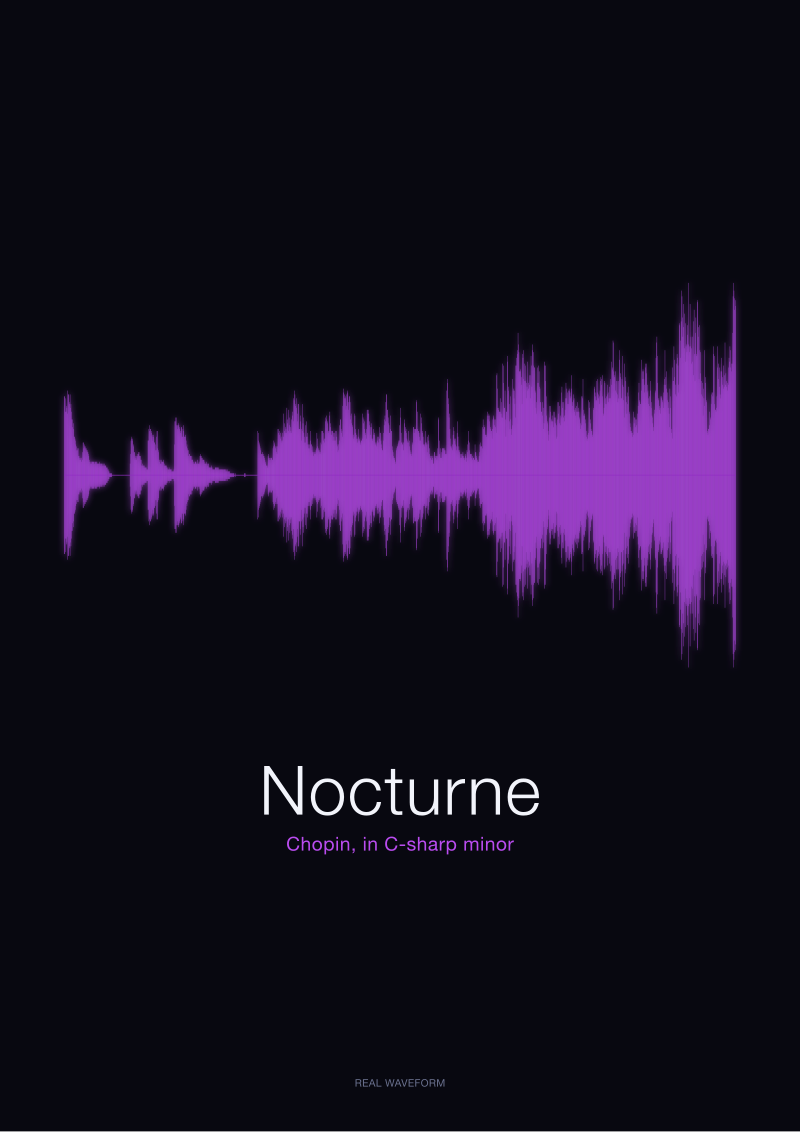
What almost no article covers is the role of silence in the shape. The C-sharp minor nocturne begins with sound — the piano's first low note, the chord underneath the singing right hand — but the moments before, between and after are the reason the shape reads the way it does. Silence, in a waveform, is a horizontal line at zero. It is white space. It is the visual equivalent of what the pianist does with the pedal between phrases, or with the lifted wrist at the end of a line. If you are trying to explain what a nocturne looks like, the shape of the quiet stretches is at least half of the answer, and often the more informative half. The rests, the lifted pedal, the breath at the end of a phrase — these are what give the wave its silhouette. Articles skip this because there is nothing dramatic to say about a straight line. But the straight lines are the phrasing.
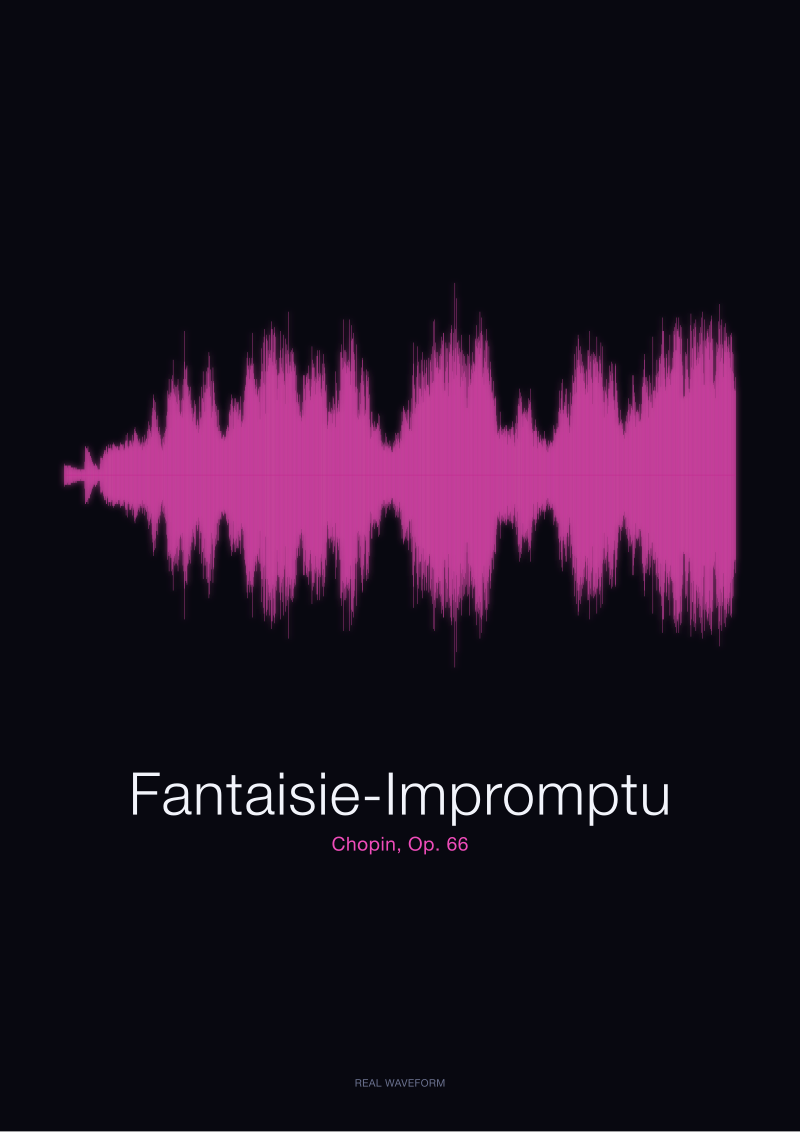
The physics of the piano attack is also almost never mentioned. A piano note is percussive. The hammer strikes, the string is set in motion, and the sound decays across the length of the note. On a waveform this reads as a sharp vertical spike followed by a slow, curved fall. Every note in the nocturne is a spike and a fall. When several notes overlap — which is almost always, because of the sustain pedal and the arpeggiated left hand — the spikes and falls compound into the thicker, blurred band that fills most of the middle of the piece. Understanding that band as an accumulation of individual attacks, each with its own envelope, is more useful than any adjective. It is why the nocturne, on paper, looks fuzzier than a solo violin recording at the same tempo would look, and why the Fantaisie-Impromptu, with its rapid running figuration, looks denser again.
Then there is the missing acknowledgement that a waveform is a portrait of one recording, not of a piece. Two pianists playing the C-sharp minor nocturne back to back on the same instrument produce two different shapes. Different rubato, different pedal, different attack, different microphone placement, different room. Articles talk about "the waveform of the nocturne" as if a canonical one existed. There is no canonical waveform. The shape we render is drawn from a specific public-domain recording in the Musopen Chopin collection, and it belongs to that performance. Another performance, drawn from another take on another day, would produce a related but distinct silhouette. A waveform is a drawing of a moment, not a drawing of a composition.
 Nocturne
The print from this article · from €29.95
View the print →
Nocturne
The print from this article · from €29.95
View the print →
What I Would Say Instead
If we were writing this piece and someone asked us to explain what a Chopin nocturne looks like as a waveform, we would start with the recording, not with the composition. The waveform is a portrait of that recording. It is a strip the same length as the audio, showing at every point how much air was moving at the microphone. That is the whole vocabulary. Amplitude on the vertical axis; time on the horizontal axis; silence at the flat centre line; sound as a filled band that thickens and thins. Everything else in the description has to be built up from those four facts.
We would then describe the C-sharp minor nocturne specifically. The piece opens with a low sustained note and a chord underneath a right-hand melody that everyone remembers even if they cannot name it. On the recording we render, that opening reads as a thin, restrained band — the piano is playing softly, and there is space around the phrases where the pedal lifts. Through the middle section, where the melody becomes more ornamented and the left hand grows in complexity, the band thickens. There are moments of stronger dynamics where the shape briefly widens into a lens of denser amplitude, and moments of pianissimo where it narrows almost to a wire. The piece ends quietly. The final seconds of the wave are a slow tapering into the noise floor of the recording. That taper is not a graph of the emotional arc. It is a graph of how hard the strings were vibrating in their last decay.
We would insist on one thing that most articles omit: rubato is what the wave shows most clearly, and rubato is the whole reason to render a nocturne as a shape at all. In the score, the beats are equidistant. On the wave, they are not. The right hand hesitates. The left hand holds a bass note under-tempo while the melody arrives late above it. Phrases are stretched and compressed against an implied clock that the pianist keeps privately and never once obeys. A metronomic performance would produce a wave whose peaks fell at regular intervals. Chopin's music, played the way he asked for it to be played, does not. The peaks are placed by feel. You can see this in the shape. The distance between one accented moment and the next is not a fixed number of pixels. It is a musical decision made in the room and captured by the microphone.
If we could give a reader one thing to hold, it would be this: the waveform is not a picture of the piece. It is a picture of a decision — a hundred decisions per minute, made by a pianist and printed by a microphone — and that is why we bother to render it at all. The composition is available as notation in any competent edition of the score. Only the recording can be printed as this particular shape, and only this particular shape can hang on a wall as evidence that a specific human played a specific Chopin nocturne on a specific afternoon and meant every irregular gap between the notes.
FAQ
Does every Chopin nocturne look similar as a waveform?
They share a family resemblance because the nocturne genre lives in low-to-moderate dynamics with a singing right hand and an arpeggiated left, so the middle band tends to be thin and even. But no two are interchangeable. The Fantaisie-Impromptu, Op. 66, though not a nocturne, sits nearby in the Chopin catalogue and looks utterly different on paper — denser, more agitated. Even inside the nocturne set, silhouette varies with the piece's dynamic range and the pianist's phrasing.
Why is the Nocturne in C-sharp minor the one most often shown?
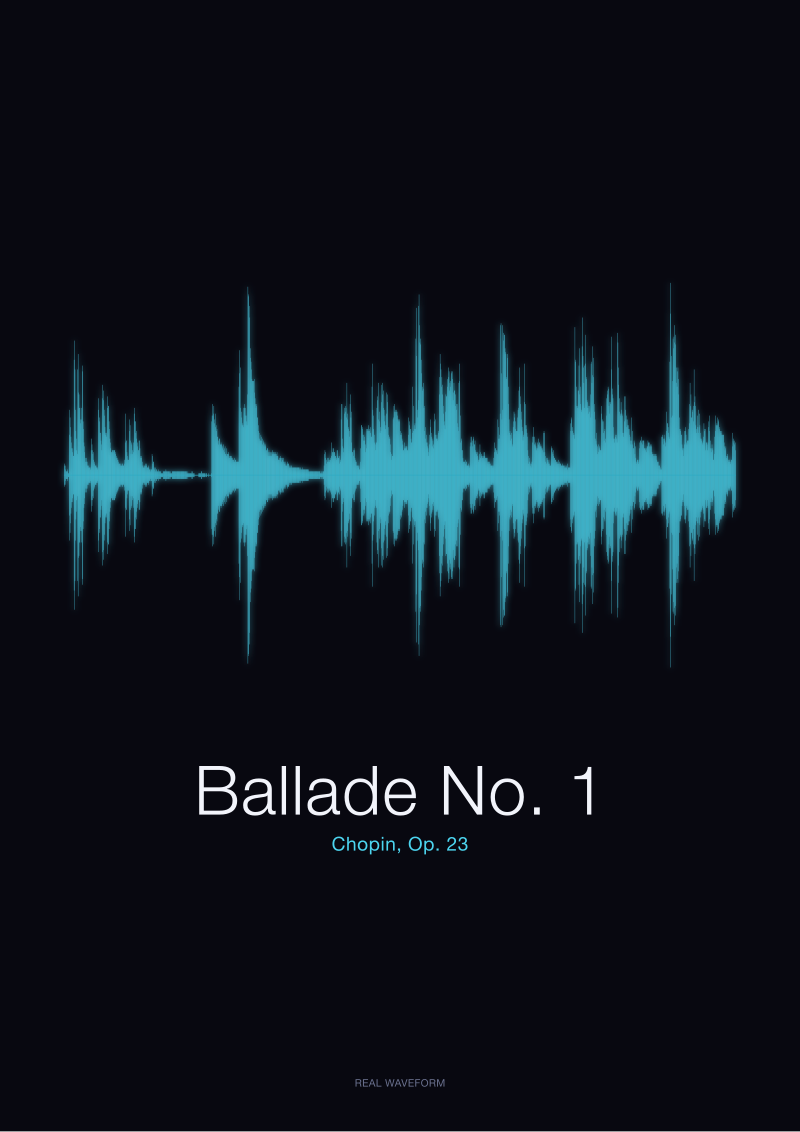
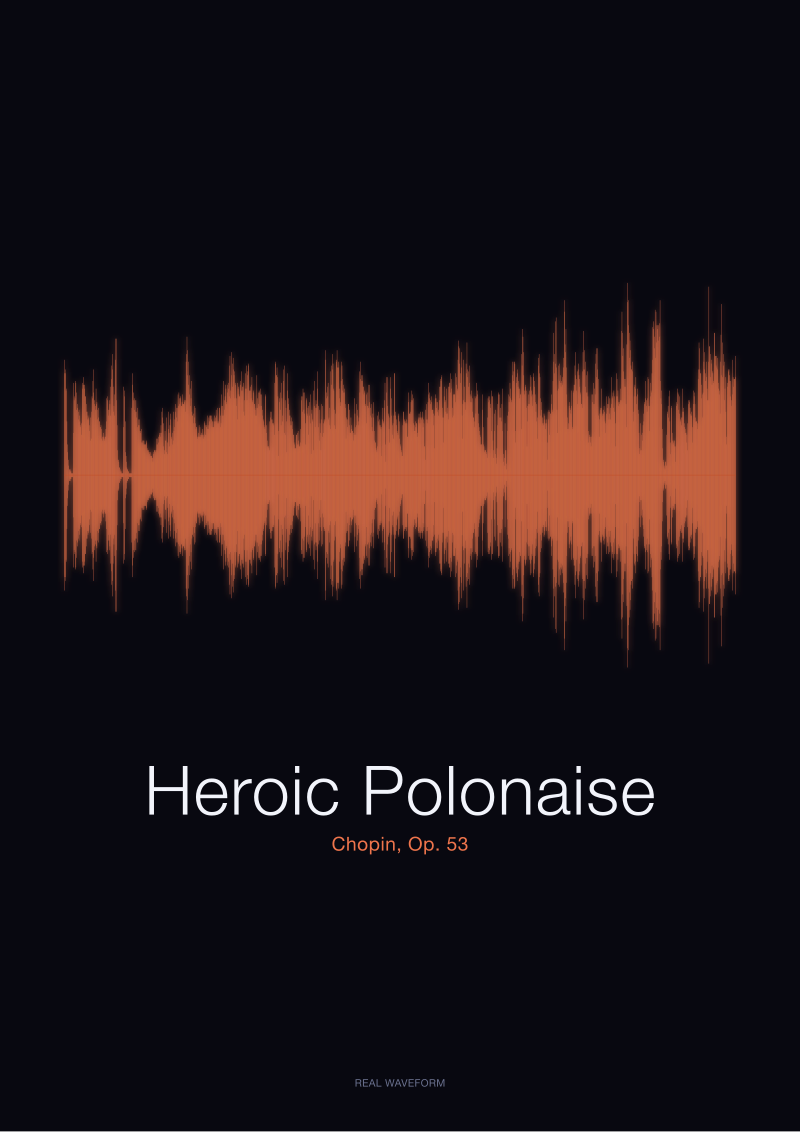
It is the most widely recognised of the posthumous nocturnes, carried by film use and by a melody that reads as instantly Chopin. It also has an especially clear silhouette on a waveform: mostly quiet, with a handful of louder passages that punctuate the shape, so the visual reads well at any print size. The Ballade No. 1, Op. 23, and the Heroic Polonaise, Op. 53, are more dramatic; the nocturne is more legible as a hushed portrait.
Can you tell which pianist recorded it just from the waveform?
Not with confidence from the shape alone. You can tell that a specific set of phrasing choices was made — that the rubato is generous, or that the pedal was lifted here rather than there — but you cannot read a name off the amplitude. What the wave carries is the fingerprint of a performance, not the identity of the performer. Two takes by the same pianist on different days would also produce two related-but-distinct shapes.
What does the sustain pedal look like on a waveform?
The pedal is not directly visible, but its effect is. When the pedal is held, notes overlap and decay together, so the amplitude band stays filled and thick between attacks. When the pedal lifts, decays cut off faster, and the band thins toward the centre line. The clean straight stretches that appear between phrases in the Nocturne in C-sharp minor are, in large part, the pedal doing its job.
Is the vertical axis of a waveform measured in decibels?
No. The vertical is instantaneous amplitude — the pressure variation the microphone captured at that sample. Decibels are a logarithmic measurement derived from amplitude over a window of time, and they compress the scale in a way waveforms deliberately do not. A waveform displays the raw excursion. It is a linear picture of a physical quantity, which is why quiet passages read as visibly thin rather than as a number on a meter.
Does the length of the waveform match the length of the piece?
It matches the length of the specific recording, which is not the same as the length of the piece. Two performances of the same nocturne can differ by tens of seconds because of tempo and rubato choices. The horizontal axis is real time, not musical time. If a pianist stretches a phrase, that stretch appears as a longer segment on the paper; a brisker performance would produce a shorter strip for the same score.
Would a live recording look different from a studio recording?
Yes, in ways that are visible without training. Live recordings usually carry more room noise, so the "silent" stretches sit slightly above the centre line rather than pinned to it. Applause and coughs appear as sharp irregular events outside the musical envelope. Studio recordings tend to have cleaner silences and a more even noise floor. The Musopen Chopin recordings we render are studio-clean, which is why the phrasing gaps read as unusually pure white space.
 Fantaisie-Impromptu
The print from this article · from €29.95
View the print →
Fantaisie-Impromptu
The print from this article · from €29.95
View the print →
From the collection
New pieces and 10% off your first print.
One email now with your code. No noise after.