There is a pattern we notice every time a customer asks us to render two recordings of the same piece side by side. They expect near-twins. What they get, when the amplitude is drawn honestly from the audio file, are two distinct silhouettes that agree on the broad shoulders and disagree on almost every millisecond in between. A public-domain performance of Chopin's Ballade No. 1 from the Musopen collection, rendered as a real amplitude waveform rather than a decorative curve, will not match another public-domain performance of the same opus number in any way that a straight ruler could confirm. This is not a rendering artefact. It is the recording telling on itself.
The Pattern: Same Score, Different Silhouettes
The score is a set of instructions. The waveform is a receipt of what happened when a human being tried to follow them. Those are not the same object, and once you have looked at enough of them lined up you stop expecting them to be.
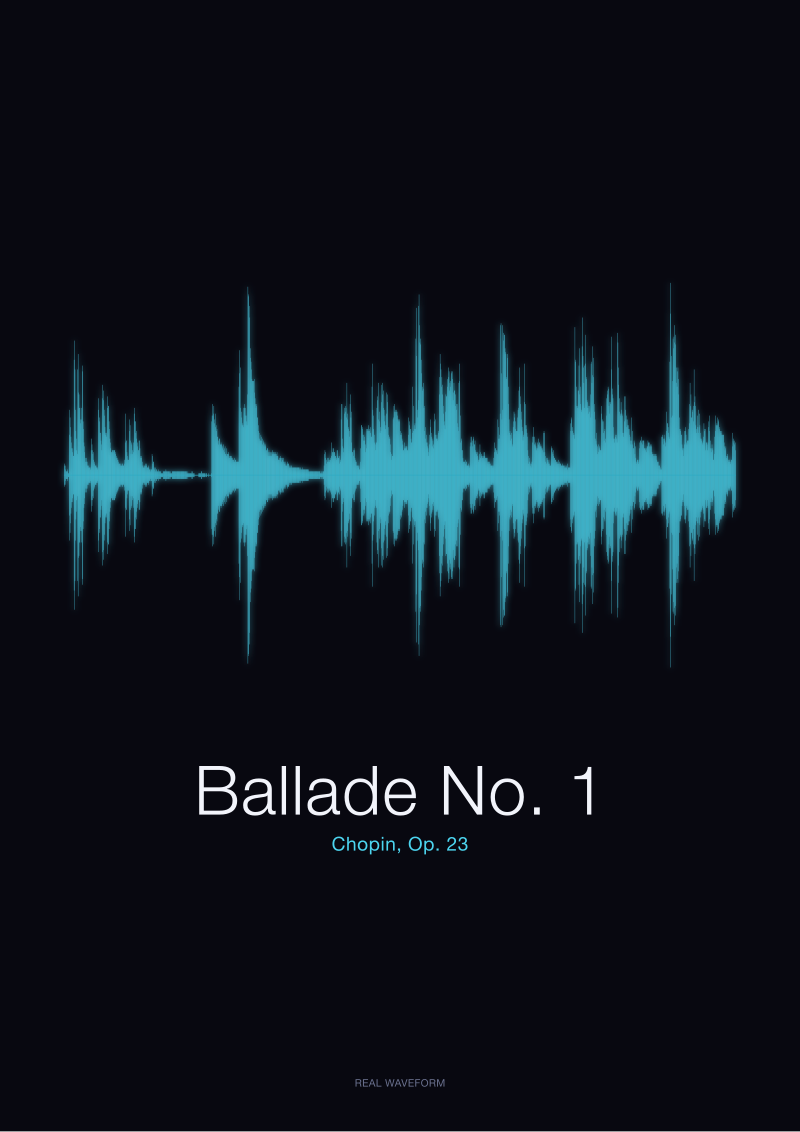
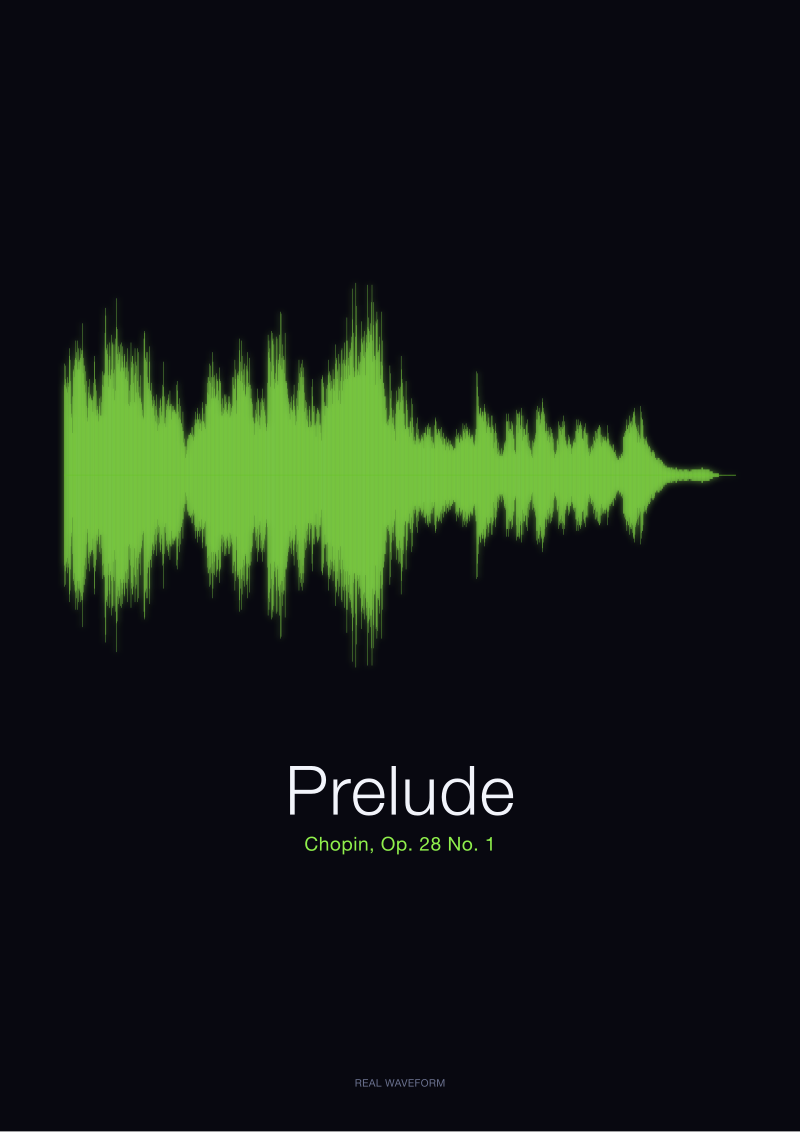
We render from real audio files. When the source is a public-domain recording of Chopin's Op. 23 pulled from the Musopen archive, we do not touch the amplitude envelope. What comes out is not a stylised curve tuned to look pretty above a mantelpiece. It is the actual pressure of air on a microphone, plotted honestly, sample by sample, from the first breath before the opening chord to the last hall reverberation after the closing one. The composer wrote the notes. The performer wrote everything else, and everything else is what the waveform draws.
That distinction matters because customers arrive with an intuition trained by streaming platform album art and by the identical-looking waveforms scattered across gift-shop posters. Those decorative curves are procedural. They repeat because they were generated to. Ours do not repeat because they were not. The Ballade No. 1 waveform is the shape of one specific performance of Op. 23, taken from one specific archive file, at one specific sample rate, with one specific pianist's rubato and pedal work and breath baked into every millisecond of amplitude. Play a different performance and the silhouette shifts across its entire timeline. The broad architecture — the four ballade-shaped arches, the closing coda's cliff — will be legible in both. Nothing beneath that architecture will be shared.
Why the Attack Alone Is a Fingerprint
Every note begins with an attack. An attack is the moment amplitude climbs from silence to something audible. It happens in milliseconds and it is where identity lives.
Consider a single spoken word. When we render *Bonjour* — a locally generated macOS speech-synthesis file we use as a reference original signal — the waveform shows a sharp rise on the plosive, a slack middle for the vowel, and a soft trailing hiss. When we render *Ciao*, from the same reference set of locally generated speech, the attack behaves differently: the initial consonant closes down instead of exploding, and the vowel opens broader. Two short words, two different silhouettes, and neither is an interpretation choice. It is what the mouth did. Change the mouth and you change the waveform. The physics does not negotiate.
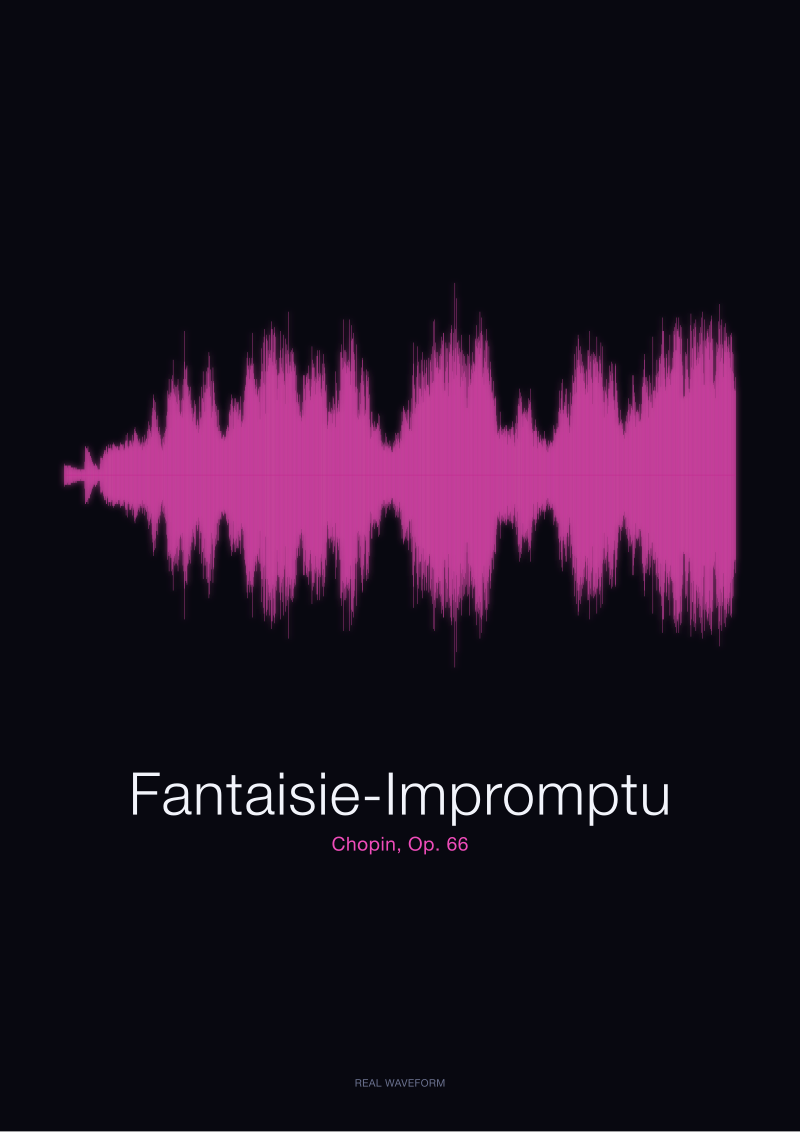
The piano is a mouth with eighty-eight tongues. A pianist's attack on the first octave of Chopin's Fantaisie-Impromptu, Op. 66, is a single physical act that includes finger weight, key velocity, hammer travel, string response, soundboard resonance and the room's first reflection off the lid. All of that arrives at the microphone in the first few milliseconds and it prints as a specific slope on the amplitude curve. Another pianist's attack on the same first octave of the same opus number will produce a different slope. Not slightly different in a way you have to squint at. Structurally different, in a way that a ruler laid across the two silhouettes will not resolve.
Multiply that by every note in the piece and you have already exceeded the amount of variance the score can constrain. A Chopin ballade has thousands of attack events. Each one is a fingerprint. The waveform is the sum of all those fingerprints, printed left-to-right on a timeline.
The score tells the pianist which notes; the waveform tells you which pianist.
 Ballade No. 1
The print from this article · from €29.95
View the print →
Ballade No. 1
The print from this article · from €29.95
View the print →
Rubato Is Not a Feeling, It Is a Geometry
Rubato is what happens when time is not a metronome. In prose we call it expression; in a waveform it is horizontal.
Look at any real amplitude rendering of the Ballade No. 1 and you will see peaks that do not sit where a strict-tempo count would put them. They sit where the pianist chose to put them, which is often earlier or later by a few tens of milliseconds, sometimes by more. That displacement is not decorative. It is geometrically load-bearing. Two peaks separated by a beat that the score counts as identical will, in one performance, sit closer together and, in another, further apart. This is what rubato does. It stretches the horizontal axis in and out of alignment with the vertical amplitude, without asking the score for permission.
The consequence is that the silhouette's timeline is unique to the take. The famous opening figure of Op. 23 does not last a fixed number of seconds. It lasts as long as the pianist made it last. Even the same pianist recording the same piece a week later will not reproduce the exact spacing of the earlier take. Their fingers do not have that precision, and even if they did, they would not want it. Rubato that reproduces to the millisecond has stopped being rubato and started being a metronome.
The Fantaisie-Impromptu, Op. 66, is instructive here because its central section is nominally the same tempo indication across recordings and yet the amplitude peaks land in visibly different horizontal positions when you compare renderings from different performances. Same opus, same section, same composer's instruction — and the waveforms disagree about where the beats are, because the recordings disagree about where the beats were. Rubato is why. When we hand a customer a print of one recording, we are handing them the geometry of one performer's decisions about time. Nobody else's would print the same shape.
The Room Is in the Waveform Whether You Like It or Not
A recording is not a piano. It is a piano plus a room plus a microphone plus a chain of gain stages plus a file format. Every one of those elements leaves a signature.
The room decides how quickly a note decays into silence. A dry studio prints attacks with steep vertical rises and sharp falls; a resonant hall prints the same attacks with visible trailing amplitude that only fades over what would look, on the waveform, like a long slope. This is not editorial addition. It is physics. Sound in a resonant space bounces off surfaces and returns to the microphone late, and that late arrival is amplitude the microphone records. The waveform includes it because the recording includes it.
The microphone decides which frequencies get through cleanly. A close-mic'd piano prints the hammer strike prominently; a room-mic'd piano prints more air, more soundboard, more decay tail. Two microphones on the same performance would produce two different waveforms of that performance. We are not rendering the microphone, but the microphone is inside the file we are rendering, and it cannot be removed.
Then there is the chain of decisions the recording engineer made about level, compression and mastering. Two masterings of the same source take will produce different amplitude envelopes. One might squash the dynamic range so the loudest and softest passages sit closer together. Another might preserve the full dynamic range so the ballade's whisper-quiet openings sit near the horizontal axis and the climactic passages spike close to the ceiling. Both are honest. Both are also different silhouettes.
The Musopen recordings we work from are public-domain files that have already been through a specific chain of these decisions. When we render Op. 23 from that archive, we are drawing the shape of that specific mastered file — pianist, room, microphone, engineer, decade all included. Another public-domain source of the same opus, mastered elsewhere, would draw a shape that is recognisably the same architecture and unrecognisably the same detail. This is why a waveform is not a picture of a piece. It is a picture of a recording.
 Fantaisie-Impromptu
The print from this article · from €29.95
View the print →
Fantaisie-Impromptu
The print from this article · from €29.95
View the print →
So What Do You Actually Do With That
If you have arrived here because you want to gift someone the shape of a specific recording, the practical answer is: choose the recording, not the piece. The distinction is not academic. When you ask us to render Chopin's Ballade No. 1, we cannot give you a canonical Ballade shape because none exists. We can give you the shape of the Musopen public-domain performance of Op. 23, or the shape of your own audio file if you own one, or the shape of a specific commercial recording that you licence separately. Each choice produces a different silhouette. Each silhouette is the true silhouette of that source and no other.
If you are gifting a recording that carries meaning — a wedding processional, a piece a parent used to play, a spoken message like the *Bonjour* or *Ciao* we hold in our reference set — the waveform's honesty is the point. You are not printing a decorative curve that vaguely evokes music. You are printing the actual pressure of that actual air on that actual microphone at that actual moment. That is why the silhouette matters. It is a receipt of a specific event, and it will not match the receipt of any other event, ever.
The next question — the one this piece is not the place to answer — is which recording of a beloved piece you should choose when several exist. That is a listening question, not a rendering question, and it is where the real work of gifting begins. A silhouette will faithfully draw whichever recording you hand us. The choice of which one to hand us is where the meaning is made, and it is a decision that belongs to the person doing the gifting, not to the studio doing the drawing. Our shop holds the pieces we render from public-domain sources. What you build with them, and around them, is yours.
From the collection
New pieces and 10% off your first print.
One email now with your code. No noise after.