The Polonaise Héroïque is not, on paper, a loud piece. Hear us out. It is a piece that becomes loud in specific, locatable seconds, and the rest of its shape sits closer to a nocturne than most listeners remember. We know the family resemblance because we render Chopin from real recordings on this desk — the Ballade No. 1, Op. 23; the Fantaisie-Impromptu, Op. 66; the public-domain Musopen collection at archive.org/details/musopen-chopin — and every Chopin waveform teaches the same lesson twice. What feels overwhelming in the ear is often quiet ink on the page, punctuated by a few unforgettable spikes.
The reputation of the piece — heroic, martial, the horses-and-banners cliché — comes from a handful of gestures the memory then paints across the whole score. Ask a listener how loud the Polonaise is and they will describe it as consistently thunderous. Draw the waveform and the same listener will point to three or four places and say, oh, right, it lives there. The rest is architecture around those moments.
That gap between remembered loudness and drawn loudness is the whole subject of this piece. It is also the reason we find Chopin, of all composers, the most rewarding to render. He writes drama with an economy that only becomes visible when you stop listening and start looking.
The Chords Are Not Loud; They Are Sudden — And Suddenness Is a Shape
Amplitude is not the same thing as drama, and Chopin knew this before there was a word for the distinction. What the ear registers as overwhelming is often a matter of contrast, not volume. A chord that would sound merely emphatic in the middle of a Liszt étude sounds thunderous in a Chopin polonaise because of what precedes it — a passage that has spent itself down to something close to silence, or a texture so evenly rippled that any interruption reads as a rupture.
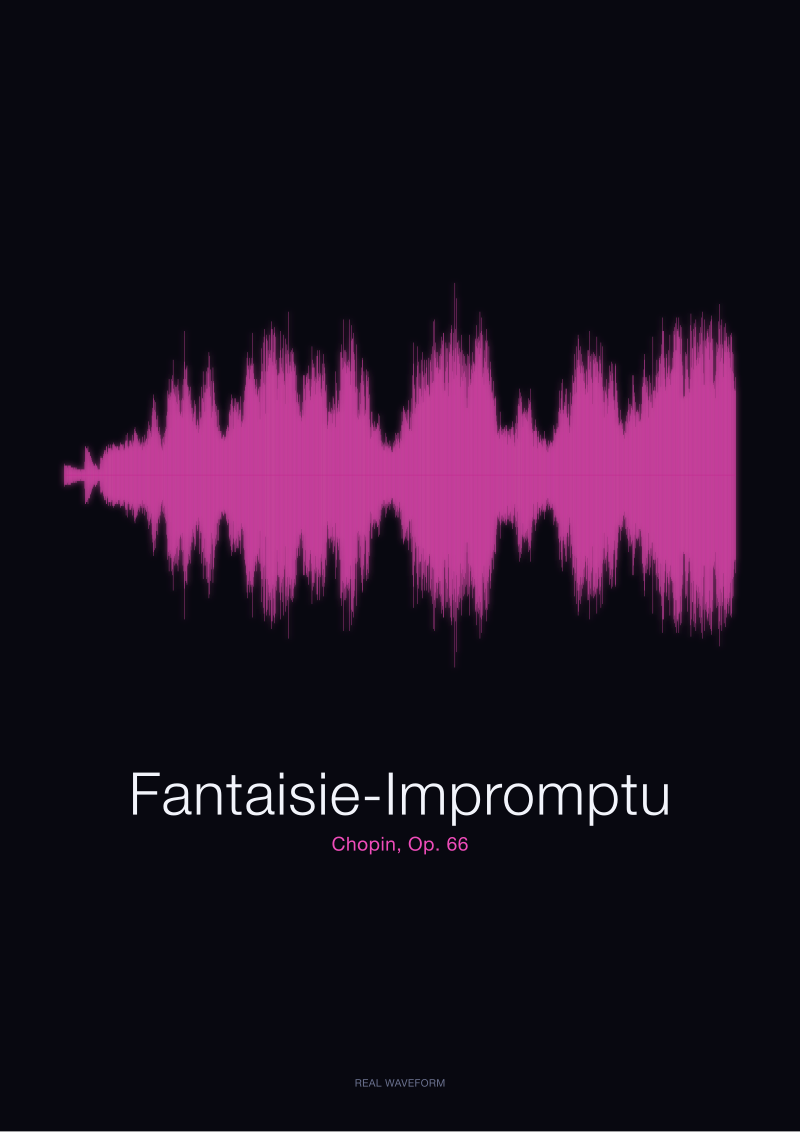
On a waveform this shows up as a shape you can name without hearing the recording. A long stretch of low, dense amplitude — the kind of steady figuration Chopin uses to build tension — then a vertical column that reaches near the ceiling of the frame and disappears within a fraction of a second. It looks like a comb tooth. It looks like something dropped from above and struck the baseline. In the Fantaisie-Impromptu, Op. 66, when we render the public-domain recording from the Musopen archive, the same rhetorical figure appears in miniature: the right-hand cascade sets a certain average height, and any accent that breaks that average by more than a factor or two reads, visually, as an event.
The Polonaise Héroïque uses this device on a larger scale, and it uses it more deliberately. The famous chordal passages — the ones the memory paints across the whole piece — are not held. They are struck and released. On paper they are narrow. In the ear they feel wide because what follows them is often a caught breath, a bar of thinner texture that lets the reverberation dominate the room before the next gesture starts. The drama is in the geometry of the transition, not in the height of the chord itself.
This is the first thing anyone learning to read waveforms should absorb, and Chopin is the composer who teaches it most clearly. Amplitude tells you how much air was moved, not how much a listener will remember. A pianissimo passage after an unexpected silence can register more sharply in the mind than a fortissimo that has been telegraphed for eight bars. The waveform draws the physics. The listener supplies the memory.
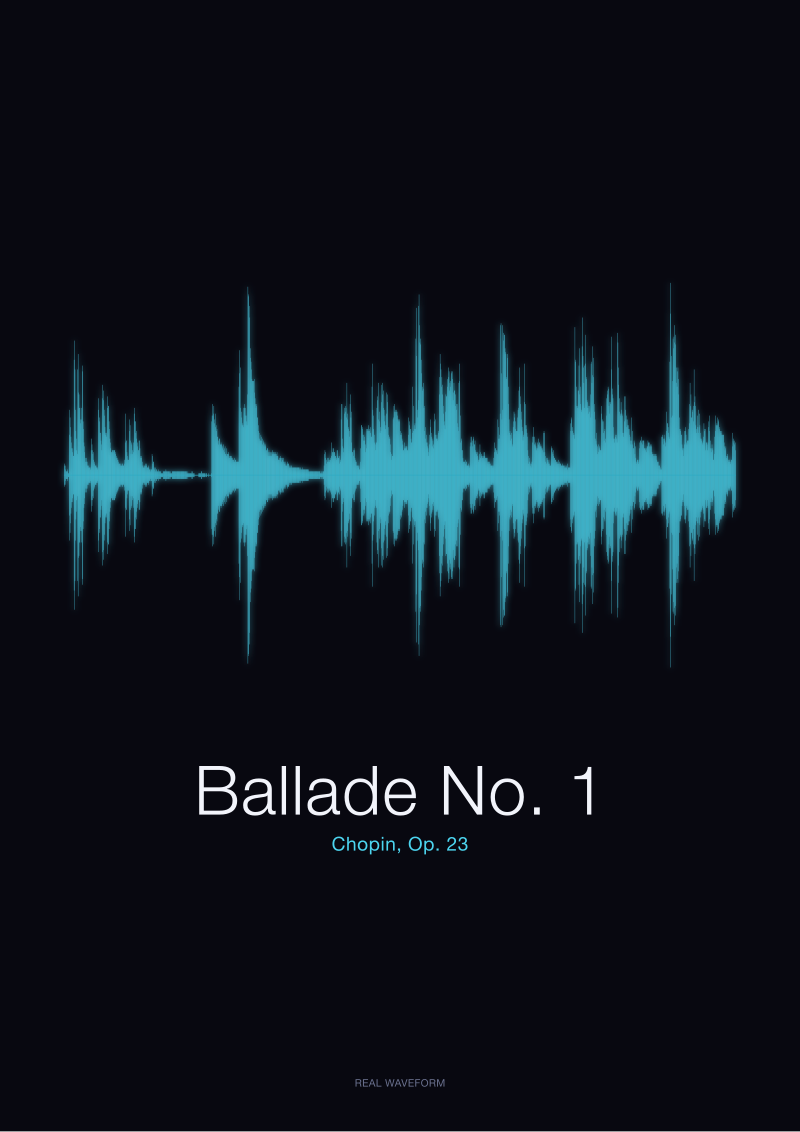
If you laid the Polonaise Héroïque next to the Ballade No. 1 on the same axis — same recording engineer, same normalisation — the two shapes would surprise most people who love both pieces. The Ballade, remembered as lyrical, would show taller sustained sections than the Polonaise in many bars. The Polonaise, remembered as heroic, would show more empty air between its events than any listener expects. What differs is not the loudness. It is the punctuation.
Rubato Draws Shoulders, Not Straight Lines
The second reason the Polonaise Héroïque looks dramatic on paper is that no two performances of it produce the same shape, and the differences are not small. Rubato — the elastic pulling and pushing of tempo that Chopin's music invites and, in truth, demands — is invisible in a score and unmistakable in a waveform.
A metronomic performance of a rhythmically insistent piece produces a shape with straight sides. The events line up on a grid; the amplitude peaks fall at predictable intervals; the eye can almost anticipate where the next one will be before it appears. A rubato performance produces something else entirely. The peaks lean. They cluster and then thin out. A phrase that on paper is four bars of equal length becomes, in the waveform, a compressed group of three events and then a lingering fourth. The shape develops shoulders.
We see this most clearly when we render two different public-domain recordings of the same Chopin piece side by side. The score is identical. The waveform is not. In one recording, the descending figure that closes a phrase resolves inside a hundredth of a beat of where the previous phrase resolved. In another, it takes almost twice as long. On the drawing this reads as a broadening — the same amplitude, but stretched horizontally, so the eye reads it as gentler and heavier at once.
The Polonaise Héroïque, being a dance form worked into a concert piece, invites this stretching more than most of Chopin's writing. The dance is announced by the rhythm — the accent pattern that gives the polonaise its walk — and then the concert composer keeps interrupting the dance, pulling against it, letting the pianist decide how long the pull is allowed to last. Every serious pianist who records this piece makes different decisions in those moments, and every set of decisions produces a different silhouette.
This is one of the reasons we are careful, on this desk, to call our prints portraits of a recording rather than portraits of a piece. The Polonaise Héroïque, as a set of notes on a page, does not have a single shape. It has as many shapes as there are recordings of it, and the differences between those shapes are not decorative. They are the whole reason we listen to more than one performance.
There is a related point that only becomes obvious once you have looked at enough of these renderings. The most dramatic waveforms are almost never the ones from the most virtuosic performances. Speed compresses shape. A player who takes the Polonaise faster than the ear can comfortably follow flattens the peaks and thins the shoulders. A player who takes the same passages slower, with more air between the events, produces a drawing with more visual drama, not less. On paper, restraint reads as intensity. On paper, the pianist who leaves more silence is the pianist whose shape carries further across the room.
 Ballade No. 1
The print from this article · from €29.95
View the print →
Ballade No. 1
The print from this article · from €29.95
View the print →
The Left Hand Is the Drum You Can See in the Waveform
The third source of visible drama in the Polonaise Héroïque is the least glamorous and the most consistent. It is the left hand. The famous octaves — the pounding descending pattern in the middle section that every listener remembers as the piece's engine — are the single most legible rhythmic feature in the whole Chopin waveform catalogue we have rendered.
Here is why. Most of Chopin's left-hand writing is what a rendering algorithm reads as texture. Broken chords, arpeggiated figures, waltz basses that keep the pulse without ever really breaking through the amplitude ceiling. On a waveform these register as a low, even carpet under the right-hand melody. You can see the melody in the peaks. The left hand is felt, not drawn.
The octave passages in the Polonaise Héroïque break this convention with an insistence that borders on rude. They are not accompaniment. They are a second voice with equal claim on the amplitude budget, and when a performer commits to them fully the waveform shows two parallel lines of peaks — one from each hand — that occasionally align and occasionally do not. The visual effect is percussive in a way Chopin almost never allows himself elsewhere in the piano writing. It looks, on paper, like someone has taken a snare drum figure and drawn it under the melody in a slightly different colour.
Compare this to the Ballade No. 1, Op. 23, which we have rendered from the Musopen collection more than once. The Ballade's most emotionally direct moments produce beautiful, sculpted waveforms — swelling and receding, with sustained shapes that the eye reads as breath. What the Ballade almost never produces is the parallel-lines effect. The left hand there is a supporting architecture, not a competing voice. The Polonaise, in its central octave passages, is one of the few places in Chopin's mature output where the two hands agree to fight for the same visual space, and the waveform records the fight honestly.
This is also, incidentally, why the Polonaise is so hard to render tastefully as a print. The peaks are so dominant that they threaten to swallow the rest of the piece's shape. When we produce a Polonaise Héroïque waveform for the studio's shop at /shop/, we spend a disproportionate amount of time deciding how much of the quieter architecture to keep visible around those spikes, because the whole point of the drawing is that the piece is not only its loudest moments. It is loudest moments in a specific relationship to everything else, and that relationship is what a good print preserves.
The listener who wants to understand why the Polonaise Héroïque feels the way it feels should look, not just listen. Put the recording on. Watch the shape build up. Notice where the eye is drawn and where it rests. The dynamics that feel so dramatic in the concert hall are, on the page, a conversation between three things: a chord that arrives without warning, a rubato that bends the horizontal axis, and a left hand that briefly refuses to be background. Everything else the memory adds is the listener's own contribution to the drama.
This piece started as an attempt to explain, in a paragraph or two, why one Chopin work sounds louder than another, and it turned into something closer to a defence of quiet passages as the true source of loud ones. We did not set out to write about restraint. We set out to write about spikes. But the more waveforms of the Polonaise we look at, the more it becomes clear that the spikes are only interesting because of what surrounds them, and the writing kept drifting toward the surroundings until they became the argument.
FAQ
What is the Polonaise Héroïque and why is it called heroic?
It is one of Chopin's late polonaises for solo piano, in A-flat major, and the "heroic" label is a nickname the listening public applied rather than a title Chopin chose himself. The name attached because of the piece's martial character — the striding rhythms, the octave passages that suggest cavalry — and it has stuck for over a century. On this desk we treat the nickname as a description of received memory, not of the score.
Is the Polonaise Héroïque actually louder than other Chopin works?
Not consistently, and this is one of the things a waveform makes obvious. The remembered loudness comes from a small number of extremely direct gestures — the chordal announcements, the octave passages in the middle section — surrounded by writing that is often no denser than a nocturne. Compared bar-for-bar against the Ballade No. 1 or the Fantaisie-Impromptu, the Polonaise's average amplitude is lower than most listeners assume.
Why do different recordings of the Polonaise Héroïque look so different as waveforms?
Because rubato — the flexible timing that Chopin's music requires — changes the horizontal shape of every phrase. Two performances of identical notes will produce peaks in different places, cluster events differently, and leave different amounts of empty air between gestures. The vertical amplitude may be similar; the silhouette almost never is. This is why we describe our prints as portraits of a specific recording rather than of the piece itself.
What makes the middle section's octaves so visible on a waveform?
Chopin's left hand is usually textural — arpeggios and broken chords that read as a low, even carpet on the drawing. The Polonaise Héroïque's central octave passages break that convention by giving the left hand a percussive, competing voice. On the waveform this shows up as two parallel lines of peaks, one from each hand, that occasionally align. It is one of the few places in mature Chopin where the two hands share the visual foreground equally.
Can you tell how "dramatic" a performance is by looking at its waveform?
You can tell where the drama lives, but not always how much of it there is. Fast, virtuosic performances tend to compress the shape and flatten the peaks; slower, more restrained performances often produce more visually striking silhouettes because they leave more empty space between events. The reading eye responds to contrast the way the ear does. Restraint frequently draws better than speed.
Where can I hear the recordings your Chopin prints are rendered from?
The Chopin waveforms we render on this desk come from public-domain recordings in the Musopen collection, hosted at archive.org/details/musopen-chopin. The Ballade No. 1, Op. 23 and the Fantaisie-Impromptu, Op. 66 are among the pieces we work from most often. We only render from recordings we can point to by URL, because the print is a portrait of a specific performance, not a stylised curve.
Why does the article call the Polonaise "closer to a nocturne" in shape?
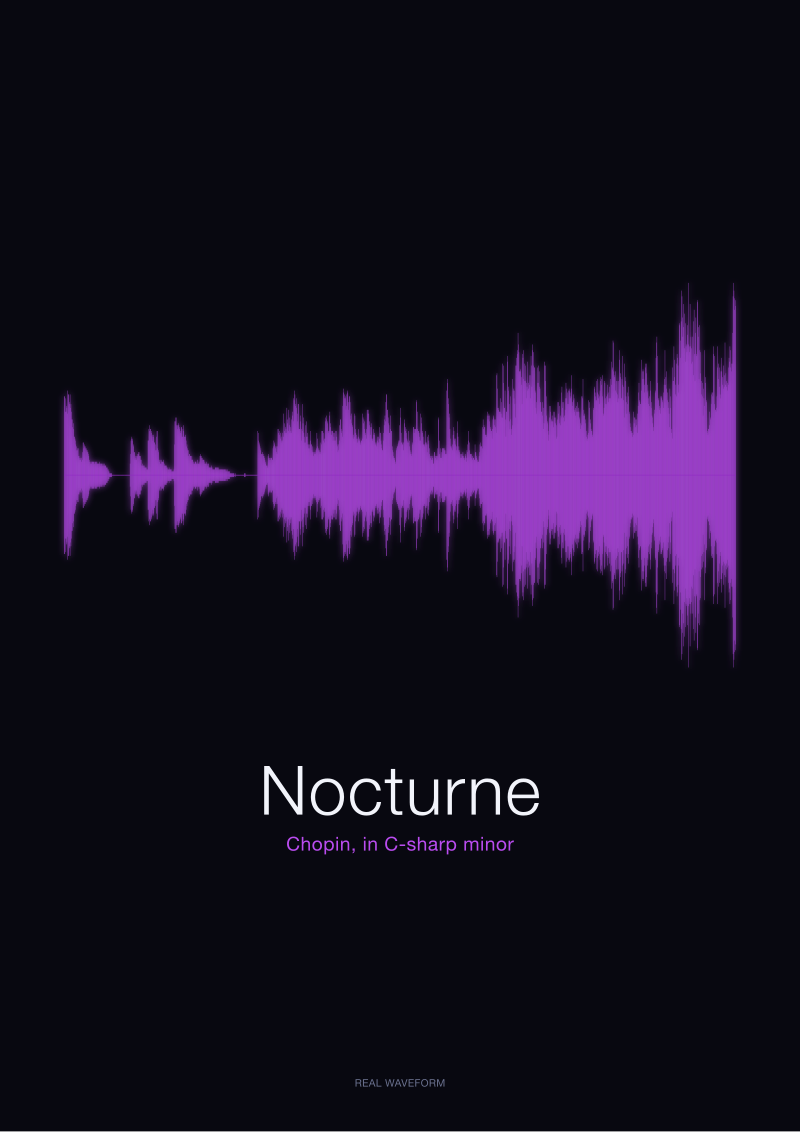
Because outside of its most famous gestures, the Polonaise Héroïque spends long stretches at amplitude levels that are visually comparable to Chopin's nocturnes. The reputation of the piece is built on a handful of seconds; the surrounding architecture is quieter than the memory suggests. Placing a Polonaise waveform beside a nocturne waveform, at the same scale, is one of the more instructive comparisons we can offer a listener who wants to understand what dynamics actually look like.
 Fantaisie-Impromptu
The print from this article · from €29.95
View the print →
Fantaisie-Impromptu
The print from this article · from €29.95
View the print →
From the collection
New pieces and 10% off your first print.
One email now with your code. No noise after.