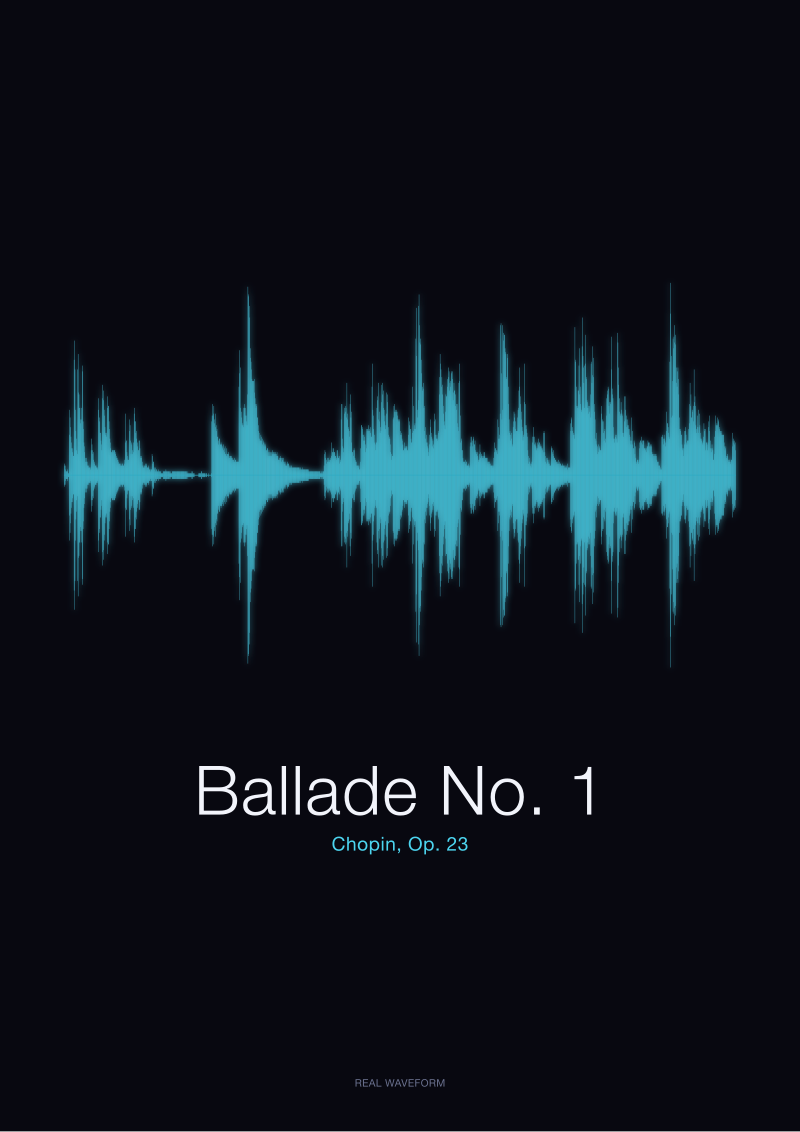
Ask us what a Ballade No. 1 print shows and the honest answer is: it depends who is looking. The drawing on the paper is fixed — the real amplitude waveform of a public-domain recording of Chopin's Op. 23, taken from the Musopen Chopin collection on archive.org and rendered from the actual audio, not a decorative curve. What changes is the reader. The same silhouette carries a different story for someone who hears the piece in their head, someone meeting it for the first time, and someone whose hands remember it. Three scenarios, one shape.
Before we walk through them, one thing worth setting down. A waveform is not a mood chart. It is a drawing of air pressure over time. Where the line is thin, the room was close to silent. Where the line swells, the air moved harder against the microphone. That is all it is, physically. Everything the eye adds on top — narrative, memory, ache — arrives from the reader, not the paper. The Ballade No. 1 silhouette is the same silhouette in every scenario below. The three sections that follow are three different acts of reading.
Scenario 1: The Listener Who Knows the Piece by Ear
Imagine someone who has lived with the Ballade for years. Picture a person who could hum the second theme in the shower without missing an interval, who knows exactly the moment the coda tips over the edge and turns into something the hands can barely hold. For this reader the print does not introduce the piece. It confirms it.
What they see, first, is the introduction. A short, low utterance — the recitative Chopin opens with, that curious moment of the piece thinking out loud before it decides to begin. On the paper this reads as a compact figure early in the drawing: modest amplitude, a small statement, then a hesitation. The reader recognises the hesitation without being told. They know that after the recitative the piece settles into the first theme, a moderate, questioning statement that does not raise its voice. In the waveform this corresponds to a long stretch of measured, mid-height activity — not quiet, not loud, a conversational middle register that fills most of the paper.
Then the reader's eye moves to the middle of the drawing and finds the second theme, the tender one, the melody people who have never played the piece still recognise from films and cafés and other people's playlists. In a waveform this section shows a different texture: the line breathes in longer arcs, with more space between peaks. Amplitude is not the same as beauty, but the eye reads calm here because calm is what the recording contains.
And then the coda. Every listener who knows this piece is waiting for the coda. On the print it is unmissable: the tallest sustained region of the entire drawing, dense with vertical activity, the paper suddenly full where a few centimetres earlier it had been half-empty. The reader knows what those centimetres sound like — the descending octave runs, the presto con fuoco marking, the whole architecture of the piece collapsing into a final argument. Seeing it drawn is a small shock of recognition. They already knew the coda was the loudest thing in the piece. They just had never seen it proven.
For this reader the print works as a map of an interior they already possess. The value is not discovery. The value is that the interior is now shareable — hung on a wall, pointed at, explained to a guest who asks what the strange dark cluster on the right-hand side is.
Scenario 2: The Gift-Giver Who Has Never Heard It
Now picture a different person. Someone who has been told — by a partner, a parent, a friend — that Chopin's Ballade No. 1 is the piece. That it was played at a wedding, or during a long recovery, or on the night something important was decided. The gift-giver has heard the name. They have perhaps clicked play on a recording once, dutifully, to see what all the fuss was about, and let it wash past without settling. They are not the person the music belongs to. They love the person the music belongs to.
For them the print does something the audio file cannot. It converts a piece of music they do not personally hear into a piece of design they can personally read. The silhouette becomes a portrait of a thing they know matters to someone they love, without requiring them to feel about that thing what the beloved feels. That is a real problem gifting a recording usually has — a Spotify link is not an object, an MP3 is not a possession, and forcing yourself to develop opinions about a piece someone else adores is a strange kind of emotional labour. The print sidesteps all of it. Here is the shape of the thing you love. I paid attention to it. I made it a thing you can look at.
What this reader sees, technically, is the same drawing the first reader saw. But their eye reads it differently. They notice the long middle section without knowing it is the first theme. They notice that the drawing is thin at the beginning and thick near the end, and they think, correctly, that the piece must build. They notice the density of the coda without knowing what a coda is. They intuit an arc. That intuition is actually right — the Ballade does build, does thicken, does end louder and denser than it begins.
The print, in other words, teaches them a small true thing about a piece of music they had held only as a name. When the person who loves the piece unwraps it and starts explaining — that is the recitative, that is the second theme, that is where it goes off the cliff — the gift-giver has a scaffold to hang the explanation on. The paper becomes a shared object. The music, previously a private country, admits a visitor.
 Ballade No. 1
The print from this article · from €29.95
View the print →
Ballade No. 1
The print from this article · from €29.95
View the print →
Scenario 3: The Pianist Who Has Played It
The third reader is the one whose hands remember. Picture someone who studied the Ballade — maybe in a conservatory, maybe as an adult amateur working through it slowly for years, maybe as a teenager who never quite got the coda clean. For them the piece is not a memory of listening. It is a memory of a specific muscular problem.
This reader looks at the print differently again. They do not first see themes. They first see difficulty. The dense right-hand region of the drawing is not, for them, the beautiful terrifying coda that a listener recognises. It is the exact bar range where the left hand crosses over, where the octave figure has to stay articulate at speed, where the pedal choices get argumentative. They read the print backwards from the technique.
There is something honest about a waveform for this reader, which decorative music prints do not offer. A stylised swirl of ink shaped like a treble clef is a pretty object; it does not correspond to anything they actually did. A real amplitude waveform of a real recording corresponds precisely to seconds they spent, notes they played, moments in the score where their teacher stopped them. The width of the coda region on the paper is proportional to how long that region takes in the recording, which is proportional to how long it took them to learn. The line is a receipt.
They also notice something the other two readers miss. Between the loud sections there are stretches where the drawing is quieter than the eye expects. A pianist knows those stretches — the transitions, the moments where the piece pretends to calm down before the next surge. In listening they can be missed. On paper they are unmistakable: pockets of thinness inside an otherwise full drawing. The pianist reads those pockets as breath, as recovery, as the room being allowed to settle before the next argument starts. They are what makes the coda land. Without them the loud parts have nothing to be loud against.
For this reader the print is a private diagram of work done. Not sentimental. Precise.
What All Three Share
Three readers, three different acts of attention, one drawing. What is the same across all three?
First: the drawing is not a metaphor. It is a direct rendering of the recording — the CC0 Musopen Chopin file, the actual audio, sampled and mapped to amplitude without smoothing, without decoration, without adjustment to make it look prettier than it sounded. This matters because the reader in every scenario is looking at truth of a particular kind. Not aesthetic truth, not emotional truth — physical truth. The paper says: on this day, this room, this microphone, this pianist, this piece made air move in exactly this pattern. Every viewer, whatever they bring, is looking at that.
Second: the drawing is mostly quieter than people expect. Ballade No. 1 has a reputation for its ending. The coda is the meme. But the coda is a small percentage of the piece by duration, and a waveform makes this ruthlessly visible. Most of the paper is not thunderous. Most of the paper is a piece thinking, hesitating, singing at conversational amplitude, holding its breath. The three readers all confront this quietly — the coda's shock only works because the piece spends most of its length not shocking anyone. Silence, or near-silence, is what the loud parts are loud against.
Third: the drawing invites a specific kind of noticing. It is not busy the way a photograph is busy. It has no faces to skim, no colours to sort. The eye that lands on it slows down, because the only thing to do is trace. In all three scenarios the reader traces — front to back, left to right, thin to thick to thin to thick again. Tracing is a slower form of attention than listening. It is closer to reading a sentence than to hearing a song.
Which Scenario Is You
If you are buying this print for yourself and you already know the piece, you are the first reader. What you will get is a map of an interior you already possess, made shareable — the private country of the Ballade, hung where guests can ask about it.
If you are buying it for someone else and the piece is theirs, not yours, you are the second reader. What you will get is a way to honour a thing you do not personally feel, without pretending. The paper does the loving on your behalf.
If you played the piece, or are playing it now, you are the third reader. What you will get is a receipt for hours of your own life. The dense region on the right is the region you worked hardest on. That is not sentimental. That is just what the drawing is.
The Ballade No. 1 print lives in the studio's shop at /shop/, rendered from the CC0 Musopen recording described above. The drawing is the same in every copy. Which story it tells depends on the wall it hangs on and the person walking past.
This piece has stayed inside the shape of the drawing and what three readers do with it. It has not addressed the biographical circumstances of Chopin's Op. 23 or the disputed narrative programmes attached to it — that is a musicology argument and not a studio one. It has not compared different recordings of the Ballade to each other, because the print in question is rendered from one specific public-domain file and comparing performances is a separate exercise. And it has not walked through the physics of how a digital audio file becomes a printable waveform in technical detail. Each of those is its own conversation.
From the collection
New pieces and 10% off your first print.
One email now with your code. No noise after.