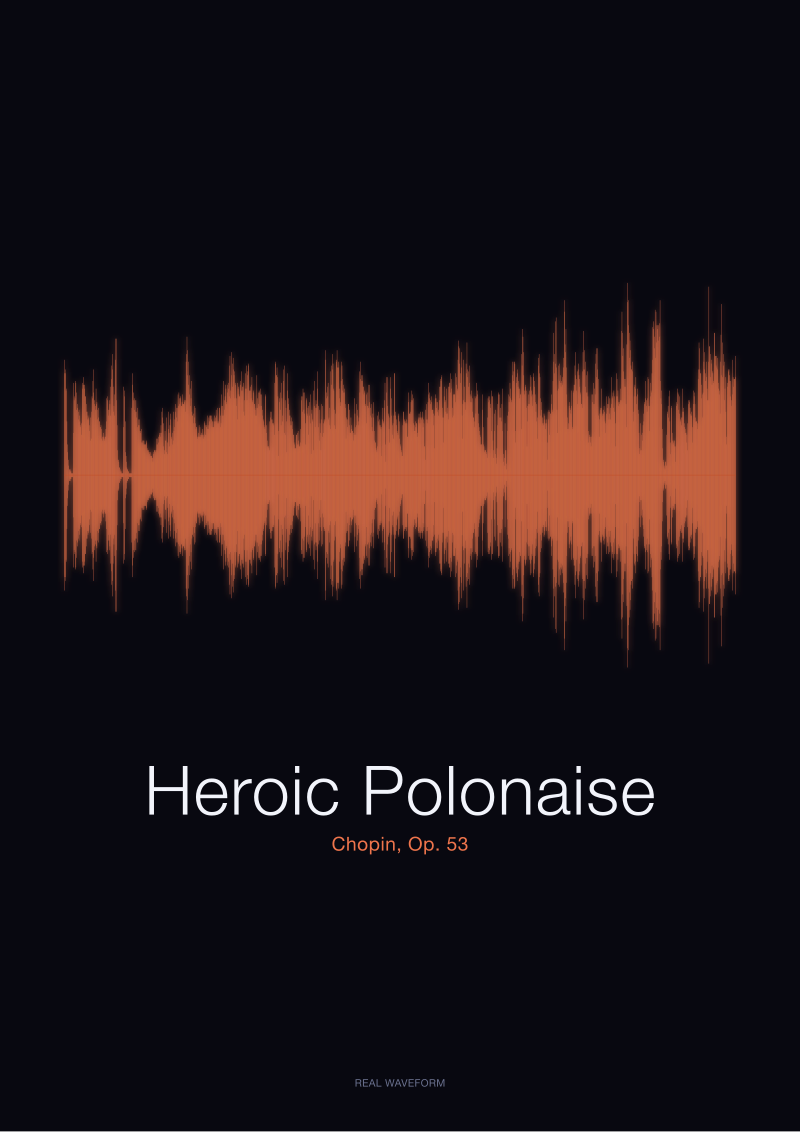
Most people think a waveform of the Heroic Polonaise is a decoration. Hear us out. The print on our wall is the real amplitude waveform of a public-domain (CC0) recording of Chopin's Op. 53, rendered from the actual audio — every ridge is a struck chord, every valley a rest, every long swell a held pedal. Reading it is a small skill, and like any small skill it goes faster when you route yourself through the right questions. This piece is a flowchart in prose form: three questions, then a table that tells you what you are actually looking at.
Question 1: Are You Looking at the Whole Piece, or a Single Passage?
This is the first fork because it changes what the print can possibly tell you. A waveform of the whole Heroic Polonaise compresses several minutes of piano into a single horizontal strip. Every second of audio becomes a narrow slice of that strip. When the piece is long and the strip is fixed in width, individual notes stop being visible — they fuse into a texture, and what you read instead is the overall architecture of the performance.
A single passage, drawn at the same physical width, is a completely different object. Now each second gets more room. Individual chords separate. The gap between a struck bass octave and its echo becomes a visible interval, not a smear.
Why the question matters: readers who try to find a specific chord in a whole-piece print get frustrated, because the print was never meant to answer that question. Readers who want to feel the arc of the whole piece and stare instead at a passage lose the architecture. Match the object to the question.
If Yes — You Are Looking at the Whole Piece
Read for architecture. Look for the tall plateaus where amplitude sits high for long stretches — those are the marching, chordal sections everyone associates with the Polonaise, hammered on repeatedly with the sustain pedal down. Look for the quieter dips between them — the lyrical episodes where Chopin lets the left hand thin out. The famous octave passage, when it arrives, will read as one of the densest stretches on the entire print: a solid, dark, evenly filled block, because the pianist is producing sound almost continuously with very little empty air between notes.
Do not try to locate individual chords. At whole-piece scale, they do not exist as visible marks. What exists is the shape of the performance's stamina.
If No — You Are Looking at a Single Passage
Now the print is closer to a diary of individual gestures. A single opening chord shows as a narrow, tall vertical spike — the attack — followed by a slower taper as the sound decays under the pedal. The next chord starts as another spike layered on top of that decay. In a passage print of the opening bars, you can count strikes if you know where to look.
Read for gesture: which chord was hit hardest, how long the pianist let it ring, where the hands lifted. This is the print that rewards standing close.
Question 2: Do You Want to Read Dynamics, or Rhythm?
A waveform encodes both, but not equally well, and readers frequently look for one when the print is showing them the other. Dynamics live in the vertical dimension of the drawing — how tall the ridges are. Rhythm lives in the horizontal — how the ridges are spaced along the timeline.
Why the question matters: the Heroic Polonaise is a piece with big dynamic swings AND a signature rhythm. If you know which axis you are questioning, you stop confusing loud with fast. A quiet passage played rapidly can look, at a glance, similar to a loud passage played slowly — until you separate the axes.
If Yes to Dynamics — Read the Vertical
Amplitude is the vertical thickness of the wave at any given point. In Op. 53, the dynamic range is large: from the near-whispered lyrical middle episode to the fortissimo of the great octave section. On the print, this shows as a wave that visibly widens and narrows across its length. The thickest points are the loudest moments of the performance.
A subtlety: amplitude is not emotion. A softly played passage can still be full of tension; the print will show it as narrow. Do not read a slender waveform as "the sad part" — read it as "the quiet part". Sadness in music often lives in harmony and phrasing, neither of which a waveform draws.
If Yes to Rhythm — Read the Horizontal
The polonaise as a dance form has a specific rhythmic identity: a stately triple meter with a characteristic accent pattern in the left hand. In a passage print with enough horizontal resolution, that pattern becomes visible as regularly spaced peaks along the time axis. You are seeing the pulse of the dance drawn out as evenly repeated marks.
At whole-piece scale, individual beats blur — but the ripple of a consistent rhythmic engine underneath still faintly shows as texture, the way a woven fabric looks different from a smooth one even at arm's length.
 Heroic Polonaise
The print from this article · from €29.95
View the print →
Heroic Polonaise
The print from this article · from €29.95
View the print →
Question 3: Are You Reading the Recording, or the Score?
This is the question most listeners forget to ask, and it is the one that decides whether the print will match what you expect. The waveform is not a picture of Chopin's manuscript. It is a picture of one pianist, on one day, in one hall, playing that manuscript. Everything about the performance — tempo choices, rubato, pedaling, the microphones, the room — is baked into the shape.
Why the question matters: if you approach the print expecting the piece as an abstract musical object, you will be puzzled by asymmetries that seem "wrong". They are not wrong. They are what actually happened. A slightly longer silence before the return of the main theme is the pianist breathing. A slightly softer restatement is an interpretive choice. The waveform is the record, not the intent.
If Yes — You Are Reading the Recording
Then accept the print as a document. Two recordings of Op. 53 produce two different shapes; the ridges align in broadly the same places, because the notes are the same, but the exact heights, the exact spacing, the exact tails all belong to that specific performance. This is why our studio only draws from real audio: the print inherits authorship from the performer, not just the composer.
For the Heroic Polonaise we work from a public-domain recording in the Musopen Chopin collection, released under CC0 and mirrored on archive.org. That specific recording is what the shape on the print refers to — a different pianist would leave a different silhouette of the same music.
If No — You Wanted the Score
Then you wanted a different object entirely, and this is worth saying out loud. Sheet music encodes instructions; a waveform encodes what happened when someone followed them. The two overlap but never coincide. If your interest is the composition — the structural blueprint of Op. 53 — a waveform is the wrong drawing to consult, and no waveform print will ever be. It will always be a portrait of a performance, not of a piece.
If You Answered Everything: The Reading Map
Cross the three questions and you get eight possible reader profiles. Each one wants something slightly different from the same print. The table below gives one concrete recommendation per combination.
| Q1: Whole Piece? | Q2: Dynamics? | Q3: Recording? | Recommendation |
|---|---|---|---|
| Yes | Yes | Yes | Read the tall plateaus as the loud chordal sections; treat the print as this specific performance's dynamic map. |
| Yes | Yes | No | You want dynamics of the score itself; a waveform cannot give you that — read a marked edition instead. |
| Yes | No | Yes | Read horizontal texture as the polonaise pulse; expect blur at note level, clarity at section level. |
| Yes | No | No | Consult the score for rhythm as written; the whole-piece waveform shows rhythm as felt, not as notated. |
| No | Yes | Yes | Stand close; count vertical spikes as struck chords and read decay tails as pedal choices. |
| No | Yes | No | A passage waveform is still a performance artefact; for dynamic markings, use the printed music. |
| No | No | Yes | In a passage print, individual beat spacing is visible; read it as the pianist's rubato, not a metronome. |
| No | No | No | You are looking for notation; the shop is not the right destination — a music library is. |
The table also doubles as a diagnostic when a print does not "feel right" to a viewer. Nine times out of ten, the mismatch traces back to one of these three questions being answered silently and wrongly.
What the Studio Actually Draws From Op. 53
For the Heroic Polonaise print in our shop, the source is the CC0 recording from the Musopen Chopin collection, hosted at archive.org/details/musopen-chopin. Public-domain, no restrictions, no rights issues, credited in the print's metadata. What we do to that audio is the smallest possible operation: we sample the amplitude at regular intervals and translate each sample into a vertical position along the horizontal timeline. The line between those points is the wave.
There is no beautification. There is no smoothing that lies. There is no invented curve added because a section "should" look more dramatic. If the recording has a moment where the pianist holds silence a beat longer than expected, the print holds that silence too — as a visible thinning of the wave, a small piece of white space cut into an otherwise dense stretch. Reading it back later is like reading a fingerprint of that specific take.
Op. 53 is generous to this kind of drawing because it has extremes. The middle section's murmuring left hand looks entirely different, at print scale, from the octave passage. A viewer standing across the room sees the architecture immediately — where the piece breathes, where it climbs, where it hammers. A viewer standing close reads the smaller vocabulary: attacks, tails, silences.
This piece does not cover the notation of Op. 53 itself — bar counts, key signatures, the harmonic analysis Chopin scholars have written libraries about. It does not compare specific recorded performances or make any claim about which reading is best; the waveform is a portrait of one, not a ranking of many. And it does not go into the audio-engineering weeds of sample rates, bit depth, or how the studio's rendering pipeline runs. Each of those is a separate conversation, and each of them shapes future pieces from this desk. If you want to see the Heroic Polonaise as a shape rather than read about it as one, our /shop/ carries the print drawn from the recording described above.
FAQ
Is the waveform on the print a real drawing of the audio, or a stylised illustration?
It is a real amplitude waveform derived from the actual audio file, not a decorative curve drawn to look like one. Every vertical position on the line corresponds to a measured sample of the recording at that point in time. The studio does no cosmetic smoothing that would falsify the shape. If the performance holds a silence, the print holds it too. What you are looking at is a faithful geometric portrait of the specific take, not an artist's impression of what a polonaise "should" look like.
Which recording of Op. 53 does the studio use?
For the Heroic Polonaise print, the source is a public-domain recording from the Musopen Chopin collection, released under CC0 and mirrored on the Internet Archive at archive.org/details/musopen-chopin. CC0 means no rights encumbrances and no attribution required — though we credit the collection anyway in the print's metadata. A different recording of the same piece would produce a different waveform, because tempo, dynamics, pedaling and room acoustics all belong to the specific performance.
Can I identify a specific chord or bar in the whole-piece print?
Usually not at whole-piece scale. When several minutes of piano are compressed into a fixed-width strip, individual notes fuse into a broader texture and single chords stop being visibly distinct. What you can read at that scale is architecture: which sections are loud, which are quiet, where the piece climbs and rests. To find individual chords or count strikes you would need a passage print of the specific bars, where each second of audio gets much more horizontal room to expand.
Why do quiet passages look thin instead of "sad"?
Because a waveform draws amplitude, not emotion. Thin means quiet — the recorded sound at that moment had low volume. Sadness in music generally lives in harmony, melodic contour and phrasing, none of which a waveform depicts. A tender, melancholy passage played softly will read as a narrow section of the print; a joyful passage played just as softly will look exactly the same on paper. Reading a waveform means reading loudness and timing, and leaving interpretive meaning to your ear.
Do two prints of the same piece look identical if they use different recordings?
No. The broad structure will rhyme — the same piece has the same score, so the loud sections tend to fall in the same places — but the exact heights, spacings, decays and silences differ from performance to performance. This is why we describe each waveform print as a portrait of a recording rather than of a composition. If you compare our Heroic Polonaise print to a waveform generated from a different pianist's take, you will see the family resemblance and the individual signature at the same time.
What does the "attack" of a chord look like on the print?
An attack shows as a sharp, near-vertical rise in the wave — a narrow spike where the sound goes from nothing to full amplitude very quickly, because the hammers have just struck the strings. What follows depends on pedaling and note length: a pedaled chord decays slowly, so the spike tapers into a long, thinning tail rather than falling straight back to zero. A dry, un-pedaled chord decays fast and the tail is shorter. In passage prints, these attack-plus-tail shapes are the alphabet of what you are reading.
Is the print useful for someone who cannot read sheet music?
Yes, and arguably more so. A waveform is not notation and does not require musical literacy to appreciate; it is a visual document of sound. You do not need to know what a polonaise rhythm looks like written down to see the regular pulse in the print, or to notice that one stretch of the piece is louder and denser than another. The print speaks the vocabulary of shape, silence and swell, which is available to any viewer with eyes.
From the collection
New pieces and 10% off your first print.
One email now with your code. No noise after.