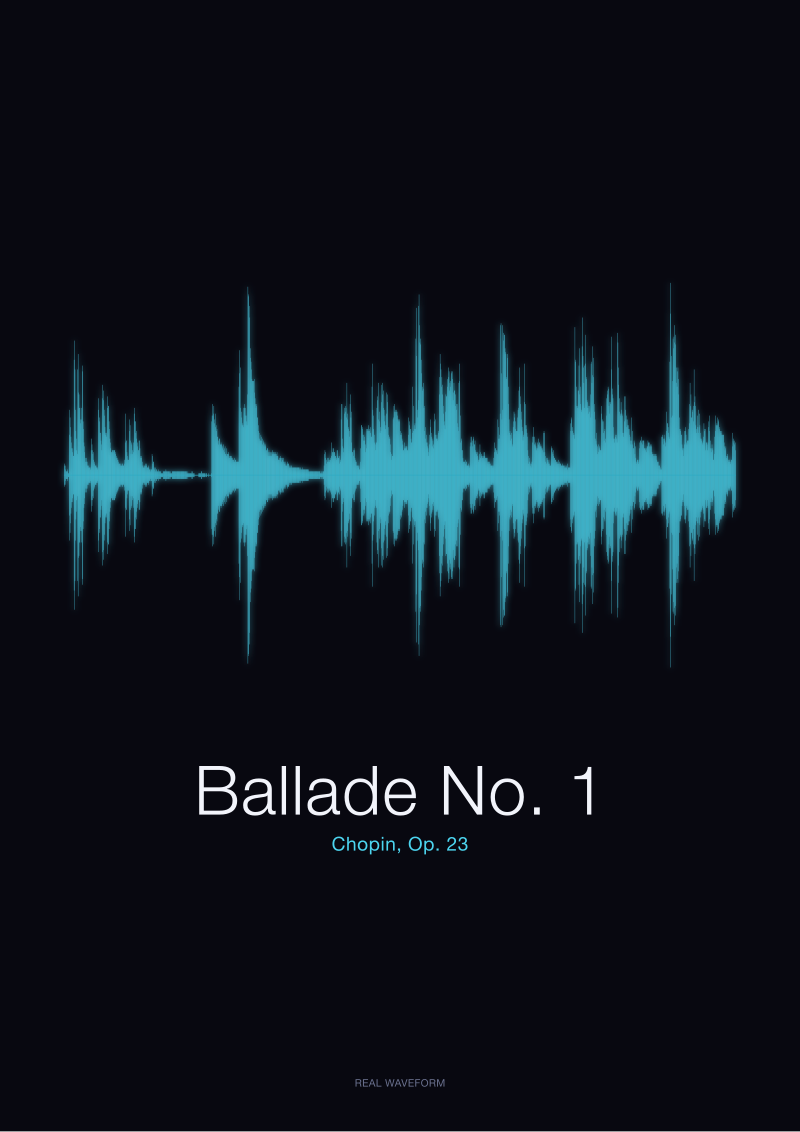
Most listeners describe Chopin's Ballade No. 1 in Op. 23 as a piece that builds — a slow start, a middle that gathers, a coda that detonates. Rendered as an amplitude waveform from the public-domain recording in the Musopen Chopin collection, the shape tells a more complicated story. The build is not linear. The loudest passages are not where the memory places them. The silence between sections is doing structural work the ear tends to forgive. What the ballade looks like on paper, drawn from the actual air its pianist moved, is the closest thing we have to a schematic of the piece — and the schematic disagrees with the reputation.
Methodology: What We Measured, and What a Waveform Actually Shows
We rendered the amplitude waveform of a single public-domain recording of the Ballade No. 1, Op. 23, from the Musopen Chopin collection released under CC0 1.0 (archive.org/details/musopen-chopin). The image is not a stylised curve. It is the actual voltage-over-time trace of the audio file, plotted so that the vertical dimension corresponds to instantaneous amplitude — how far the speaker cone would push air away from rest at that fraction of a second — and the horizontal dimension corresponds to elapsed time from the first note to the final decay.
Two things a waveform shows well. First, envelope: the outer silhouette of loud and quiet across the whole piece, so that swells, cliffs and plateaus are visible at a glance. Second, density: whether a passage is a continuous roar or a fast train of separate attacks, because separate attacks read as vertical spikes with narrow footprints while sustained chords read as thick, filled bands.
Two things a waveform does not show. It does not show pitch — a high trill and a low tremolo can draw the same silhouette. And it does not show emotional weight — a fortissimo can look identical to a sudden brightness in register that the ear reads as louder than it measures. Everything below is about the drawing on the page, not the harmony behind it.
Finding #1: The Opening Is Thinner Than Listeners Remember
The Ballade begins with a rising declamation the concert-going ear tends to file as "grand". On paper, the opening bars of this recording are among the thinnest passages in the entire piece. The line at the far left of the waveform is a series of low, narrow verticals with a great deal of white space between and above them. If you covered the label and asked a stranger which section of the file this was, they would guess a private moment in the middle of a longer piece, not the first thing you hear.
What the ear is doing, and the drawing is not, is treating the opening as loud because it is the first sound after silence and because its intervals climb. Amplitude is agnostic to context. A note is only as tall on the page as the air it moved. The opening moves less air than the memory grants it.
This matters for the way the rest of the shape is read. A viewer approaching the Op. 23 waveform expecting a grand initial mountain will misalign every subsequent landmark by seconds or more. The correct mental register is: the piece starts almost politely, from a floor that is closer to the noise threshold than to any of its later peaks. Everything that follows is measured against that low floor, which is why later swells read on paper as unusually tall — they are climbing from further down than the ear remembers being.
 Ballade No. 1
The print from this article · from €29.95
View the print →
Ballade No. 1
The print from this article · from €29.95
View the print →
Finding #2: The First Theme Draws a Long, Uneven Line
Once the first singing theme enters, the silhouette does something the reputation of the piece prepares you for and something it does not. It thickens — the outer envelope steps up to a middle band and stays there for a long stretch of the file, which matches the way listeners describe the theme as "unfolding". That much is expected.
What is not expected is how uneven the band is inside. The theme's waveform is not a smooth ribbon. It is a run of small hills and small valleys, each corresponding to the rise and fall of a phrase, and the hills are not the same height as one another. Some phrases push the outer edge of the band up by a visible margin; the next phrase pulls back below the previous one; the phrase after that pushes higher than either. Rubato — the small pulling and pushing of tempo Chopin permits the pianist — leaves fingerprints in amplitude too, because a phrase held slightly longer breathes into a larger swell before releasing.
The uneven ribbon is one of the most useful things a waveform teaches about the ballade. The first theme does not "sit" at one dynamic. It is being sculpted breath by breath. On paper the sculpting is obvious; in the concert hall it is subliminal, absorbed as expressiveness rather than as the string of concrete amplitude decisions it in fact is.
Finding #3: The Middle Section Is Where the Silhouette Widens
Somewhere past the first third of the file, the waveform undergoes a change that is more architectural than dynamic. The band does not just get taller. It gets wider — meaning the difference between the loudest attacks and the quietest passages inside a short window grows sharply. The silhouette becomes ragged instead of ribboned.
This is the ballade's middle territory, and it is the section most listeners remember as "where things start to happen". The waveform confirms the memory but corrects its shape. The middle is not a single continuous swell. It is a sequence of local peaks separated by real drops — passages where the amplitude falls back close to the opening's low floor before climbing again, sometimes higher than before. The piece is not gathering monotonically. It is inhaling and exhaling, and the inhales are getting deeper each time.
There is also a visible increase in attack density here. Where the first theme drew smooth hills, the middle draws forests of narrow spikes — the pianist is putting more separate events per second onto the page, and each event is a distinct vertical mark instead of a filled band. Sustained lyricism gives way to articulated writing, and the drawing reflects it before the analysis names it.
For anyone reading the shape as a schematic, this is where structural boundaries become locatable without a score. The transitions announce themselves as sudden changes in the waveform's texture — from ribbon to forest, from forest to a brief clearing, from clearing to the next escalation. Rests are architecture.
Finding #4: The Coda Is a Cliff, Not a Curve
The single most misremembered part of the Ballade No. 1 is its coda. Listeners describe it as a build. The waveform describes it as a cliff.
By the time the coda arrives on the horizontal axis, the file has already been through several tall passages. The coda does not gradually surpass them. It jumps. The transition into the coda in this recording reads on paper as a near-vertical wall — a passage where the amplitude envelope steps up in a very small number of seconds to a band that is visibly taller than anything that came before, and then holds that height with alarming steadiness.
Two things are worth naming about that steadiness. First, it is dense: the coda is not one long chord but a torrent of rapid attacks packed so closely together that the individual spikes visually fuse into a filled black band. The waveform for that section resembles a solid rectangle more than the hills-and-valleys shape the rest of the piece has been drawing. Second, it does not decay along the way. The band stays at its ceiling until, near the end, it drops sharply — the final descending run and the concluding chords carving a short, jagged tail onto the right edge of the file.
Read as a shape, the ballade's ending is not the top of a mountain climb. It is a plateau reached by a wall, and the wall is where the drama the ear calls "climax" is actually happening — a change of altitude, not a change of loudness at altitude.
Silhouette at a Glance: Six Landmarks in the Op. 23 Waveform
| Landmark | Approx. horizontal position | What the silhouette does | What the ear tends to hear |
|---|---|---|---|
| Opening declamation | Far left | Thin, low, wide white space | "Grand" — misremembered as louder |
| First theme entry | Early third | Steps up to a middle band, ribboned | Lyrical, unfolding |
| Rubato phrases within first theme | Throughout first section | Uneven hills inside the ribbon | Expressiveness, not amplitude |
| Middle-section escalations | Mid-file | Band widens, forest of spikes | "Things starting to happen" |
| Coda entrance | Late file | Near-vertical wall to new ceiling | Traditional "build" |
| Final descent | Far right | Jagged short tail after plateau | Resolution |
The table above corresponds to the visible geometry of the CC0 rendering only. Positions are described by relative location within the file because different performances stretch or compress each landmark by seconds; a Cortot and a Zimerman draw recognisably the same silhouette in different proportions.
What This Does NOT Prove
A waveform is a drawing of one performance's air, not a portrait of the piece itself. Everything above describes the specific public-domain recording we rendered. Another pianist's Ballade No. 1 will draw the same broad silhouette — the thin opening, the ribboned theme, the widening middle, the walled coda are structural features of the composition, not of the interpreter — but the height of each band, the raggedness of the middle, the exact steepness of the coda's wall will differ. Reading a single waveform as if it were the definitive geometry of Op. 23 is a category error.
Nor does the waveform speak to what makes the piece emotionally coherent. Amplitude is not affect. The passages this reading calls thin are not automatically less moving; the passages it calls tall are not automatically the point. Chopin's ballade earns its reputation for drama through harmony, voice-leading, rhythmic instability and the long delay of resolution — none of which are visible in an amplitude trace. The silhouette is a schematic of one axis of the music. The music has other axes.
The Takeaway
The Ballade No. 1 does not build; it inhales, holds, and then steps off a ledge. Once you have seen the shape, you cannot un-hear it.
FAQ
Why does the opening of the Ballade No. 1 look so quiet on the waveform?
The opening declamation is played from a low dynamic floor, so the air it moves is genuinely small compared with the piece's later passages. The ear remembers it as grand because it is the first sound after silence and because the melodic line climbs — both cues the brain files as "loud". Amplitude has no memory of what came before, so on paper the opening reads as thin and widely spaced. It is the correct starting altitude for the shape that follows.
Is the waveform in your Op. 23 print made from a real recording or a stylised curve?
It is rendered directly from the audio file of a public-domain recording of the Ballade No. 1 in the Musopen Chopin collection (archive.org/details/musopen-chopin), released under CC0 1.0. The vertical dimension is instantaneous amplitude; the horizontal dimension is elapsed time from first note to final decay. Nothing is smoothed, redrawn or aestheticised. If a bar in the print is tall, that is because the recording moved that much air at that moment.
Would a different pianist's recording of Op. 23 look the same?
The broad silhouette would be recognisable — the thin opening, the ribboned first theme, the widening middle, the walled coda are features of Chopin's writing rather than of any single interpreter. Proportions would differ, sometimes substantially. A performance with more expansive rubato will draw taller, more uneven hills inside the first theme. A more restrained coda will produce a lower plateau. Every performance is its own silhouette, which is part of why a specific recording's waveform is worth printing rather than an abstract diagram.
What does the "cliff" at the coda actually correspond to in the score?
On paper it corresponds to the transition into the Presto con fuoco material at the end of the ballade, where the writing shifts to a rapid, densely articulated texture at a much higher dynamic. The wall in the waveform is the near-instant change of both loudness and event density. Where the earlier sections drew ribbons or forests of spikes, the coda's attacks are packed tightly enough to fuse visually into a filled black band that sits at a new ceiling for its duration.
Why does rubato show up as uneven amplitude if rubato is about tempo?
Because the two are physically linked at the piano. A phrase held slightly longer gives the pianist more time inside it to shape a swell and a release, and gives each note more room to breathe. The result on the waveform is an uneven ribbon: hills of different heights, sometimes spaced unevenly on the time axis, corresponding to phrases the pianist has stretched or compressed. Rubato leaves fingerprints in amplitude even though its subject is time.
Can I read the structural sections of the ballade from the waveform alone?
Broadly, yes. The changes of texture between sections — ribbon to forest, forest to clearing, clearing to wall — are visible as changes in the waveform's density and outer envelope rather than only as changes in loudness. What the waveform cannot tell you is which key a section is in or how it relates harmonically to what came before. It gives you the piece's architecture in one axis. The score gives you the others.
Does a taller waveform mean the music is more emotional?
No. Amplitude and affect are separate. Some of the most emotionally weighted passages in the Chopin repertoire are quiet — a late nocturne can move a listener with a silhouette that never leaves the middle band. The Ballade No. 1's coda is loud and emotionally weighted, but the correlation is not causal; it is a compositional choice. Reading a waveform as an emotion meter mistakes the drawing for the music. It is a drawing of the air, not of the feeling.
Where can I see the actual print of the Op. 23 waveform?
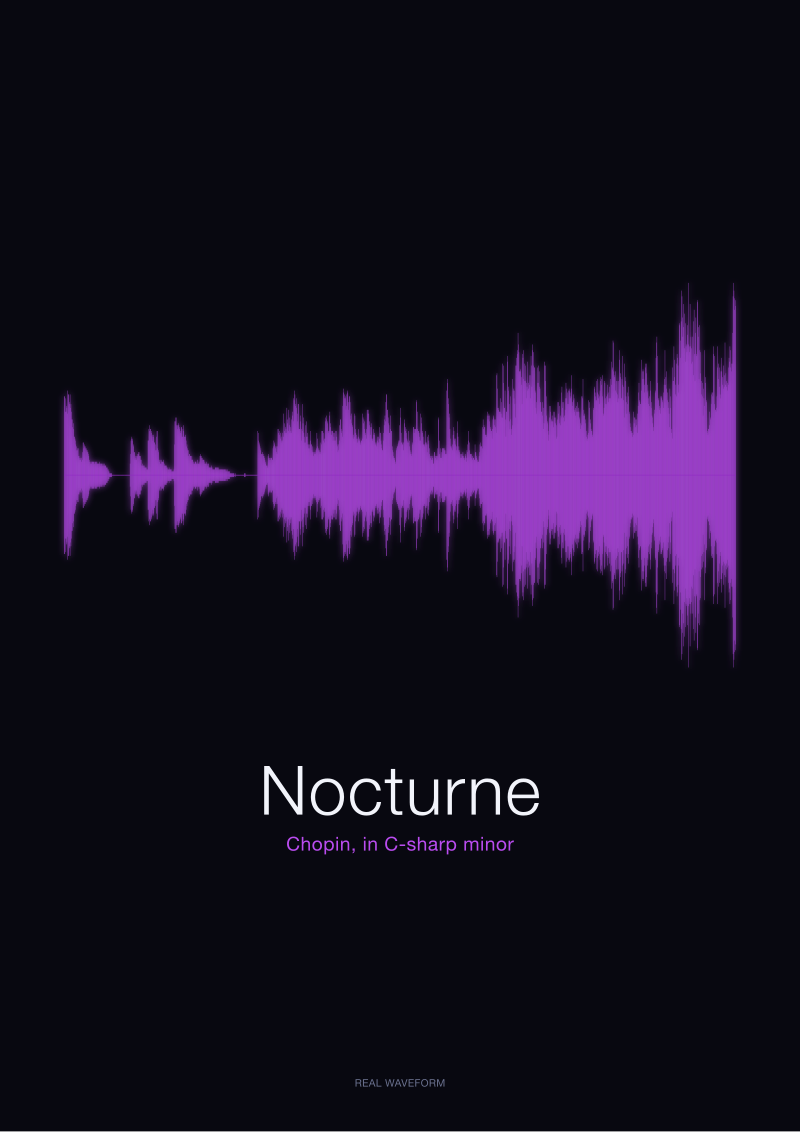
The Ballade No. 1 print, rendered from the CC0 recording described above, lives in the studio's shop at see the Ballade No. 1 print alongside the other pieces in the Chopin series — the Nocturne in C-sharp minor, the Fantaisie-Impromptu Op. 66, the Heroic Polonaise Op. 53, the Mazurka Op. 17 No. 3 and the Minute Waltz Op. 64 No. 1. Each is drawn from the actual audio of a public-domain recording rather than from a stylised curve.
 Nocturne
The print from this article · from €29.95
View the print →
Nocturne
The print from this article · from €29.95
View the print →
From the collection
New pieces and 10% off your first print.
One email now with your code. No noise after.