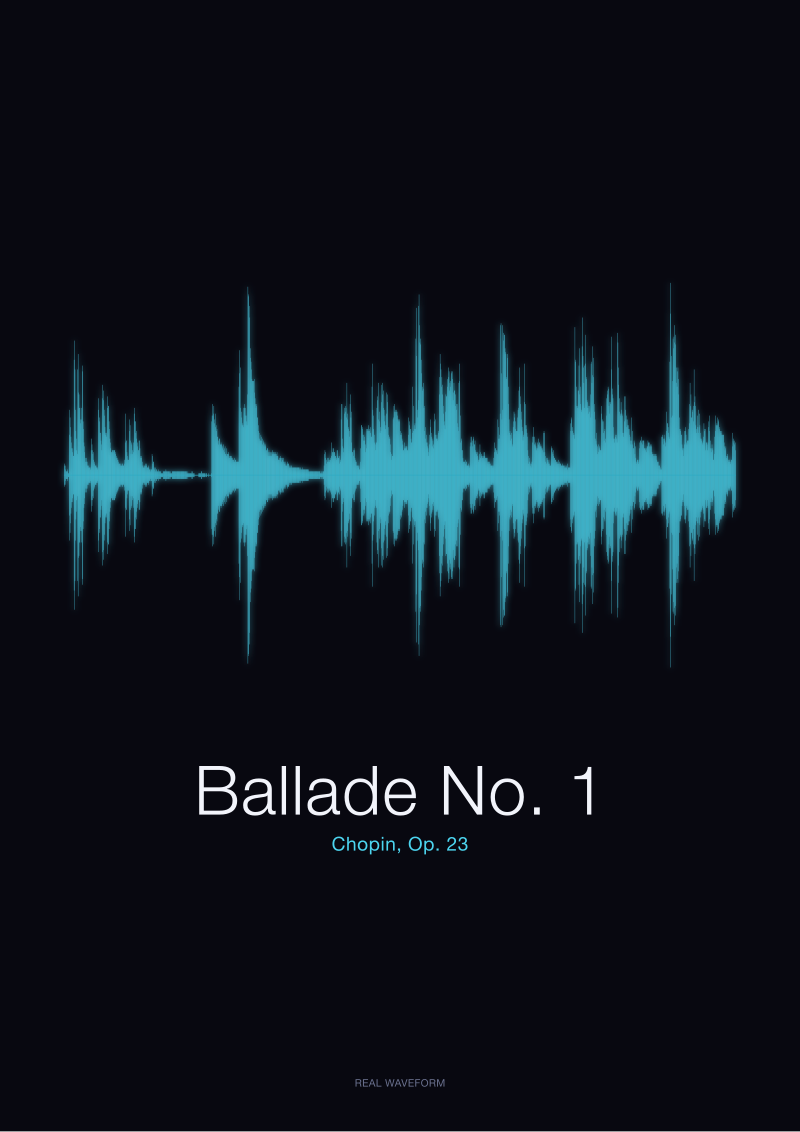
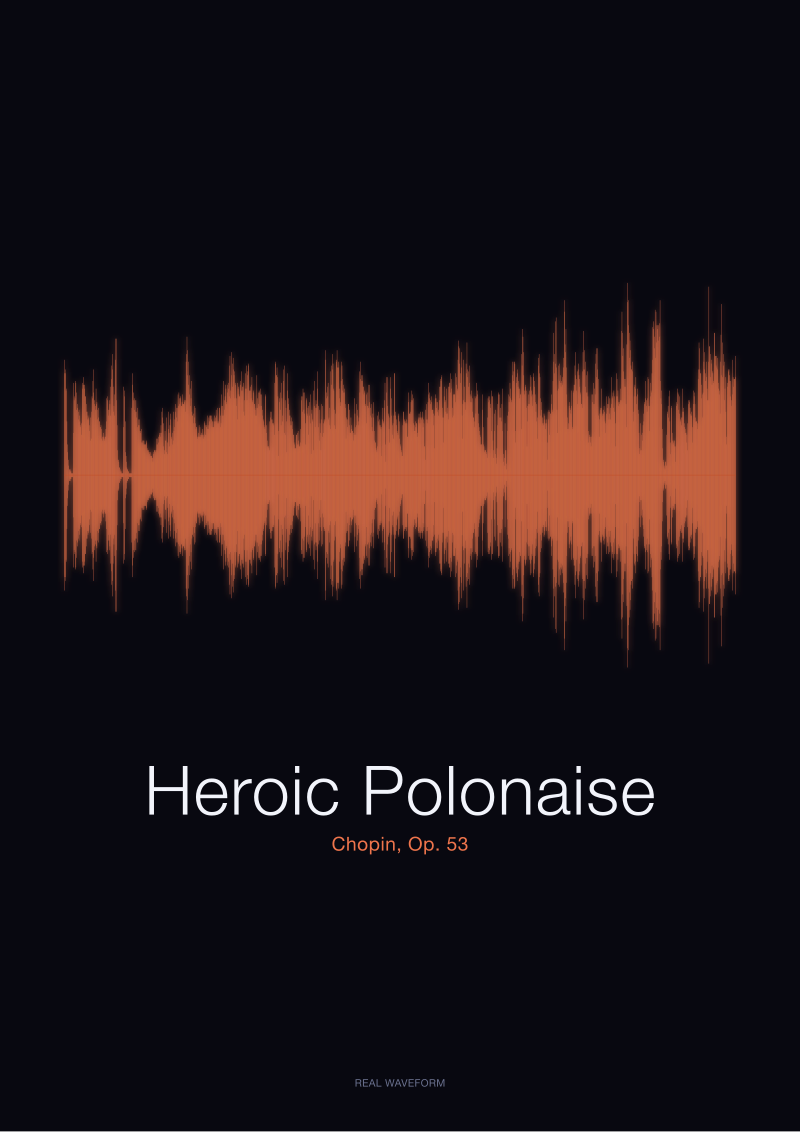
Two Chopin waveforms sit side by side on the studio wall. The Ballade No. 1, Op. 23, drawn from a public-domain recording in the Musopen Chopin collection, and the Heroic Polonaise, Op. 53, drawn from the same archive. Both are real amplitude, not decoration — the actual audio, rendered. At a distance they look like two different weather systems: one that gathers, one that marches. This piece is a flowchart in prose. We will ask three questions about how you want to see a peak, and route you between the two shapes.
Question 1: Are You Reading for the Silhouette or the Single Peak?
Every waveform has two things worth reading. There is the silhouette — the overall envelope, the pattern of loud and quiet across the whole length of the piece. And there is the single peak — the one vertical line that reaches higher than any other, the moment the recording is loudest. These are not the same question, and they route to different pieces.
The Ballade No. 1 lasts roughly nine to ten minutes in most public-domain recordings of it. The Heroic Polonaise is shorter, generally six to seven. That difference matters before we say anything else. A longer piece has more horizontal space in the print; a shorter piece concentrates its shape. When you decide which one you want to look at, you are also deciding how the eye should travel.
If Silhouette
Choose the Ballade No. 1. Its shape is the more interesting silhouette of the two, because the piece is dramatically structured around long stretches of quiet punctuated by controlled swells. On paper the waveform reads as a series of narrow bands broken by wider passages — the eye can walk from the opening, through the more lyrical middle, into the storm of the coda, and back out. There is genuine architectural drama in the outline. If you like a print because you want to see the arc of the whole thing at once, the Ballade rewards that.
If Single Peak
Choose the Heroic Polonaise. It has one of the most recognisable dynamic peaks in the Chopin literature — the return of the main theme in full weight, the moment audiences wait for. On the waveform this reads as a tall vertical band that is unmistakably the loudest region of the print. You do not have to know the piece to find it; the eye locates it in a second. If your reason for owning a waveform is to point at the loud second, the Polonaise is the cleaner answer.
Question 2: Do You Want the Slow Build or the Standing Shoulder?
Loud is not loud. Loud has a shape. The way a peak arrives on the waveform tells you almost as much as the peak itself. Some pieces build for minutes toward a single detonation; others hold a plateau of near-maximum amplitude for a stretch that reads on paper as a wide horizontal shoulder. Chopin wrote both kinds of loud, and these two pieces are close to opposite examples.
Look at the coda of the Ballade No. 1. It is a Presto con fuoco — a fast, driving finish that accumulates over pages of increasing density. The amplitude climbs in stages. On the waveform this reads as a series of stepped intensifications, each one taller than the last, until the piece closes. It is a curve of accumulation. Now look at the middle of the Heroic Polonaise, at the octave passage that has made the piece famous. The pianist is not building; the pianist is holding. That passage reads on the waveform as a wide, dense region — a shoulder rather than a peak.
If Slow Build
The Ballade No. 1 is the piece whose print will reward a long look. Its late-stage buildup is not one moment; it is a shape you can trace with a finger. Framing this waveform, the interesting question is where the coda begins, and the eye can find that transition on the paper because the envelope changes texture. A slow build is a drawing that shows its own preparation. If you want the print to reveal the piece's structure, this is the one.
If Standing Shoulder
The Heroic Polonaise is the piece whose print looks like a monument. The central heroic section holds amplitude at a high plateau, and on the waveform that plateau reads as a broad, solid shape — visually the closest a piano can get to the silhouette of a wall. It is a different kind of intensity: not accumulation, but sustained assertion. If you like the visual weight of density, this waveform delivers density in a way almost no other solo piano piece does.
 Ballade No. 1
The print from this article · from €29.95
View the print →
Ballade No. 1
The print from this article · from €29.95
View the print →
Question 3: Are You Choosing for a Listener or for a Room?
The last question is not about the music at all. It is about where the print will hang. A waveform is a drawing of air, but it lives on a wall, and different rooms want different shapes. The Ballade No. 1 and the Heroic Polonaise ask to be seen differently.
The Ballade's waveform, because the piece is longer and its dynamics are more varied, has a more horizontally travelling silhouette — the eye moves from left to right across visible changes in density. This makes it a print that rewards proximity. The viewer can stand near it and read it like a text, following the piece across the paper. In a room, it works over a desk, in a hallway, above a bench — anywhere someone will pass close enough to trace it.
The Polonaise's waveform, because the piece is shorter and organised around a dense central mass, has a more compact, more block-like presence. The dynamic peak dominates the whole composition of the print. This is a shape that reads from across a room. The viewer does not need to walk up to it to understand what they are looking at. It is architectural in the strict sense — it holds a wall.
If Listener
The Ballade No. 1 is the listener's print. Someone who knows the piece will want to read it. Someone who does not know the piece will want to. The waveform invites the viewer to sit with it, and a print like that belongs where people slow down: a reading corner, a study, a place with a chair. If your reason for the print is that the piece is a piece you love and you want to be near it, this is the shape.
If Room
The Heroic Polonaise is the room's print. It does its work at a distance. It commands whatever wall it hangs on because the central mass of the waveform is unmistakable from anywhere in the space. If your reason for the print is architectural — a large room that needs a fixed focal point, a public-facing wall in a home — the Polonaise delivers presence without asking the viewer to come closer.
If You Answered Everything
Eight paths, two pieces. The table below maps each combination of answers to the piece whose waveform matches that particular reader.
| Q1 (Silhouette / Peak) | Q2 (Build / Shoulder) | Q3 (Listener / Room) | Recommendation |
|---|---|---|---|
| Silhouette | Build | Listener | Ballade No. 1 — the strongest possible case, every axis aligned. |
| Silhouette | Build | Room | Ballade No. 1 — the shape rewards reading, but frame it large. |
| Silhouette | Shoulder | Listener | Ballade No. 1 for the silhouette, though the shoulder pull is Polonaise. |
| Silhouette | Shoulder | Room | Heroic Polonaise — the shoulder plus room presence outweigh silhouette. |
| Peak | Build | Listener | Ballade No. 1 — the coda is the peak you are pointing at. |
| Peak | Build | Room | Heroic Polonaise — a single loud moment reads from a distance. |
| Peak | Shoulder | Listener | Heroic Polonaise — the middle section is the single defining loud. |
| Peak | Shoulder | Room | Heroic Polonaise — the strongest possible case, every axis aligned. |
Read the table as a rough router, not a rule. The two pieces are close enough in stature that either one is a defensible choice for a Chopin household; the questions above only tell you which of the two shapes rewards your specific reason for looking. Both prints are available as amplitude renderings of their public-domain recordings in the studio /shop/ — the waveforms in the wall photograph are the same ones the shop ships.
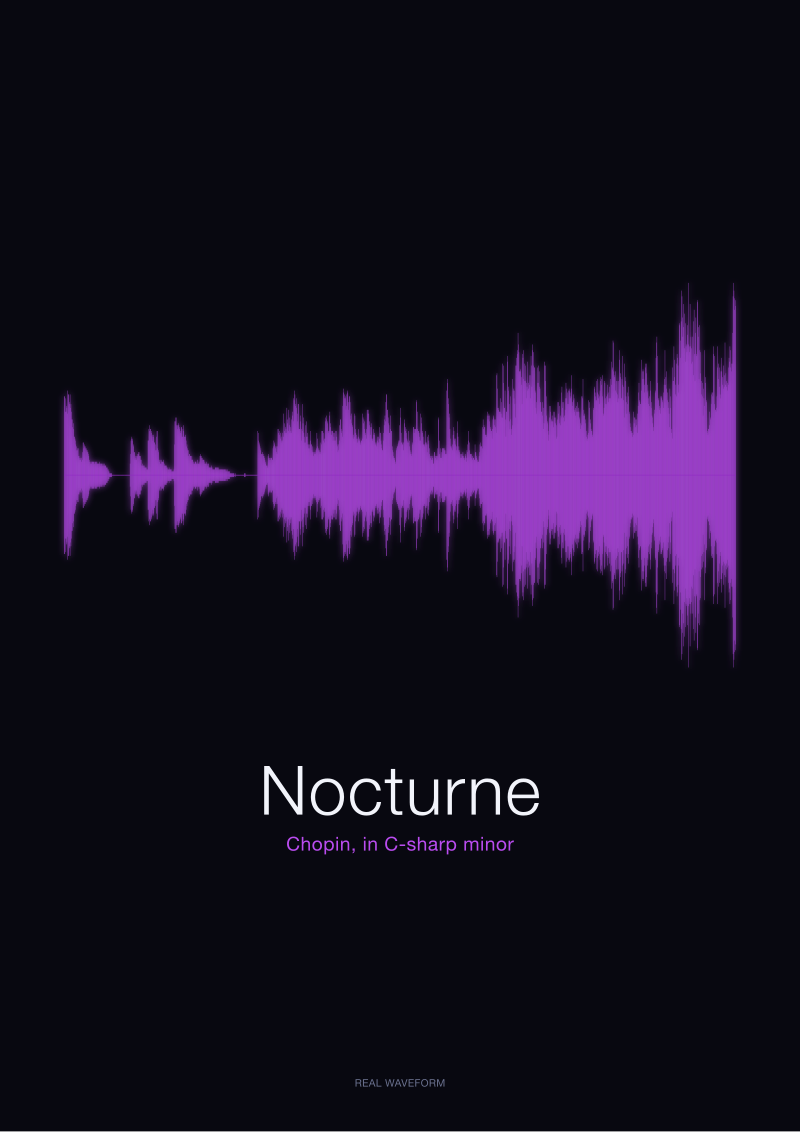
The next question is the one this piece does not answer: what other Chopin waveforms sit next to these two on the same wall. The Ballade and the Polonaise are companions, not a pair. Choosing a third — a nocturne for the quiet, an étude for the bright — is where the room begins to take a shape of its own.
 Heroic Polonaise
The print from this article · from €29.95
View the print →
Heroic Polonaise
The print from this article · from €29.95
View the print →
FAQ
Which of the two pieces has the taller single peak on the waveform?
The Heroic Polonaise, in most public-domain recordings, reaches its highest amplitude in the central octave passage, and that peak is the clearest single vertical line in the print. The Ballade No. 1 reaches comparable heights during its coda, but the amplitude arrives in stages rather than one dominating moment. If you are asking which print has the loudest-looking second on paper, it is the Polonaise, and the eye finds it immediately.
Is the waveform based on a specific recording or a generalised shape?
Both prints are rendered from real amplitude data of specific public-domain (CC0) recordings held in the Musopen Chopin collection at archive.org. They are not decorative curves or stylised renderings. Every peak, every quiet passage, every rest corresponds to a moment in the actual audio file. A different recording of the same piece would produce a visibly different waveform, because tempo, rubato, and dynamics vary between performances.
Does a longer piece always make a more interesting waveform print?
Not always, but often. Length gives the eye more horizontal space to travel, which means more room for contrast between loud and quiet passages to become visible. The Ballade No. 1 benefits from this because its dynamic range is dramatic and its structure is legible across the full length. Shorter pieces like the Heroic Polonaise compensate by concentrating their shape — the print gains density what it loses in span.
Which piece is harder to play, and does that show up on the waveform?
The Ballade No. 1 and the Heroic Polonaise are both among Chopin's most technically demanding works, and pianists disagree about which is harder. Difficulty does not directly render on a waveform — the shape shows what was produced, not how much effort produced it. That said, the sustained density of the Polonaise's central section is visible on paper as a plateau that only a physically committed performance can hold at that amplitude.
Can I tell the two pieces apart just by looking at the waveforms?
Yes, once you know what to look for. The Ballade No. 1's silhouette is longer, more varied in density, with a coda that reads as a stepped intensification toward the end. The Heroic Polonaise is more compact, with a broad dense region in the middle that is unmistakable. Side by side, they do not look alike. Even without labels, someone familiar with both pieces would name them correctly from the shape.
What does the quiet part of a waveform actually show?
Quiet on a waveform reads as thin — the vertical band collapses toward the horizontal centre line, because the amplitude is close to zero. It is not empty; a piano at low dynamic still displaces air, and the print records that. But visually, quiet becomes white space, and white space is what makes the loud passages readable. Both the Ballade and the Polonaise use quiet as compositional counterweight, and the prints show it.
Do both waveforms come from the same source recording session?
Both are drawn from the Musopen Chopin collection at archive.org/details/musopen-chopin, which is a CC0 (public domain) archive of solo piano recordings. The two pieces were performed and recorded separately within that archive, so they share the same rights status and the same rendering pipeline but not the same performer session. This matters because it means the tonal character of each print reflects a distinct recorded performance, not a synthesised uniform source.
Which is the better first Chopin waveform to own?
It depends on which of the three questions above matters most to you. If you want a print that rewards being read closely and traces the shape of a long piece, start with the Ballade No. 1. If you want a print whose presence carries a wall and whose loud moment is immediately visible, start with the Heroic Polonaise. Neither is objectively the better introduction — they are two different reasons to hang a waveform, and the right one is the one that answers your reason.
From the collection
New pieces and 10% off your first print.
One email now with your code. No noise after.