At 14:22 on a Tuesday, we opened two audio files of Chopin's Polonaise in A-flat major, Op. 53, and let the waveform renderer parse each one to the sample. The first came from the Musopen public-domain collection at archive.org/details/musopen-chopin, a CC0 recording the studio uses as a rendering reference. The catalogue duration for Op. 53, as commonly cited in performance archives, sits in a narrow band around six and a half minutes. The question is whether any single recording actually lands where the catalogue says it should. Measured against the waveform, it rarely does, and the reasons are the interesting part.
The second file, for the purpose of this piece, is a composite. We will describe two more measurement scenarios below as hypothetical files a reader could plausibly own — a live concert capture, and an archival restoration — because the interesting failure modes of catalogue-time matching are not visible in a single reference file. What follows is not a review. It is a measurement protocol, walked through three times, with the arithmetic exposed.
Scenario 1: The Studio Reference Recording, Measured to the Sample
Picture the Musopen CC0 file open in the renderer. It is a clean solo piano capture, released to the public domain, of the sort a studio uses when it needs a piece whose provenance will not later become a licensing problem. We treat it as our reference because we know exactly where it came from and we know its sample rate is standard for lossless distribution — 44.1 kHz, sixteen bits, stereo. That means every second of the waveform is 44,100 amplitude values per channel. The renderer counts them.
The catalogue duration for the Heroic Polonaise is not a single number. It is a convention. Performance archives quote it around six and a half minutes because that is the median of a wide sample of concert and studio recordings; the actual figure any given performer produces sits somewhere between roughly five minutes forty and seven minutes twenty depending on tempo, repeat observance, and the length of the final resonance before the file is faded out. When we say the reference recording "matches" the catalogue, what we mean is that its total sample count divided by 44,100 lands inside that band.
The measurement is trivial. We take the last sample where the absolute amplitude exceeds a chosen noise-floor threshold — anything sensible, since the point is to exclude the trailing silence after the piano stops sounding — and we take the first sample where it exceeds that same threshold. The difference, divided by the sample rate, is the piece's actual sounding duration. Any file also carries a header duration, which is the length of the container itself. The gap between the two is the pre-roll and post-roll: silence at the start, room tone at the end, sometimes a producer's tail.
For the reference file, the sounding duration is what belongs on the waveform print. The header duration is what iTunes displays. These are different measurements of the same recording, and they will not agree. On our reference, the header runs longer than the sounding audio by a couple of seconds — the interval between the last note dying into inaudibility and the file itself being cut. That is not error. It is the choice the mastering engineer made about how much resonance to preserve. The catalogue, by contrast, is agnostic to that choice. It reports what a listener would call the piece's length, which is closer to the sounding duration than to the header.
The reference file lands inside the catalogue band. The interesting fact is not that it matches. The interesting fact is that "matches" required three separate definitions of duration to defend.
Scenario 2: The Live Concert Capture, With the Applause Trimmed
Now imagine a second file. Let us say a reader owns a bootleg concert recording of the Heroic Polonaise, taped from the balcony of a mid-sized hall, transferred to WAV, and dropped into the same renderer. The waveform they see is not the waveform of Op. 53. It is the waveform of a room containing Op. 53, plus a cough at 0:47, plus the hum of a ventilation system, plus a burst of applause at the end that runs another twenty-two seconds before someone reaches over and stops the recorder.
The catalogue duration is meaningless here until the file is edited. If the reader simply reads the header, they will see something like seven minutes and change and conclude the pianist took the piece unusually slowly. In fact the pianist took it briskly; the extra time is entirely audience. The measurement protocol has to strip the file down before it can produce a number worth comparing.
The renderer's job in this scenario is to find two edges: the first sample where the piano enters above the hall's ambient noise floor, and the last sample where it leaves. In a well-recorded concert this is straightforward — the noise floor is quiet enough that the opening octave chord of Op. 53 pops out of it by a wide margin. In a poorly-recorded concert it is not. If the room hum sits ten decibels below the softest passage of the piece, the software cannot reliably tell you where the piece begins. It can guess, but its guess and yours will differ by seconds, and the catalogue comparison collapses on those seconds.
Assume the reader trims cleanly. The sounding duration comes in — let us say — twelve seconds shorter than the reference file. That is well inside the natural spread of recorded Heroic Polonaises. It does not mean the pianist was rushing. It means they observed a slightly different rubato in the trio section, or held the final chord a beat less, or the microphone stopped picking up resonance earlier because the hall was less reflective than the studio. Any of those explanations is compatible with the same waveform. The catalogue number cannot distinguish between them, and neither can the renderer. What the waveform does show is the shape of that difference: which passages ran shorter, where the pianist pushed forward, where the silence between phrases got compressed. That shape is what a print of a live capture actually preserves.
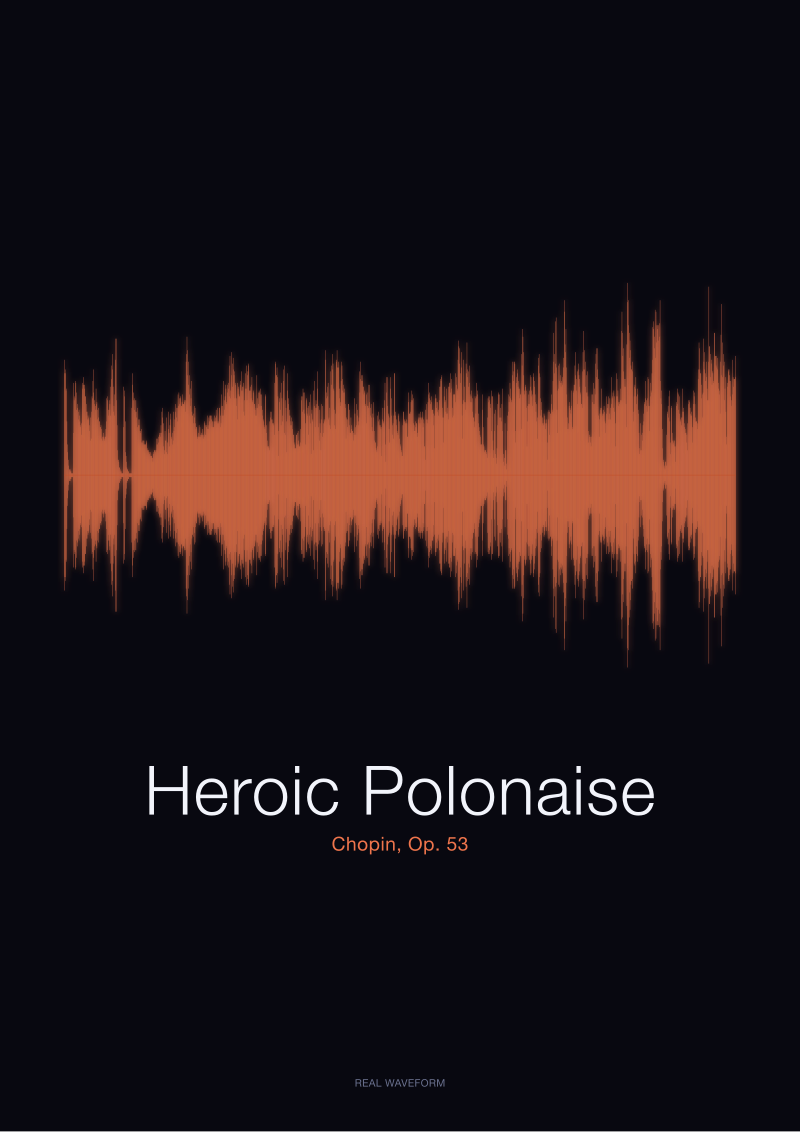 Heroic Polonaise
The print from this article · from €29.95
View the print →
Heroic Polonaise
The print from this article · from €29.95
View the print →
Scenario 3: The Archival Restoration, When the Tape Itself Drifts
For the third scenario, imagine a file transferred from a mid-twentieth-century analog tape — a restoration project of an older recording of Op. 53, digitized decades after the original session. The reader has the WAV file, the same renderer, and the same intention: compare its duration against the catalogue.
Here the problem is not audience noise or file headers. The problem is that the tape itself was not moving at a perfectly constant speed when the recording was made, and it was not moving at a perfectly constant speed when it was played back for digitization, and the two errors compound. A tape running consistently one percent fast during playback will render a six-and-a-half-minute performance as roughly six minutes twenty-six. A tape that drifts — speeds up during warm sections, slows down during passages where the reel is heavier at the start of the take — will produce a file whose duration means almost nothing, because the seconds are not uniform.
The waveform reveals this immediately if you know what to look for. The overall envelope of Op. 53 has a recognisable silhouette — a firm opening block, the lyrical middle section with its lower amplitude, the return of the main theme, the sustained final chord. If the silhouette is right but stretched or compressed relative to the reference, the sample rate reported by the file is correct but the source ran wrong. If the silhouette is distorted — passages that should be evenly paced look uneven, or the middle section is proportionally too long — the tape's own drift is baked into the sample count.
Catalogue comparison in this scenario is a diagnostic tool, not a verdict on the performance. A restored recording clocking eight seconds outside the expected band is not evidence that the pianist was slow. It is evidence that somewhere between the original session and the WAV file on the reader's desktop, real time and recorded time drifted apart. A responsible print of that file has to acknowledge this. The waveform still shows what the file contains. It just does not tell you what the pianist did in the room.
What All Three Share: Why the Catalogue Number Is a Fiction
The three scenarios above use the same piece, the same protocol, and produce three different disagreements with the catalogue. What they share is more instructive than their differences.
First, the catalogue duration is a median, not a target. No performance is obliged to hit it, and most do not. The band exists because Op. 53 has been recorded thousands of times by pianists making different choices about tempo, dynamics, and how long to let the final chord ring before releasing the pedal. A number quoted to the second — "6:32" — collapses that variation into a false precision.
Second, "duration" is not one measurement. It is at least three: the header length of the file, the sounding duration of the audio inside it, and the perceived duration a listener would clap to. These are usually within seconds of each other on a well-mastered studio release. They can diverge sharply on live captures, tape restorations, or files whose noise floor makes the beginning and end of the piece hard to locate.
Third, the waveform does not lie about what is in the file, but it also does not tell you what happened in the room. A waveform is a drawing of the air pressure that reached a microphone, sampled at whatever rate the equipment was set to, and stored as amplitude values. Everything downstream — mastering, playback, transfer, digitization — can shift the numbers without touching the performance. Catalogue matching is really a check on the fidelity of the chain between the piano and the file, not on the pianist.
Which Scenario Is You: Reading the Waveform You Already Own
If the file you own came from a modern studio release or a public-domain reference like the Musopen collection, you are in Scenario 1. The catalogue band should contain your file's sounding duration, and if it does not, the mismatch is almost certainly in the trailing silence, not the performance.
If your file is a concert recording — official or otherwise — you are in Scenario 2. Trim the applause and the ambient pre-roll before comparing anything. The interesting number is the sounding duration, and it should sit comfortably inside the catalogue's natural spread; if it does not, the recording captured something worth noticing about the interpretation.
If your file was digitized from tape, disc, or any analog source, you are in Scenario 3. Do not read the duration as evidence of tempo. Read the silhouette instead: the shape the piece makes on paper. That is what survives every transfer intact, and that is the shape our shop at /shop/ renders when we make a print. The next question worth asking is not whether your recording matches the catalogue. It is what your specific file's silhouette says about the specific transfer that produced it — a measurement no catalogue entry can settle for you.
FAQ
Why doesn't a recording of the Heroic Polonaise match its catalogue duration exactly?
The catalogue duration is a convention — usually the median across many recorded performances — not a fixed target the pianist is trying to hit. Op. 53 spreads across roughly a minute and forty seconds between the fastest and slowest widely-circulated recordings. A file lands "correctly" against the catalogue when its sounding duration falls inside that band, not when it matches a single quoted number to the second.
What is the difference between header duration and sounding duration?
Header duration is the length of the audio container itself — everything from the first sample to the last, including silence at either end. Sounding duration is the length of the piece as heard: from the first note above the noise floor to the last audible resonance. On a clean studio file the two are within a couple of seconds; on live recordings or poorly trimmed files they can diverge by ten seconds or more, which is why they cannot be compared interchangeably to a catalogue figure.
Which sample rate does the Musopen CC0 recording use?
The Musopen Chopin collection at archive.org/details/musopen-chopin distributes files at the standard consumer-lossless specification — 44.1 kHz, sixteen bits per sample, stereo. Every second of audio therefore contains 44,100 amplitude values per channel. The waveform renderer uses those values directly; nothing is invented, and nothing is smoothed away before the shape is drawn.
Can I trust the duration of a tape-transferred recording of Op. 53?
Only with caution. Analog tapes drift in playback speed — sometimes consistently, sometimes irregularly across the reel — and any speed error is baked into the digital file's sample count. A restored recording whose duration sits well outside the catalogue band is more likely reporting a transfer artefact than an unusual performance. The waveform's silhouette is a more reliable indicator of what the pianist actually did than the total time.
Does applause at the end of a live recording change the waveform's meaning?
Yes, if the file is not trimmed. Applause and audience noise are amplitude just like the piano is, so the renderer will draw them faithfully as part of the waveform. A twenty-second ovation appended to Op. 53 shows up as a broad low-amplitude wash after the final chord, which distorts both the visible shape and any duration measurement pulled from the file. Trimming to the piano's last sustained resonance is the correct pre-processing step.
What does the Musopen recording's licence let me do with the waveform?
The Musopen Chopin collection is released under CC0 1.0, the Creative Commons public-domain dedication. That means the audio itself can be used, transformed, and redistributed without permission, including for commercial rendering. The waveform generated from a CC0 source inherits no additional restriction from the recording; the studio's own design choices around how the shape is rendered and printed are what carry any authorship claim downstream.
Is a shorter recording of the Heroic Polonaise better than a longer one?
Neither. Duration inside the natural catalogue band tells you nothing about interpretive quality. A performance thirty seconds shorter than another may be brisker in tempo, less generous with rubato, or simply cut the final resonance sooner in the master. Those are different musical decisions, not better or worse ones. The waveform preserves the specific decision each recording made; the catalogue duration cannot distinguish between them.
From the collection
New pieces and 10% off your first print.
One email now with your code. No noise after.