We rendered both recordings from the same source — the Musopen Chopin collection on archive.org, CC0, unedited — and laid the amplitude waveforms side by side on a single strip. The Raindrop Prelude, Op. 28 No. 15, and the Heroic Polonaise, Op. 53, share a composer and almost nothing else on paper. As drawings of air, they share even less. What follows is not a review of either performance. It is a reading of four amplitude peaks — two per piece — and what the shape of each peak tells a listener the ear, moving in real time, cannot fully hold.
The Two Silhouettes, Before Any Peak Is Named
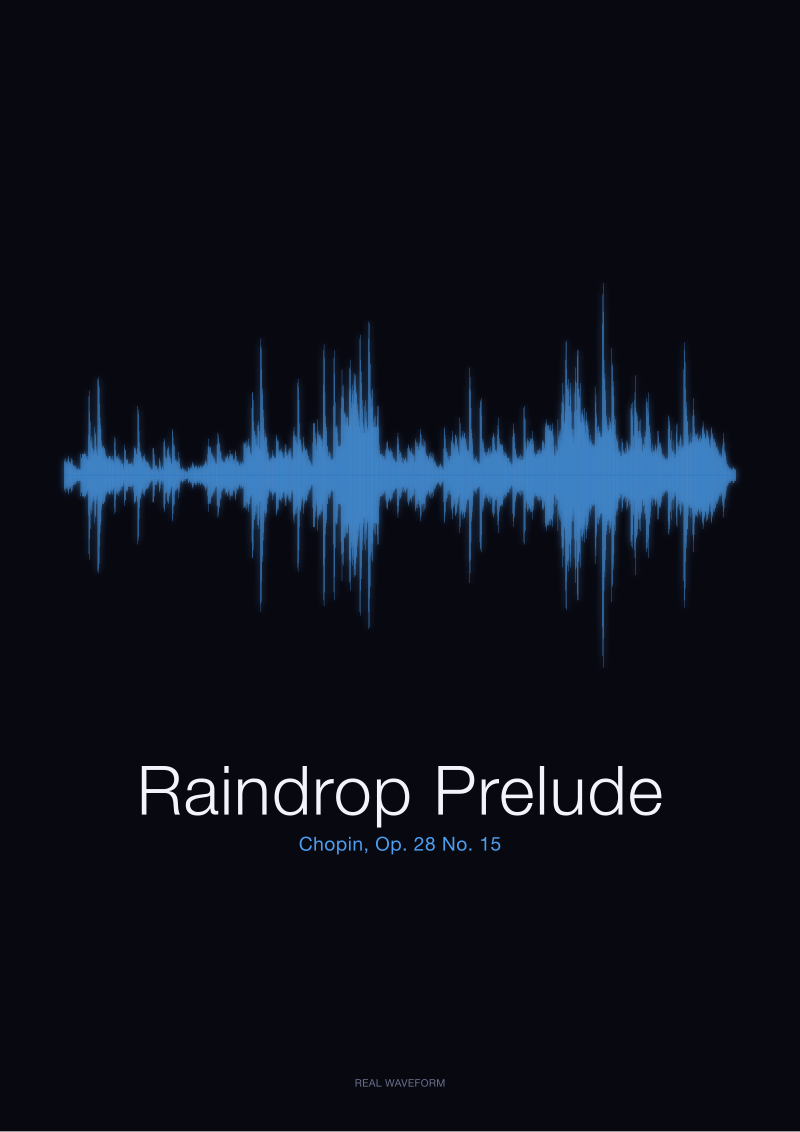
Put the two waveforms on the same horizontal strip and the eye finds the difference before the mind names it. The Raindrop, at rest, hovers close to the axis for most of its length. It is a long, low band of activity with a single dark thickening near its middle and a return to the same slender line on either side. The overall silhouette is patient. It reads, from a metre away, as a horizon with weather passing through it.
The Polonaise has a different geometry entirely. Its baseline is thicker from the first bar. There is no long stretch of quiet to establish before the first surge. The waveform steps up immediately, then again, then holds a broad plateau of sustained amplitude across most of its length. Where the Prelude asks the eye to notice a single event against calm, the Polonaise asks the eye to notice which of many events is the largest.
This is the reason a comparison of "peaks" between them is not a symmetric exercise. A peak in the Raindrop is defined by contrast with what surrounds it — the silence gives the storm its edge. A peak in the Polonaise is defined against a floor that never drops far. One piece uses white space as an instrument. The other refuses white space almost entirely. When we speak of a peak in each, we are speaking of two different physical events with the same label.
There is a second thing the silhouettes settle before any specific bar is examined. The Raindrop is longer in duration and lighter in average amplitude. The Polonaise is shorter and heavier. On a print, this shows up as a Prelude drawing that stretches wide and lies flat, and a Polonaise drawing that is more compact and stands taller. The ratio of length to loudness is a property of the piece before it is a property of any performer. Chopin composed those proportions in.
The third thing worth naming, before we point at any one moment, is that we are looking at amplitude and only amplitude. Amplitude is loudness. It is not harmony, not melody, not tempo, not the emotional temperature the pianist chose. A waveform can tell you where the loudest second sits. It cannot tell you whether that second is triumph or grief. A print is honest about this. It shows the physics of the recording, and it lets the listener supply the meaning. Keep that boundary in mind as we compare the four peaks below.
Peak One and Two: The Raindrop's Central Storm Against the Polonaise's Opening Fanfare
The first peak we mark is the Raindrop's central storm. Everyone who has heard the piece knows it. The nickname of the prelude comes from the repeated single note that runs beneath the whole thing — the raindrop — but the moment the piece is famous for is the middle passage, where that pattern moves into the left hand, the harmony darkens, and the dynamic swells from something you could easily talk over to something that fills a room. On the waveform, this event appears as a distinct thickening of the band — the strand doubles or triples in height and stays there for a stretch — before the drawing returns to the slender resting line that opened the piece.
What the shape tells you that a real-time listening cannot is how narrow this event actually is compared to the whole. The Raindrop's storm feels, in the ear, like the centre of gravity of the piece. On the print, it is a single dense passage bracketed by long stretches of quiet on either side. The visual proportion is not what memory reports. Memory files the storm as the piece; the drawing files it as an interruption of the piece's default state. Both readings are correct. They are answering different questions.
The Polonaise's opening fanfare is a completely different kind of peak. It is not a swell that arrives after preparation. It is the first thing that happens. The waveform starts high — the initial chords, the famous rising figure, the announcement — and does not settle for a considerable time. Draw a horizontal line across the piece at the height of that opening and you will find the line intersects the shape repeatedly, at the top of many later moments. The opening does not stand alone; it establishes a ceiling that the piece will keep touching.
Compare peak one and peak two on the same strip and the honest description is this. The Raindrop's central storm is a taller-than-its-neighbours event in a piece that mostly whispers. The Polonaise's opening fanfare is a tall event in a piece that mostly shouts. Their absolute amplitudes, on the same rendering, are closer than the ear predicts — a well-played Raindrop storm can approach a Polonaise fanfare in raw loudness. But the shape around each peak is opposite. Contrast, not absolute height, is what the eye is reading. The Raindrop's peak stands out because of the quiet around it. The Polonaise's peak stands out because it establishes the rule.
There is a design consequence to this that anyone who has hung both prints in the same room notices within a day. The Raindrop reads well at small sizes because the storm is visually unmissable against the calm; you can hang it small and still see the piece's argument. The Polonaise wants more square footage. Its argument is a sustained plateau of activity, and a small print flattens the internal detail into a single dark bar. This is a physical fact about the two waveforms, not a preference.
 Prelude
The print from this article · from €29.95
View the print →
Prelude
The print from this article · from €29.95
View the print →
Peak Three and Four: The Return to Quiet in One, the Coda Charge in the Other
The third peak is not really a peak. It is the Raindrop's return to quiet — the way the piece releases its storm and settles back into the raindrop pattern that opened it. On the waveform, this reads as a descending shape: the thickened middle band tapers, then narrows, then returns to the slender resting line. It is not a spike. It is the resolution of a spike. We are calling it a peak because it is the peak of information, not of loudness. The eye that has just been shown a swell now watches the swell dissolve, and the dissolving is legible in a way the initial swell was not.
This is where the piece's white space earns its rent. The tail of the Raindrop uses more silence than the head. The recording does not end at maximum quiet, but it ends closer to the axis than it began, and the last inches of the strip are the visible answer to the storm in the middle. On a print, this reads as breath. There are people who buy this piece specifically for that tail — the storm is what draws them to the score; the return is what makes them want the drawing on a wall.
The fourth peak is the Polonaise's coda charge. Where the Raindrop empties out, the Polonaise fills up. The final passage of Op. 53 is one of the loudest sustained events in the piano repertoire that a single player can produce, and the waveform shows exactly why the piece exhausts pianists. The amplitude does not spike and release. It climbs to a level and stays there, then climbs again and stays there, then finishes on a hammered chord whose shape on the drawing is closer to a rectangle than a spike. It is a peak that refuses to be a peak — it refuses the shape a peak is supposed to have, which is up-and-then-down. The Polonaise's coda is up-and-then-more-up.
Set the Raindrop's tail and the Polonaise's coda beside each other and the honest description is this. One piece uses its ending to answer a question. The other uses its ending to raise the volume as far as the physics of the instrument will allow, and stops when the instrument does. On the waveform strip, these two endings are the most visually opposite events either piece produces. If a single strip carried only the last thirty seconds of each, a viewer with no musical background could tell you which recording ends in whisper and which ends in shout. Amplitude is honest about that much.
We keep the two prints together on the studio wall for exactly this reason — they teach the eye what dynamic range looks like when composers use it in opposite directions. If you want to see both, they are catalogued in our /shop/. They are the same paper, the same ink density, the same rendering pipeline. Only the drawings differ, because only the recordings do.
What the Comparison Refuses to Settle
A comparison of peaks does not tell you which piece is greater. Amplitude does not carry that argument. The Raindrop and the Heroic Polonaise are aimed at different rooms in the listener. The Prelude is a piece about a single sustained texture interrupted by weather. The Polonaise is a piece about announcement and forward motion. A waveform can show you the shape of each. It cannot rank them.
A comparison of peaks does not tell you which performance is best either. We rendered a single public-domain recording of each from the Musopen collection. A different pianist, at a different tempo, with a different room and a different microphone position, would produce different peaks — the same piece, a different drawing. This is not a flaw of the medium. It is the point. Every recording of every piece has its own silhouette. Two Raindrops rendered from two performers are visibly different objects. The score is the score; the sound is a specific reading of it.
A comparison of peaks does not resolve the question of what the ear actually holds during a first listen. Memory compresses. The Raindrop is remembered as the storm. The Polonaise is remembered as the opening figure. The waveform shows that the storm is a small fraction of the Raindrop's runtime and that the opening figure is one of many high events in the Polonaise. The drawing is the piece's honest length; memory is the piece's headline. Both are worth having. They are not the same document.
This piece started as a note about the two most obvious loud moments in the Chopin catalogue — the Raindrop storm and the Polonaise opening — and turned into a note about how differently the same composer used silence in the same decade. The peaks were the excuse. The white space between them was the argument. We keep coming back to that. Every waveform we render is a drawing of a specific piece of air, and the shape of the air, in the end, is mostly the shape of the quiet around the loud.
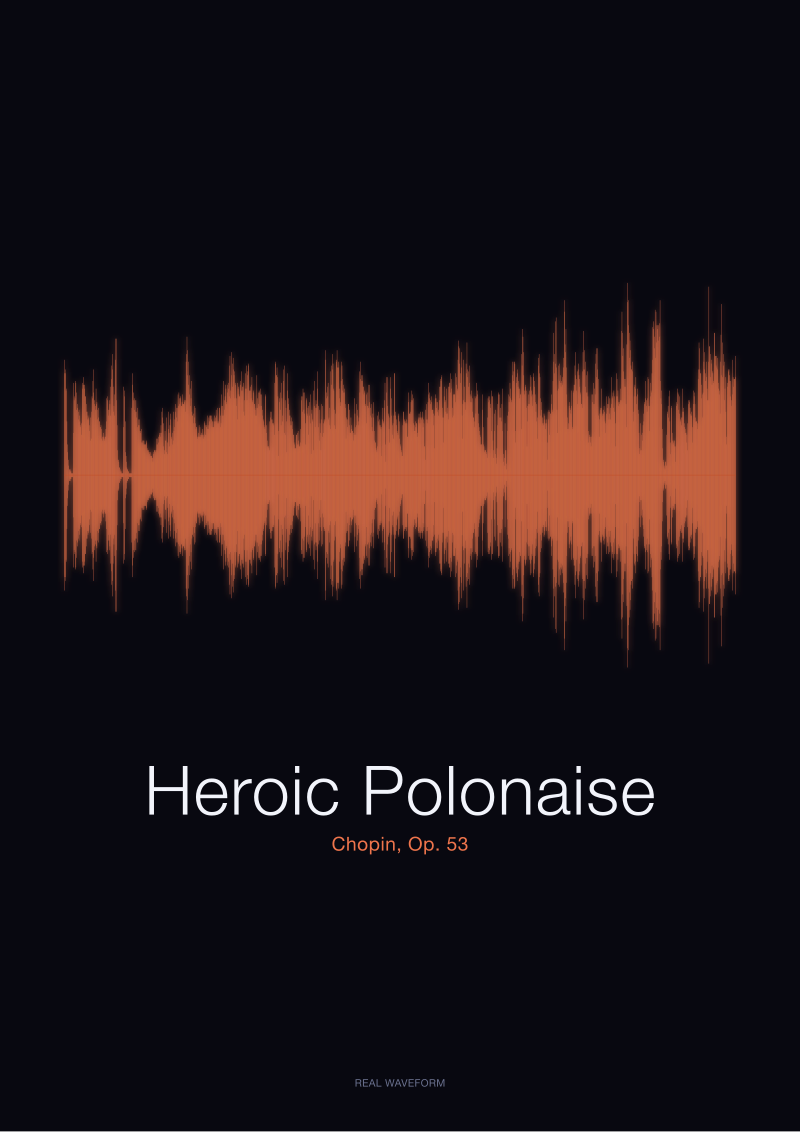 Heroic Polonaise
The print from this article · from €29.95
View the print →
Heroic Polonaise
The print from this article · from €29.95
View the print →
FAQ
Why compare four peaks instead of ranking the two pieces overall?
Ranking two pieces by amplitude confuses loudness with quality. Op. 28 No. 15 and Op. 53 were written for different purposes and use dynamic range in opposite directions. Peaks are useful because they are physical events a waveform can locate precisely, and because they let a reader see how each piece uses contrast. A ranking would collapse that into a number. The comparison of shapes preserves what the drawings actually show.
What recordings were used for the waveforms discussed here?
We used the public-domain recordings of Chopin's Op. 28 No. 15 (Raindrop Prelude) and Op. 53 (Heroic Polonaise) from the Musopen Chopin collection hosted at archive.org/details/musopen-chopin, released under CC0 1.0. They were rendered unedited, from the audio file, into an amplitude waveform. No decorative smoothing, no artistic license — the strand you see is the loudness of the recording moment by moment.
Does a taller peak on the waveform mean the piece is more emotional there?
No, and this is worth being explicit about. Amplitude is loudness. It is not emotion. Very sad music can be very quiet, and very loud music can be triumphant, mournful, angry, or joyful depending on harmony, melody and context — none of which appear on a waveform. A tall peak tells you the recording is loud at that instant. What the listener feels at that instant is supplied by the piece and the performance, not by the drawing.
Would a different performer produce a different waveform of the same piece?
Yes, always. The score fixes the notes; the performer fixes the sound. A slower Raindrop with a heavier left hand will show a broader central storm. A leaner Polonaise with less pedal will show a thinner coda. This is why every waveform print is tied to a specific recording. Two prints of Op. 28 No. 15 rendered from two different pianists are visibly different objects, and the difference is the performance, made visible.
Why is the Raindrop's central storm memorable if it is a small fraction of the piece?
Because the ear encodes contrast more strongly than duration. The Raindrop spends most of its length near the noise floor, so the middle passage — where amplitude thickens and stays elevated — becomes the piece's centre of gravity in memory. The waveform shows the actual proportions: a long quiet, a shorter loud, a long quiet. Memory reports the loud as the piece. Both readings are true; they are answering different questions about what the piece is.
Can the same print size work for both waveforms?
Not equally well. The Raindrop reads at small sizes because its argument is a single dense event against a mostly empty band. The Heroic Polonaise wants a larger surface because its argument is a sustained plateau of activity with internal detail that flattens if you shrink the print too far. If you are hanging both, we suggest the Polonaise gets the larger of the two — you will see more of what the piece actually does at scale.
Where can I see the waveform prints of these two pieces?
Both are catalogued in the studio's shop at /shop/. They are rendered from the CC0 Musopen recordings referenced above, printed on the same paper stock, and framed identically so that the only visual difference between the two objects is the shape of the recording itself. That is the whole point of hanging them together — the drawings do the arguing.
From the collection
New pieces and 10% off your first print.
One email now with your code. No noise after.