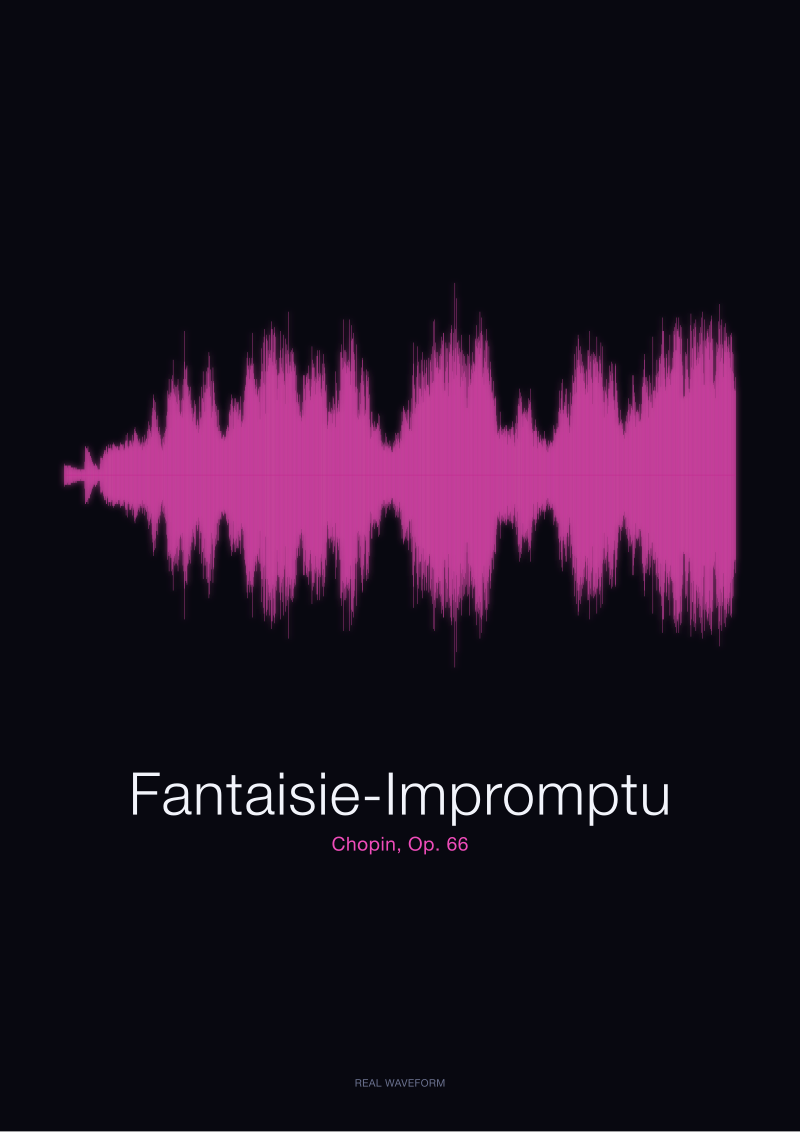
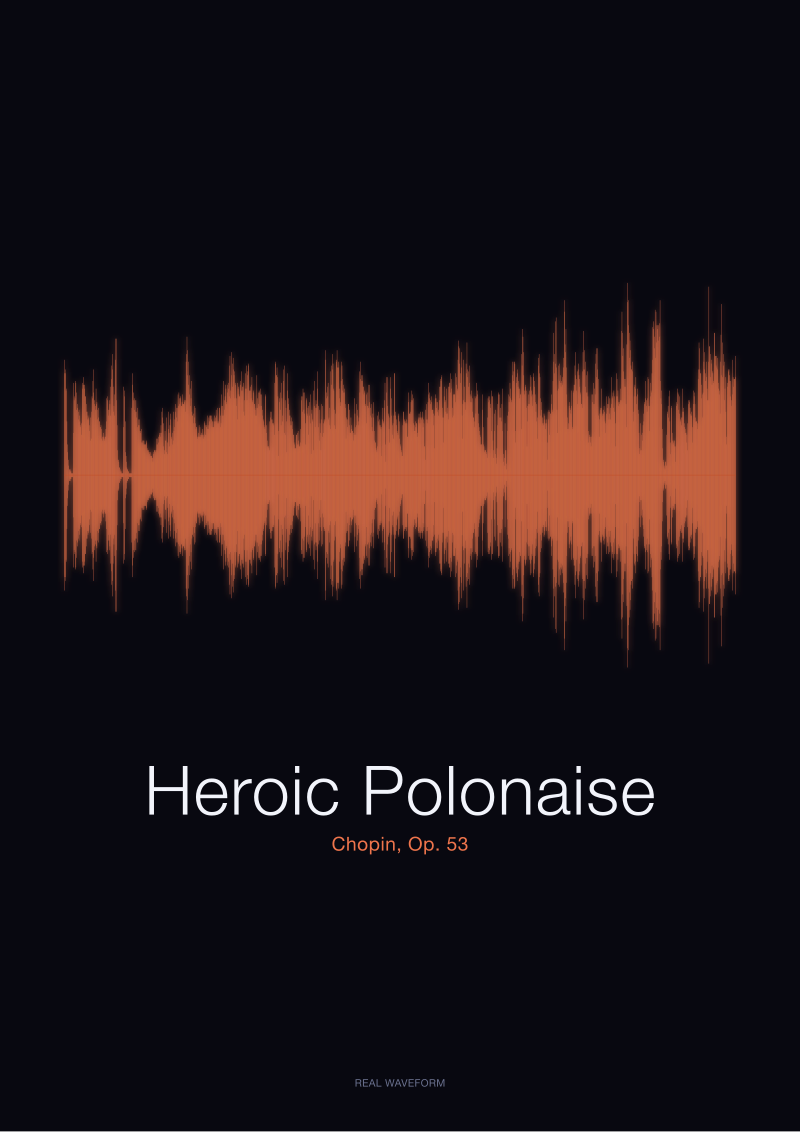
For the listener who wants to understand Chopin through shape rather than through score, the Fantaisie-Impromptu (Op. 66) is the more instructive of the two waveforms, not the Heroic Polonaise (Op. 53). The obvious objection is that the Polonaise is louder, grander, and built from the sort of chordal weight that draws itself in thick black bands on any amplitude plot. We will defend the choice anyway, because three peaks compared side by side reveal that Op. 66 teaches the eye more about how Chopin thinks in sound than Op. 53 does.
The Verdict, Stated Before the Shapes Are Drawn
Both waveforms in front of us come from the same public-domain source: the Musopen Chopin collection on archive.org, released under CC0. They are not decorative curves. They are the real amplitude traces of two real performances, rendered from the actual audio our studio prints. That grounding matters, because the argument only holds if the peaks being compared are peaks that a listener could point to in a specific recording rather than idealised abstractions of the two pieces.
Our verdict is narrow. We are not saying the Fantaisie-Impromptu is the greater work, nor that its waveform is more beautiful, nor that it is easier to read. We are saying that if a listener wants to learn how Chopin builds and releases dynamic tension — how he decides when to raise the ceiling of a piece and when to drop the floor — the Op. 66 silhouette exposes that decision-making more legibly than the Op. 53 silhouette does.
The reason, in one sentence, is that the Polonaise spends most of its length near its ceiling and therefore has fewer moments where a peak stands out against a genuine trough, whereas the Fantaisie-Impromptu keeps the floor of its dynamic range low enough that its peaks announce themselves against the quiet. Peaks are only informative when there is something to measure them against. A piece drawn as a mostly-thick band with three slightly thicker sections tells the eye less than a piece drawn as a threaded line with three well-defined swells.
That is the whole argument. The next six sections do the work of showing it, first by conceding the case for the Polonaise honestly, then by defining the technical vocabulary, then by locating the three peaks in each piece and comparing them on their own terms.
The Steel-Man: Why the Polonaise Is the Obvious Answer
The intuition that pulls a listener toward the Heroic Polonaise as the more dynamically informative piece is not wrong; it is simply looking at a different question. The Polonaise is louder for longer, its chordal writing sets up a rhythmic silhouette that is visible even at low zoom levels, and its climaxes are held rather than passed through. If the question were "which of these two waveforms is more immediately impressive as a static image on a wall," the Polonaise would win without argument. Its shape has weight in the graphic-design sense: broad, dense, architectural, with the visual signature of a piece written to fill a hall.
The steel-man goes further than aesthetics. The Polonaise's dynamic architecture is closer to what a general listener imagines when they think of Chopin at his grandest — the martial rhythm of the polonaise form itself, the famous octave passages in the left hand, the sense of a procession moving through several key areas without ever really quieting down. All of that is present on the waveform as sustained amplitude. A first-time reader of the shape would find more to point at, more to name, more moments where the drawing looks obviously "loud."
If our task were to teach the difference between a nocturne and a grand piece, we would use Op. 53 without hesitation. The Polonaise is what a full orchestra of a single piano sounds like when Chopin is not holding back. The waveform is a record of that lack of holding-back.
But the question we are actually answering is different. It is about what three specific peaks — chosen because they are the highest three dynamic events in each piece — reveal about the compositional logic. And on that narrower question, the Polonaise's density works against it. When the whole page is loud, the three loudest moments do not stand apart. Op. 66, by keeping its floor lower, gives its peaks the room they need to be visible as peaks and not just as slightly-taller sections of a long crest.
 Fantaisie-Impromptu
The print from this article · from €29.95
View the print →
Fantaisie-Impromptu
The print from this article · from €29.95
View the print →
What a Peak Actually Is on a Waveform
Before we compare, one technical clarification. A peak on an amplitude waveform is not the loudest note in a subjective sense. It is the moment where the wave reaches its greatest absolute deflection from the zero line, positive or negative, over a short window. On the printed shape it looks like a spike, a swell, or a widening band, depending on how sustained the loud moment is.
Three properties matter for reading a peak. The first is height: how far the deflection reaches from the centre line. The second is width: how many milliseconds or seconds the deflection is held before the shape narrows again. The third, and most easily overlooked, is contrast with the surrounding material — the relationship between the peak and the quietest section immediately before or after it. A tall peak next to a tall floor reads as a plateau. A moderate peak next to a very low floor reads as a genuine event.
The three peaks we are locating in each Chopin waveform are the three largest sustained amplitude events in the public-domain recordings that the studio has rendered. They are not the three most famous passages by reputation. Reputation is a poor guide to shape; the "famous" moment in a piece is often not the loudest, and the loudest moment is often not the one a listener would name. That gap between reputation and amplitude is part of what a waveform is for.
The rendering itself is straightforward. Each recording is a stereo audio file sampled at CD quality. Amplitude at each sample point is plotted on the vertical axis; time runs along the horizontal. No frequency information is shown — this is not a spectrogram. What we are reading is the raw physical displacement of air, translated through microphone, wire, and file, drawn back onto a page as the shape of that displacement over time.
| Reading dimension | What it measures on the waveform | Why it matters for these two pieces |
|---|---|---|
| Peak height | Maximum deflection from zero line | Sets the ceiling of the dynamic range |
| Peak width | Duration the deflection is sustained | Distinguishes an accent from a climax |
| Local contrast | Peak height relative to the surrounding floor | Determines whether the peak reads as an event or a plateau |
| Attack profile | Steepness of the wave's approach to peak | Reveals whether the moment is struck or arrived at |
| Decay profile | Rate at which amplitude returns toward zero | Tells the eye how Chopin releases what he built |
The five rows above are the reading grammar for everything that follows. Height and width are obvious. Contrast is the one most listeners miss when they look at a waveform for the first time, and it is the one that decides our verdict.
The First Peak: Arrival vs. Announcement
The first significant dynamic peak in the Fantaisie-Impromptu comes not at the opening but shortly after the opening gesture — the shape settles into its rushing figuration, and then reaches a moment where the amplitude widens noticeably as the melodic line asserts itself over the accompaniment. Visually, this first peak is preceded by a stretch of thinner, more thread-like waveform. That is what makes it register as a peak: the eye is coming from a narrower shape and encountering a swell.
The first peak in the Heroic Polonaise arrives much sooner. The famous introduction announces itself with heavy chords, and the amplitude band is already close to its eventual ceiling within the first few seconds of the recording. The waveform does not thread its way toward height; it opens near height. Read as shape, the Polonaise's first peak is an announcement — a declaration that the ceiling of the piece is up here and will be visited often.
The contrast between the two first peaks is the whole aesthetic distinction between the two pieces compressed into a single reading. Op. 66 arrives at its first peak. Op. 53 declares its first peak. Neither is superior as music. But as a reading exercise, an arrival is more informative than a declaration, because the arrival tells you where the piece has been and where it has decided to go. A declaration only tells you where the piece stands.
There is a second observation worth making here about the Polonaise's opening. The chords are struck rather than sustained; the amplitude drops between them, and the waveform shows a series of tall narrow spikes rather than a continuous crest. This is the signature of a rhythmic gesture. In the Fantaisie-Impromptu's first peak, by contrast, the amplitude is more continuous — the wide band holds for longer, suggesting a melodic phrase rather than a rhythmic accent. Two entirely different ways of being loud, both visible on paper without any need for a score.
 Heroic Polonaise
The print from this article · from €29.95
View the print →
Heroic Polonaise
The print from this article · from €29.95
View the print →
The Middle Peak: Sustained Weight vs. Sudden Swell
The middle peak is where the argument for Op. 66 hardens. In the Fantaisie-Impromptu, the central dynamic event coincides with the return of the opening material after the slower middle section — the piece has spent a considerable stretch at a genuinely low amplitude, a threaded and quiet passage that draws itself as a thin line close to the zero axis, and then the amplitude rises back toward, and past, the level of the first peak. The visual jump from the quiet middle to this returning swell is dramatic in a way that requires no interpretation. The eye simply sees a low band become a wide band.
The Polonaise's middle peak, by contrast, sits inside its middle section — the famous octave passage in the left hand, which drives the amplitude upward and holds it there. Because the surrounding material was already loud, the middle peak reads as a plateau extension rather than a swell. It is undeniably present. It is undeniably where the piece is at its most massive. But on the waveform, it does not announce itself against silence. It announces itself against more loudness.
Here the reading grammar from the previous section pays off. The Fantaisie-Impromptu's middle peak has strong local contrast: peak against trough. The Polonaise's middle peak has weak local contrast: peak against plateau. A listener who wants to understand how Chopin uses dynamic range as a compositional resource — how the same composer can build a piece around the drop into silence and then a piece around the refusal to drop — sees that difference clearly in the middle-peak comparison.
This is also the section where the pedagogical case for Op. 66 becomes concrete. If we were teaching a student to hear dynamic architecture on paper, we would put them in front of the Fantaisie-Impromptu middle peak first. The lesson is immediate: quiet is not the absence of the piece, it is the setup for the peak that follows. The Polonaise cannot teach that lesson because it does not use quiet the same way.
The Final Peak: How Each Piece Closes Its Own Silhouette
The final peak is the most temperamentally revealing of the three. The Fantaisie-Impromptu ends with a return of the slow middle theme, quietly, so its highest amplitude event near the close is a passing peak rather than a terminal one — the peaks are behind us, and the piece exits at the low end of its dynamic range. The waveform closes on a whisper, and the last significant peak sits some distance from the actual ending. On paper this reads as a piece that expends its energy and then confides.
The Polonaise closes differently. Its final significant peak comes at or very near the end of the piece — the closing chords are among the loudest moments of the entire waveform, and the shape terminates in a wide band that runs almost to the edge of the drawing. The silhouette does not confide. It declares its ending with the same weight it declared its opening.
Both endings are, in the language the studio uses in the shop, "signature-shaped." The Fantaisie-Impromptu silhouette has a distinctive downward taper toward the right edge of the page, which any experienced reader of these waveforms could identify without a label. The Heroic Polonaise has a distinctive right-edge fullness, the shape terminating close to its ceiling rather than descending from it. Two different exit strategies, two different visual signatures, both legible on the page.
For the specific reading question we opened with — where do the three loudest seconds of each piece live, and what do they tell us — the closing peak comparison seals the argument. In Op. 66, the third peak is inside the piece; the piece cools off after it. In Op. 53, the third peak is the piece's exit. The Fantaisie-Impromptu therefore has a three-peak structure with genuine dynamic room around each of them. The Polonaise has a three-peak structure where the third peak also does the work of the ending.
Which is a more interesting compositional decision is not something a waveform can settle. Which is more visible as three distinct events, though, is exactly the kind of question a waveform can settle, and the answer is Op. 66.
What You Should Actually Do With These Two Shapes
If you are a listener trying to teach your ear to see dynamics, sit with the Fantaisie-Impromptu waveform first. Look at where the shape narrows to a thread and then look at what happens immediately after. Do this three times. Each of the three peaks in Op. 66 is set up by a preceding thinness, and the setup is a large part of why the peak reads as a peak. Once that reading is fluent, the Heroic Polonaise silhouette becomes easier to read as a different problem entirely — a piece that stays high and asks how you distinguish among nearby heights, rather than a piece that visits height and returns.
If you are considering a print of either piece, our recommendation is grounded in the same reading. The Fantaisie-Impromptu makes the more graphically active print — more contrast between the thin and thick sections, more variation across the width of the frame. The Heroic Polonaise makes the more architecturally dense print — a fuller, heavier silhouette that reads as weight from across a room. Both waveforms live in the studio's see the Fantaisie-Impromptu print as prints rendered from the same public-domain Musopen recordings referenced throughout this piece. Choose Op. 66 if you want a print that rewards close reading. Choose Op. 53 if you want a print that carries at a distance.
None of this settles the question of what these two waveforms would look like in a different performance of the same pieces. The recordings we rendered are one interpretation each — one pianist's rubato, one microphone placement, one moment of one afternoon. A different performance would produce a related but not identical silhouette, and the three peaks might sit at different heights, different widths, with different local contrasts. Where the shape of Chopin ends and the shape of an interpretation begins is the next question, and it is not one that this piece has answered.
From the collection
New pieces and 10% off your first print.
One email now with your code. No noise after.