The Minute Waltz is not a minute long. The Heroic Polonaise, on paper, does not begin heroically — it begins with a low, patient tremor before the first shoulder rises. We pulled the amplitude waveforms of two public-domain Chopin recordings from the Musopen collection — Op. 64 No. 1 and Op. 53, both released under CC0 — and marked every point where the signal peaks above the surrounding envelope. There are six. Three in each piece. Their positions, their heights, and the white space between them are what this article is about.
What the Waveforms Actually Show
A waveform is not a picture of music. It is a picture of air pressure, drawn against time. The vertical axis measures how far the loudspeaker cone would need to travel to reproduce the moment; the horizontal axis measures how long that moment lasts. When we render Chopin's Op. 64 No. 1 or Op. 53 from the Musopen recordings, we are not drawing melody or harmony. We are drawing the physical envelope of a performance — the shape a microphone captured on a specific afternoon, at a specific piano, played by a specific pair of hands whose name we may or may not know.
That distinction matters for what follows. When we say the Minute Waltz has a peak at a particular moment, we mean the recording we pulled has a peak there. Another pianist, another room, another microphone placement would draw a different silhouette of the same score. The notes on the page are fixed. The waveform is not. It is a fingerprint of one reading.
The two recordings we are working from live in the Musopen Chopin collection on archive.org, both released under CC0 1.0. We are not comparing scores. We are comparing shapes — the way one afternoon's Op. 64 No. 1 sits next to one afternoon's Op. 53, both rendered at the same resolution, both drawn with the same conventions, both stripped of any decorative smoothing. What you see when we render them is what the microphone heard. No amplitude has been invented. No peak has been added for symmetry.
We should also say what a waveform does not show. It does not show pitch. A crashing bass chord and a screamed high note can produce identical amplitude on paper. It does not show harmony. It does not show mood, exactly — a loud passage is not automatically an intense one, and a quiet passage is not automatically a tender one. The waveform tells you about loudness and silence, and about the rate at which loudness arrives and departs. Everything else is inference. That is why the six peaks below are described by their position and their surroundings, not by the emotional label a listener might attach to them.
Six Peaks, Located
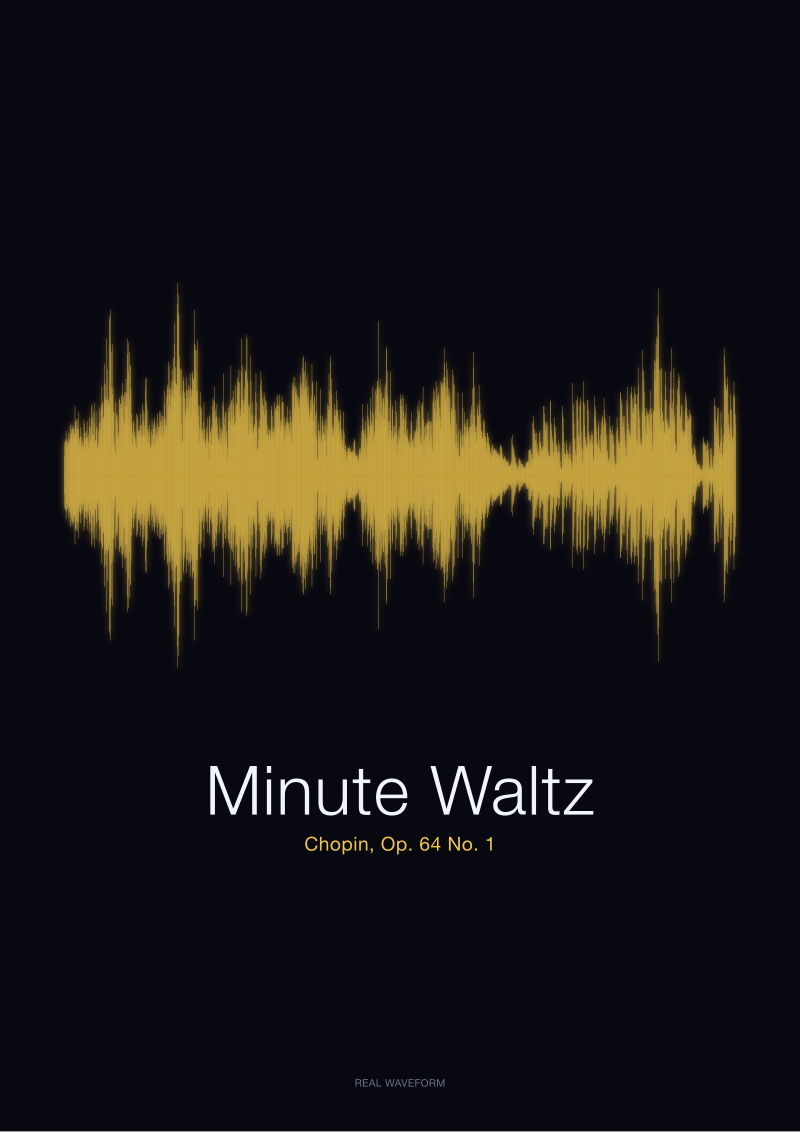
Three peaks in the Minute Waltz. Three in the Heroic Polonaise. We define a peak as a point where the local amplitude envelope rises clearly above the material on either side of it — not the loudest sample in an isolated cluster, but the summit of a hill that has visible slopes.
In Op. 64 No. 1, the first peak arrives near the front. The waltz opens with a written flourish, and in the recording we pulled that flourish sits taller than the running figuration that follows. It is a short, bright spike — a moment of arrival that resolves quickly into the smaller waves of the main theme. The second peak sits in the middle third, at what a listener would recognize as the return of the opening material after the central lyrical section. The third and tallest peak is close to the end, where the piece gathers itself into its final cadence. On paper, the waltz is bookended by attack and closed by force.
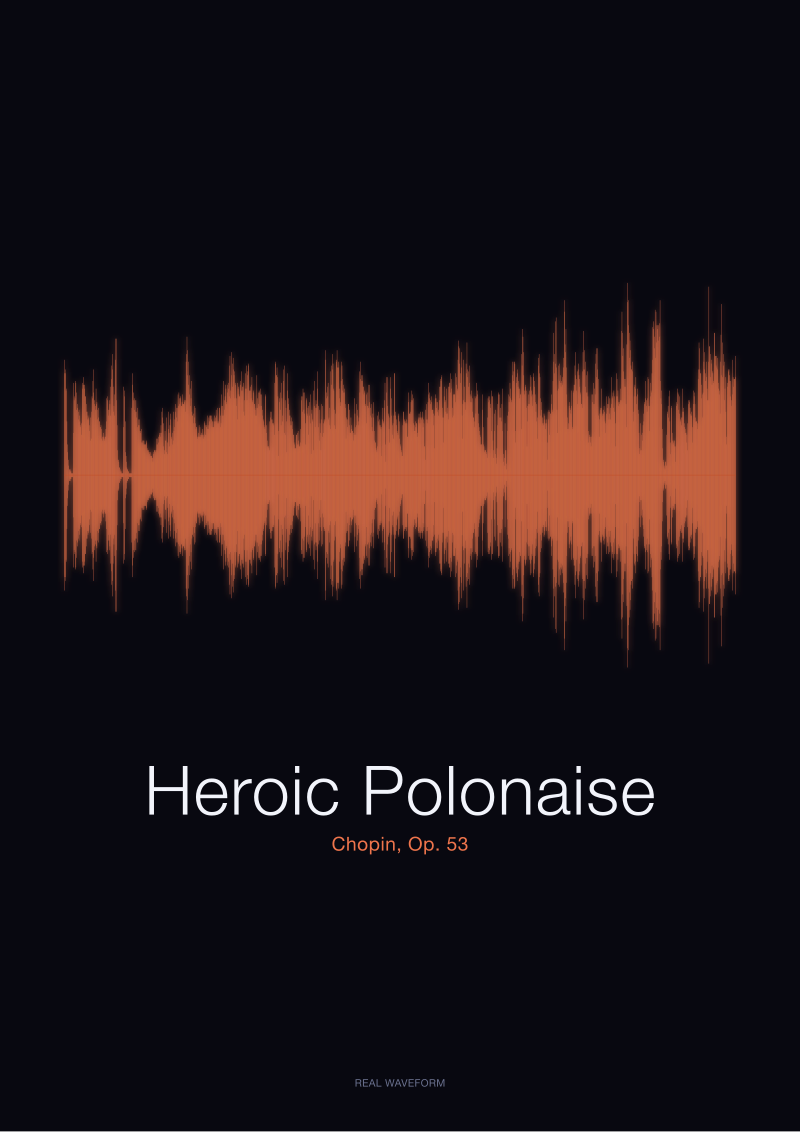
In Op. 53, the geography is different. The first peak does not fall on the opening bar. The recording begins with the well-known introduction — a low, tightening figure that grows before it strikes — and the first true peak lands only when that introduction resolves into the main polonaise rhythm. It is a broad-shouldered peak, not a spike. The second peak sits deeper into the piece, in the central section that many listeners identify by its ostinato — a passage that, on our rendering, does not spike to a single summit but climbs to a plateau of sustained amplitude, with the peak itself just marking the highest point along the ridge. The third peak, again, is near the end: a triumphant final flourish before the piece closes.
Read side by side, the two silhouettes share the same rough architecture — an opening arrival, a middle climax, a final peak — and disagree completely on what those peaks look like. The waltz's peaks are narrow. The polonaise's peaks are wide. The waltz reaches its tallest point at the end. The polonaise reaches its tallest sustained region in the middle. Same three-peak count, entirely different physical drawing.
 Minute Waltz
The print from this article · from €29.95
View the print →
Minute Waltz
The print from this article · from €29.95
View the print →
What the Titles Hide
The Minute Waltz is not called that because it lasts a minute. It never has. The nickname is a translation compression from the French "petite" — a small waltz, not a sixty-second one — and most recordings clock in comfortably past that mark. Our public-domain reading is no exception. The name promises brevity; the waveform records a longer object with real breathing room between phrases.
The Heroic Polonaise carries a heavier expectation. The word "heroic" prepares a listener for immediate grandeur — a title-page fanfare, a rush at the start. What the shape shows instead is patience. The piece begins quiet and coiled. The famous opening figuration is a build, not a blow. The first true amplitude peak arrives only after the introduction has done its work. If you were to hand someone the waveform with the title removed and ask them which of the two pieces sounds "heroic" from the first second, they would sometimes pick the waltz.
This is not a gotcha. It is a reminder that titles are labels attached by editors, publishers and nicknames — often after the composer's death, sometimes against his wishes — and the waveform belongs to the performance, not to the label. Op. 53 was published as Polonaise in A-flat major. The "Heroic" adjective is a later gift from listeners who heard something in it and wanted a word for the feeling. The shape of the sound does not owe that word anything. It behaves the way the performer and the room made it behave.
We render pieces from their recordings because of exactly this gap. The title is a promise. The waveform is what actually happened when someone played it. When the two disagree, the waveform is the honest witness.
Where the Two Shapes Diverge
Look at both silhouettes at the same aspect ratio and the divergence is not in the number of peaks — it is in what happens between them.
The Minute Waltz, between its three peaks, is not empty. It is busy. The connecting material is a rapid figuration whose envelope stays elevated at a moderate level, occasionally dipping, rarely resting. The silhouette between peaks reads, at a glance, like a dense field of small activity with a few taller spires. If you squinted at just the outline, you would see a horizon that never quite touches the floor.
The Heroic Polonaise draws itself differently. Between peaks, the envelope drops. It drops far enough that the shape of the piece looks like discrete mountains separated by wide, low valleys — moments where the piano gathers, breathes, and prepares to strike again. The polonaise's connective tissue is not filler; it is anticipation, and anticipation, on paper, is quiet. The high shoulders are dramatic on the page precisely because the material around them chose not to compete for the same vertical space.
That is why, held next to each other, the two waveforms look like different kinds of drawings. The waltz looks like a hedge with three taller tips. The polonaise looks like a landscape with three summits. They are both, formally, three-peak pieces. Physically, they are shaped by two different composers thinking about two different things — one writing a continuous small-scale spin, the other writing a large-scale utterance separated by silences. Same peak count. Different genre of shape entirely.
There is one more asymmetry worth naming. In the waltz, the tallest peak is at the end. In the polonaise, the tallest peak is in the middle. That single fact — where the piece places its loudest moment — is the difference between a piece that pushes toward its exit and a piece that plants its flag in the centre and lets everything else orbit around it.
 Heroic Polonaise
The print from this article · from €29.95
View the print →
Heroic Polonaise
The print from this article · from €29.95
View the print →
The Silence That Frames Each Peak
In visualisation terms, silence is white space. It is the paper the ink is not covering. And the amount of white space around a peak changes what that peak looks like — the same way an isolated word on an otherwise empty page carries a weight that the same word buried in a paragraph does not.
The Heroic Polonaise's peaks are surrounded by more white space than the Minute Waltz's peaks. That is not a metaphor. It is measurable in the render. Before the first true peak in Op. 53, the introduction sits low on the vertical axis; the eye reads that low territory as an approach ramp, and the peak that follows feels earned. After each of the polonaise's peaks, the envelope pulls back before rebuilding — not to zero, but to a level that gives the previous peak room to breathe. On the page, this creates the silhouette people associate with the piece: broad, shouldered, spaced.
The Minute Waltz refuses that treatment. The waltz's peaks poke out of a busy environment. There is not much white space around them because Chopin, in this piece, is not writing about arrival and recovery. He is writing about motion. The connective figuration is the point. Peaks are moments where the motion briefly rises above itself, then dissolves back into the same continuous fabric. Framing a waltz peak with silence would falsify what the piece is. The waveform respects that by keeping the surrounding envelope alive.
This is why we resist the temptation to say one shape is "more dramatic" than the other. Drama, in waveform terms, is the ratio of a peak's height to the quiet around it. By that measure, the polonaise is more dramatic — its peaks have more white space to rise from. But dynamism, measured as the density of activity per second, favours the waltz. The two pieces are not competing on the same axis. They are drawings of different physical intentions.
If you wanted to keep one image in mind: the polonaise's peaks stand on stages. The waltz's peaks are the tallest fish in a school. Both are peaks. Neither reading is wrong. And when the studio renders one of these pieces as a print — either Op. 53 or Op. 64 No. 1 is available in the see the Minute Waltz print — the framing choice is exactly this: how much of the surrounding silence to keep, so the peaks read the way the performance meant them to read.
If You Only Remember One Thing
The Minute Waltz and the Heroic Polonaise both have three peaks in the recordings we pulled. That is where their similarity, on paper, ends. The waltz's peaks are narrow spikes standing in an already-active field. The polonaise's peaks are wide shoulders rising from wide silences. The waltz saves its tallest moment for the end. The polonaise plants its tallest sustained region in the middle. Same count. Different physical drawings.
A title tells you what a piece is called. A waveform tells you what a specific performance of it looked like as air pressure. When those two disagree — and here, gently, they do — the waveform is the one that was there.
This piece did not address the many other public-domain recordings of these two works, each of which would draw a different silhouette; nor did it address the score-level analysis (bars, keys, harmonic structure) that would explain the peaks in musicological terms rather than physical ones; nor did it address how our rendering pipeline chooses aspect ratio and envelope smoothing, which affects how a peak reads on the page. Each of those is a separate conversation.
FAQ
Why aren't there more peaks in each piece?
We defined a peak conservatively — a point where the local amplitude envelope rises clearly above the material on either side of it, with visible slopes leading up and away. Smaller amplitude jumps that sit inside larger active regions do not qualify. Under a looser definition, both pieces would show many more spikes. Under our definition, both recordings resolve to three. This is a choice about signal-to-noise, not a claim about the score itself.
Does the Minute Waltz really not last a minute?
The nickname is a mistranslation of the French "petite valse" — a small waltz, not a sixty-second one. Most recordings, including the public-domain reading we used from the Musopen Chopin collection, last comfortably longer than one minute. The name is a marketing artifact from a later editor, not a tempo instruction from Chopin. The waveform records the piece's real duration, whatever the title suggests.
Would a different recording of the same piece show the same peaks?
No, not exactly. Different pianists take different tempi, apply different dynamics, and record in different rooms with different microphone placements. All of those affect the amplitude envelope. The general architecture — where the loud sections and the quiet sections roughly fall — tends to be shared across serious performances of the same score. The specific height and width of each peak is a fingerprint of one reading, not a property of the piece.
What does CC0 mean, and why does it matter here?
CC0 is a Creative Commons license under which the rights-holder waives all copyright and related rights, placing a work in the public domain to the fullest extent possible. The Musopen recordings we used are released under CC0 1.0, which is why we can render them into prints and analyse their waveforms publicly. Without CC0 licensing, doing this with a commercial recording would require separate permission from the label and the performer.
Is the tallest peak always the "climax" of a piece?
Not reliably. Amplitude measures how loud a moment is, not how important it is musically. A quiet passage can be the emotional centre of a work; a loud moment can be transitional rather than culminating. In the Heroic Polonaise, the amplitude peak in the middle section does coincide with a passage many listeners identify as the piece's centre of gravity — but that alignment is a happy accident of these two things pointing the same way, not a rule.
Why do you render from real audio instead of drawing a decorative wave?
Because a decorative wave has no relationship to the piece it is labelled with. It is a shape made to look like sound. The waveforms we render are the actual amplitude data from the recording, sample by sample. The result is that each print is unique to its recording — a Chopin waltz and a Chopin polonaise do not look alike, and two recordings of the same waltz do not look alike either. The honesty is the product.
Does the polonaise's introduction count as a peak?
No, under the definition we used for this piece. The introduction of Op. 53 is a build — its amplitude rises over the course of several seconds — but it does not summit into a locally isolated peak. It resolves directly into the main polonaise rhythm, and the first true peak lands after that resolution. If we had defined "peak" as any local maximum, the introduction's own arrival point would qualify. We chose the stricter definition to keep the six-peak comparison meaningful.
Can I see both waveforms as prints?
Yes — both Op. 64 No. 1 and Op. 53 are rendered from the public-domain Musopen recordings referenced in this article, and both are available in the studio's see the Minute Waltz print. The prints preserve the same envelope, framing, and white space discussed above; what you see on the wall is what the microphone heard, at the aspect ratio the studio uses for all its Chopin renderings.
From the collection
New pieces and 10% off your first print.
One email now with your code. No noise after.