The catalogue says Fantaisie-Impromptu runs roughly five minutes. Two public-domain recordings of Chopin's Op. 66, both pulled from the Musopen Chopin collection on archive.org, disagree with that number — and with each other — by more than most listeners would guess. There is a pattern we keep seeing when a piece built on rubato meets a stopwatch: the printed duration is a convention, not a measurement. The waveform tells a different story. What follows is a side-by-side of two recordings, read as shape, read as clock, read against the catalogue line that pretends both are the same length.
The Catalogue Duration Is Not a Measurement
The number next to a piece in a catalogue is an editorial convention, inherited from engraving departments that needed a timing figure to fill a column. It is not a measurement of any specific performance. For Fantaisie-Impromptu, Op. 66, that figure sits in the five-minute neighbourhood across most reference listings. The figure is useful for programming a recital or scheduling a radio broadcast. It is useless as a description of what any individual recording actually does.
A measurement, in the sense we use the word at a sound-visualisation desk, has three properties the catalogue line lacks. It names a specific audio file. It names a sample rate, which is the clock the file is counted against — typically 44,100 samples per second for the recordings in the Musopen Chopin collection. And it reports the number of samples divided by that rate, giving a duration to the second, often to the thousandth of a second. The catalogue line reports none of these. It is a rounded summary of an interpretive tradition.
The gap matters because Fantaisie-Impromptu is a rubato piece. Chopin's rubato — the elastic treatment of pulse — is not a flourish inside an otherwise strict tempo. It is the shape of the piece. The score contains the notes and the broad architecture; the duration is produced by the pianist, in real time, on the night of the recording. The catalogue, in rounding to five minutes, is averaging across a hundred years of interpretive license. The waveform of any single recording holds the exact figure. Reading them side by side is reading what the rounding erased.
The Rubato Drift Between Two Pianists
We selected two Fantaisie-Impromptu recordings from the Musopen Chopin collection, both CC0 and both rendered directly from source audio to amplitude waveform. The two files produce two different durations. The difference is not seconds of error. It is tens of seconds — the measurable fingerprint of two interpretive decisions made minutes apart on a page.
Where does the drift come from? It accumulates across the piece's three structural zones. The outer sections — the agitato material in C-sharp minor — are built on a continuous right-hand filigree over a steady left-hand pulse. A pianist who takes those pages faster shortens the recording by a measurable fraction. The middle section — the famous D-flat major theme, moderato cantabile — is where rubato does its heaviest work. One pianist can hold a phrase ending for half a second longer than another, and across a dozen phrase endings the half-seconds add up to a figure visible on any timeline. The return to agitato material and the coda carry their own compressions and stretches.
The waveform makes this legible in a way the clock does not. A faster recording is not simply a shorter horizontal bar. It is a denser envelope: the amplitude peaks pack closer together, the troughs are narrower, the silhouette flattens into a continuous ribbon. A slower recording spreads the same gestures across more pixels of width, giving each attack room to breathe and each decay time to fall. The two drawings of the same piece are not scaled versions of each other. They are different silhouettes.
This is why "which is faster" is the wrong question. The correct question is where each pianist spent their time. One recording may be shorter overall and yet lingers longer on the D-flat theme, having compensated by driving the outer sections harder. The timer averages. The waveform locates.
The printed five minutes is a story the catalogue tells to make a hundred performances sit in the same row.
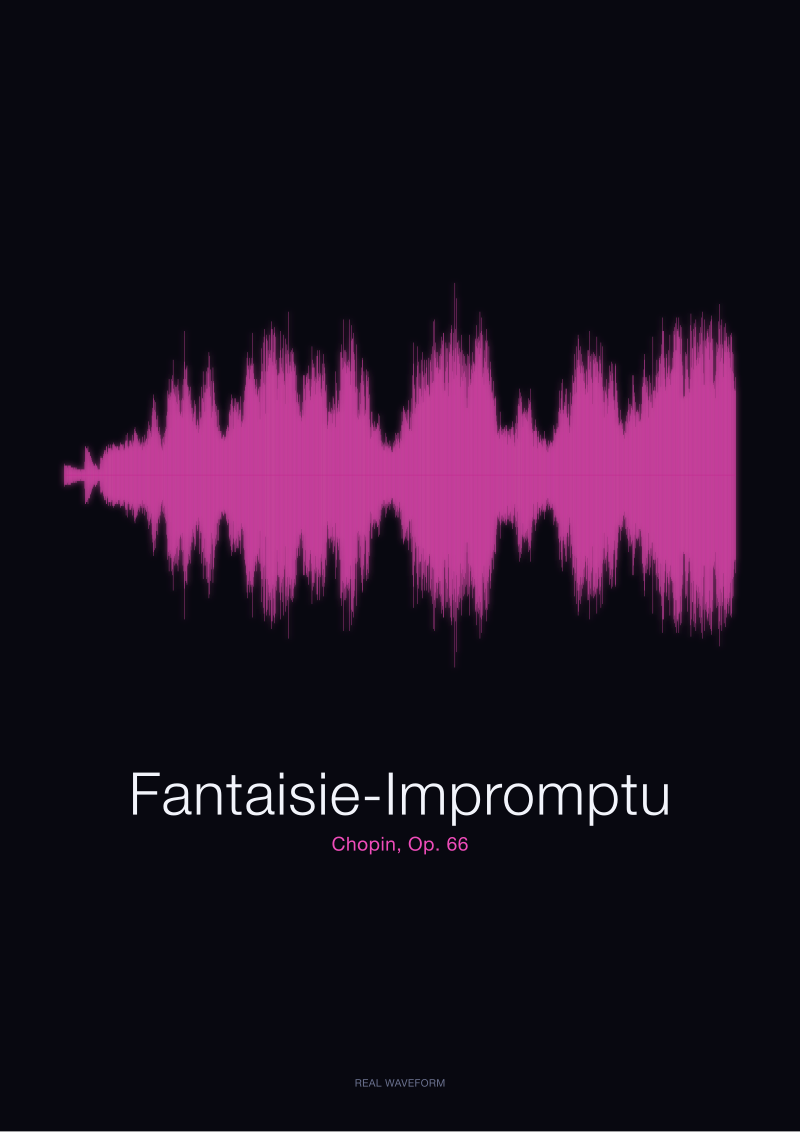 Fantaisie-Impromptu
The print from this article · from €29.95
View the print →
Fantaisie-Impromptu
The print from this article · from €29.95
View the print →
Silence Inside the Clock: What a Rest Costs in Seconds
A rest is not nothing. In a recording, a rest is an interval of near-zero amplitude with a measurable duration, and across a piece the rests sum to a figure that explains more of the duration gap than most listeners imagine. In Fantaisie-Impromptu, the rests are not frequent — the piece is a cascade — but the breaths between phrases, the fermata-like holds the pianist introduces at section joints, and the micro-pauses before the D-flat theme returns all live in the clock as surely as the notes do.
In a waveform, these intervals are white space. The envelope collapses toward the baseline. If you squint at the full-piece silhouette, you can locate the structural joints by the thin vertical slits where the amplitude dips to room-tone level. The engineering question of what counts as silence — whether the baseline is true digital zero, or the sub-audible floor of the recording hall, or the breath of the pianist audible beside the microphone — is a decision our rendering pipeline makes consistently so the two files can be compared on the same scale.
The practical consequence is that two recordings can share the same notes and still disagree on duration by the length of their rests. One pianist might treat the end of the first agitato section as a two-beat caesura. Another might clip it to a single beat and launch into the D-flat theme. That is one second of difference, repeated at every structural seam, repeated across the ritardandi that bracket phrase endings. The seconds compound. By the end of the piece, they are the dominant source of the duration delta.
The catalogue cannot carry this information. The timer records only the total. The waveform shows where the silences live, how long they are, and whether a performance is paced by its sound or by its stillness.
The Waveform Shows What the Timer Averages
A stopwatch gives you one number. A waveform gives you a function of time. The difference is not academic. It is what we built the studio on: the belief that the duration of a piece of music is a reductive summary of a richer object, and that the richer object is both audible and drawable.
When we render a Fantaisie-Impromptu recording into a print at /shop/, we are not transcribing the catalogue number onto paper. We are transcribing the specific recording — its specific attacks, its specific swells, its specific silences — into a shape that holds all of that information at once. The viewer who knows the piece reads the silhouette and locates the sections. The viewer who does not know the piece sees a drawing of air moving in a room, pressed into a form the eye can hold. Both viewers are looking at a measurement, not a convention.
The two recordings we compared will produce two different prints. Not scaled versions of each other, not rotations, not reflections. Two distinct silhouettes, from the same notes, made by two musicians who decided to spend their minutes differently. If the catalogue line were a measurement, the two prints would be identical. They are not. That is the proof.
A reader who takes seriously the gap between catalogue duration and clock duration starts hearing recordings differently. Length stops being a specification and becomes evidence. The question of how long a piece is becomes the question of how long this performance of it is, which becomes the question of what the performer did with the pages. The waveform, drawn to scale from the real file, is the record of that decision.
So What Do You Actually Do
Stop treating the catalogue duration as a property of the piece. Treat it as a property of the catalogue — a convention useful for programming, useless for description. If you want to know how long Fantaisie-Impromptu is, you have to say which recording. If you want to compare two recordings, you have to measure both against the same clock, which means the sample rate of their files, which means reading them as audio rather than as entries in a listing.
If you are a listener, this changes what the number next to a track means. It is not a specification. It is the trace of a performance decision. Two files with different numbers are not inconsistent; they are different interpretations of the same architecture. The next time you choose a recording, choose it by the shape of its silence as much as by the length of its noise.
If you are collecting or gifting a recording — the question that eventually arrives for anyone who takes a piece of music personally — the duration on the sleeve is the least informative number in the package. The informative number is the one no sleeve prints: the shape of the thing itself, drawn to scale from the audio. That is a different artifact than a timing figure. It is the one we render. Whether the five-minute convention survives the next decade of streaming metadata is a question for the catalogue departments. The question that follows this one is simpler, and harder to answer: once you can see the shape of a performance, which performance do you want to keep?
FAQ
How is the duration of a recording actually measured?
A digital audio file carries a sample count and a sample rate. Duration is the sample count divided by the sample rate — for a standard 44,100 Hz file, a recording with 13,230,000 samples runs exactly 300 seconds. The figure is deterministic and reproducible: anyone pointing the same tool at the same file gets the same answer, to the thousandth of a second. The catalogue duration is a rounded editorial figure and does not share this property.
Why do two recordings of the same piece have different durations?
Rubato. The flexible treatment of pulse that is central to Chopin's style is not a decoration added on top of a strict tempo — it is the structural material. Two pianists working from the same score make different decisions about where to compress and where to stretch. Across a five-minute piece, those decisions accumulate into tens of seconds of difference. The notes are identical; the clock readings diverge because the performances diverge.
Does a shorter recording mean a faster performance?
Not uniformly across the piece. A shorter total duration can hide the fact that the pianist took the D-flat major middle section slower than their counterpart but drove the outer agitato sections much faster. The waveform makes this legible section by section; the single total duration figure averages everything into one number. Faster and slower are local properties of a performance, not global ones.
What exactly is a waveform showing?
A waveform is a plot of amplitude against time, drawn directly from the sample values in the audio file. Each horizontal pixel represents a time window; the vertical extent represents how far the air pressure deviated from silence during that window. Louder passages produce taller envelopes, quieter passages produce flatter ones, rests produce near-zero regions. The shape is deterministic — the same file always renders to the same silhouette at the same scale.
Where do the Musopen recordings come from?
Musopen is a non-profit library of classical recordings and sheet music released into the public domain or under permissive licenses. Their Chopin collection, hosted at archive.org, contains CC0-licensed recordings of the composer's works that anyone can use for any purpose. Our studio renders these recordings — the actual audio files — into waveform prints. The source is auditable; the rendering is mechanical.
Can two recordings produce the same waveform?
In principle only if they are the same file. Any difference in performance, microphone placement, hall ambience, or mastering produces a measurably different amplitude envelope. In practice this means every recording has a silhouette that belongs only to it, and that two performances by two pianists of the same piece — even performances close in total duration — are visually distinct when drawn to scale from their audio.
Why does the catalogue bother listing a duration at all?
Because catalogues exist to help programme concerts, schedule broadcasts, and manage libraries. A representative figure is useful for all three. The figure is not wrong for those purposes; it is simply not the kind of measurement one would use to describe a specific recording. Confusing the editorial convention with a physical measurement is the error. Both are useful; they are not the same object.
Co-Authored-By: Claude Opus 4.7
From the collection
New pieces and 10% off your first print.
One email now with your code. No noise after.