Most sound wave art sold as a gift for musicians is not, on inspection, a drawing of the music. It is a decorative curve — a stock silhouette stretched to fit a frame, printed over a colour the buyer chose from a swatch. The recording it claims to represent was never opened. We know because we render the actual audio: a public-domain Chopin Ballade No. 1 from the Musopen collection has a specific silhouette, and a Fantaisie-Impromptu, Op. 66, has a different one, and neither of them looks like the generic wave on the checkout page. Whether that distinction matters to the person receiving the gift is the entire question, and the honest answer is: it depends on which musician you are buying for. Hear us out. We will walk through three.
The three cases below are composite illustrations, not people we interviewed. Picture them the way a novelist pictures a character: assembled from a hundred small observations, then given a single name for convenience. Each one wants a different thing from an object hung on a wall, and each one will look at your gift for a different length of time before deciding whether it is meaningful or landfill.
Scenario 1: The Conservatory Pianist Who Owns Every Recording
Imagine a pianist in their late twenties, second year of a doctoral programme, whose apartment already has three prints on the wall — none of them of music. They own six recordings of the Chopin Ballade No. 1 on physical media and probably twenty more on streaming. They can hum, from memory, the exact place in the coda where the tempo turns and the left hand starts hammering. Ask them to describe that passage and they will not reach for a metaphor; they will reach for a bar number.
For this person, a sound wave print of "Ballade No. 1" that is not, in fact, the Ballade No. 1 is an insult. Not a loud one — they are polite — but a private one. They will glance at it, register within about four seconds that the silhouette does not match any recording they have ever heard, and file it under objects-received-graciously. The frame will end up in a hallway.
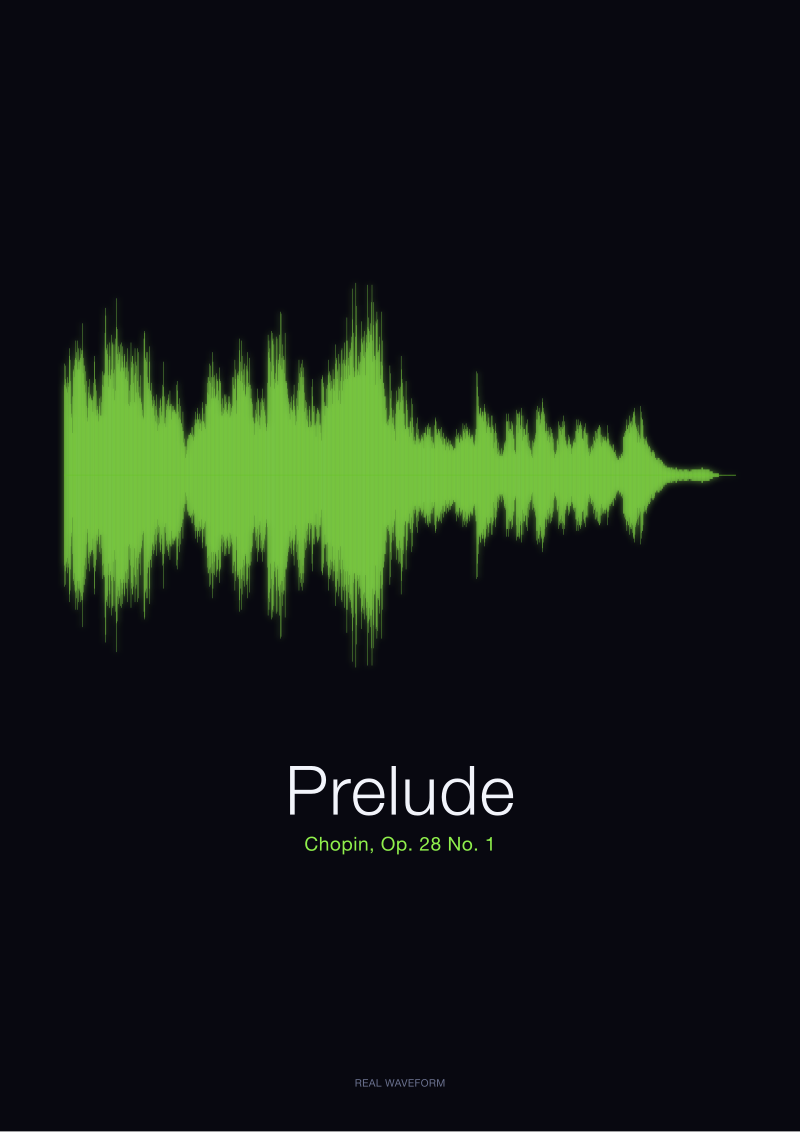
What lands, for this reader, is grounded specificity. If the print is a real amplitude waveform of an actual recording — say, the public-domain Musopen performance of Op. 23, rendered from the file itself rather than approximated — they will look at it for longer than four seconds. They will find the coda. They will trace the dynamic build from the introduction through the middle section and locate the loudest moment on the page. That reading is not decorative to them; it is analytical. They spent a year of their life learning to read music that way.
The rule for gifting into this scenario: the recording must be nameable and the rendering must be honest. A print that says "Chopin Ballade No. 1, Musopen public-domain recording, rendered from the actual audio" is a different object from a print that says, evasively, "Chopin Ballade No. 1 (inspired by)". The first is a document. The second is a poster. The doctoral pianist knows the difference in the time it takes to read the caption. Do not buy the second one for them. It is the gift equivalent of quoting a philosopher you have not read to a philosophy PhD — technically fine, quietly humiliating.
If you cannot verify which recording a shop is rendering, assume it is a stock curve. Ask before buying, or buy from a shop that publishes the source (ours is at /shop/, for exactly this reason: the Ballade is the Ballade, the Fantaisie-Impromptu is the Fantaisie-Impromptu, and the source URL is on the caption).
Scenario 2: The Amateur Cellist Who Played One Piece at a Wedding
Picture a hobbyist cellist in their mid-forties, an accountant by trade, who took up the instrument at thirty-two and now plays in a community orchestra on Tuesday evenings. Two years ago, at their sibling's wedding, they played a solo arrangement of a piece that everyone cried at. They will talk about that performance if you let them. They will not talk about it if you do not. It was, functionally, the peak musical event of their adult life.
For this person, a sound wave print of a famous concert recording is a shrug. What they want, if they want anything, is a print of *their own* recording — the phone-mic capture from the third row of the reception, or the rehearsal take their spouse recorded on a laptop. The shape does not need to be technically pretty. It needs to be theirs.
This is the case where the gift is transformed by input, not by curation. If someone can send in the audio file — an .mp3, a voice memo, a wedding videographer's raw export — and receive back a real amplitude waveform of that specific take, the object crosses over from decoration to relic. It becomes the physical proof that the moment happened, in a form the cellist can point at when they tell the story.
Two hard caveats. First: the file has to actually exist. Do not surprise a hobbyist musician by promising a print of the wedding performance and then discovering, two weeks in, that nobody kept the recording. That failure mode is common and it stings. Ask, quietly, before ordering. Second: the wedding-piece cellist does not need the piece labelled with academic pomp. If the arrangement was a folk tune, call it the folk tune. If it was a pop song adapted for solo cello, call it the pop song. Fake seriousness is a tell.
The unglamorous piece of infrastructure that makes this scenario work is the shop's willingness to render *any* audio file into a real waveform, not only its own catalogue. Some shops will. Many will not; they only sell prints of pieces they have pre-rendered, because per-order rendering is operationally expensive. If the second condition applies to a shop you are looking at, that shop cannot help you in this scenario, no matter how tasteful the frames. Move on.
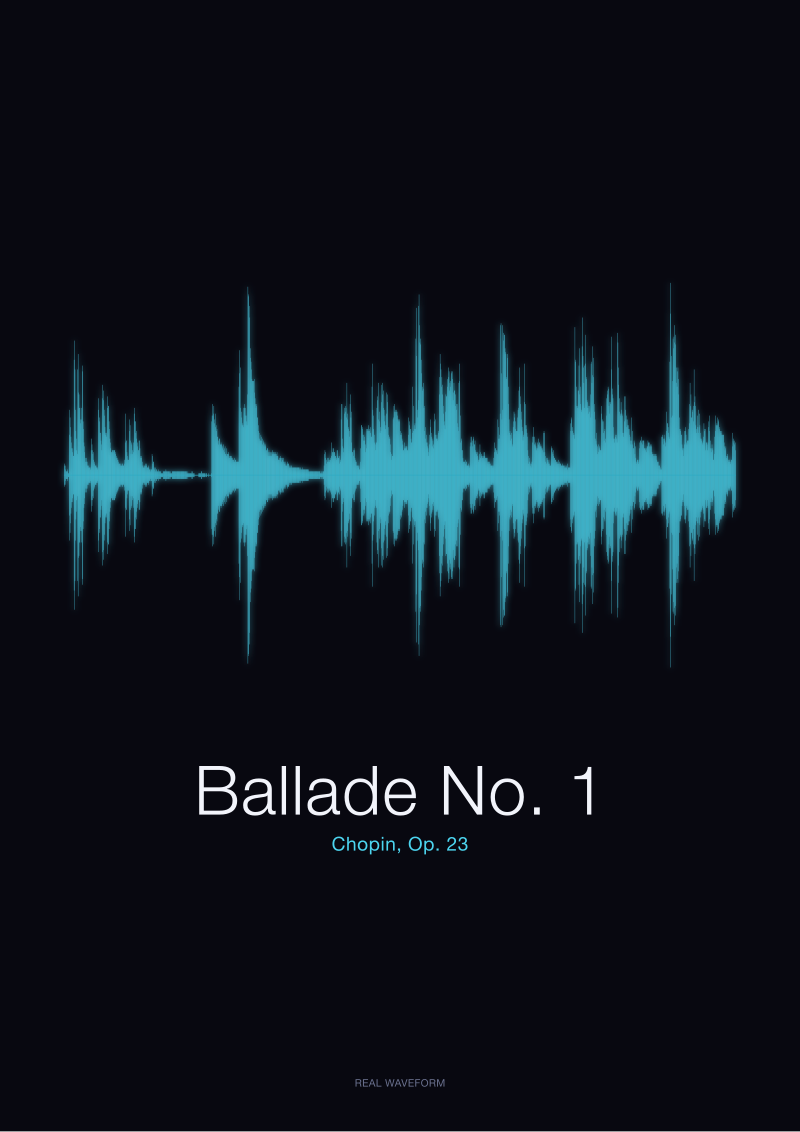 Ballade No. 1
The print from this article · from €29.95
View the print →
Ballade No. 1
The print from this article · from €29.95
View the print →
Scenario 3: The Non-Musician Gifting a Musician They Love
Now imagine you are the buyer. You are not a musician. You do not know the difference between Op. 23 and Op. 66, you have never heard of Musopen, and the phrase "amplitude waveform" is doing all its work in this sentence for the first time. The person you are buying for is a musician — a violinist partner, a parent who was a choir director for thirty years, a friend who plays keyboards in a band you have politely attended once. You want to give them something that says you were listening. You have a budget. You have three days.
This is the scenario where the gifting industry preys hardest, and where the most well-intentioned money is wasted. The trap is that "sound wave art for musicians" reads as a solved problem — search the phrase, click the top result, choose a colour, checkout in under four minutes. The output is a decorative curve that the musician in your life will thank you for and never look at twice, because they will clock, within seconds, that the shape is not from any recording they know.
The escape from the trap is a smaller, more useful question: is there a specific recording that matters to this person, and can you name it? The Chopin Ballade No. 1 that plays in the kitchen every Sunday morning. The Fantaisie-Impromptu, Op. 66, that they learned in their first year of piano lessons. The spoken-word file of their grandmother saying *bonjour* on an old voicemail. The recording of their own voice saying *ciao* to their child at bedtime, captured on a phone. Any of those is a starting point. All of them are drawable — a spoken word rendered from an actual audio signal (even a locally generated one, the way we produce the "Bonjour" and "Ciao" prints in our own catalogue) is a waveform in exactly the same way a Chopin recording is.
The rule here is the inverse of Scenario 1. In Scenario 1, expertise is the reader's, and your job is not to insult it. Here, expertise is the recipient's, and your job is to route around your own lack of it. Ask them, without giving away the surprise, what recording of what piece they have listened to more than any other. Their answer is the specification for the gift. Do not improvise it.
What All Three Share
The three scenarios above look different on the surface — one is a specialist, one is a hobbyist, one is a bystander to music entirely — but the failure mode is identical in every case. A sound wave gift fails when the recording it claims to represent was never opened. The shape is stock. The label is generic. The object communicates neither the piece nor the performance, and the musician receiving it registers the absence in the amount of time it takes to unwrap the frame.
The success mode, similarly, is one thing across all three cases: the print is a rendering of a specific, nameable audio source, and the caption says so plainly. It might be a public-domain Chopin recording from an archive with a URL you can visit. It might be a phone-mic capture from a wedding. It might be a two-second speech signal saying *bonjour*. What connects the three is that the waveform on the paper corresponds, sample by sample, to sound that actually happened somewhere. Everything else — frame colour, size, mount — is packaging around that single fact.
The musicians in the three scenarios are looking, without necessarily articulating it, for evidence that the gift-giver did the reading. In Scenario 1, the reading is knowing which recording. In Scenario 2, the reading is knowing which performance. In Scenario 3, the reading is asking someone else to tell you which piece. The evidence does not need to be loud, but it needs to be present, and it needs to be true.
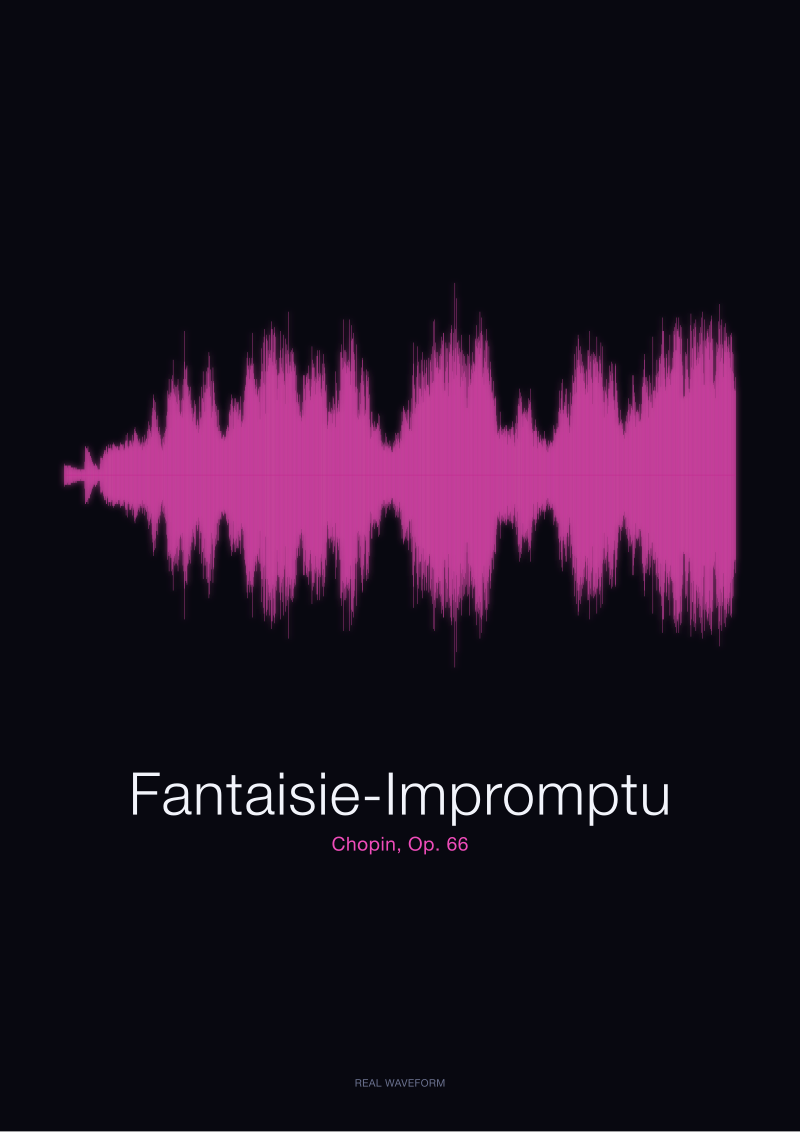 Fantaisie-Impromptu
The print from this article · from €29.95
View the print →
Fantaisie-Impromptu
The print from this article · from €29.95
View the print →
Which Scenario Is You
Read the three again quickly and locate yourself. If the musician you are buying for could, without hesitation, name their preferred recording of the piece you are considering, you are in Scenario 1: buy only if you can name the source too, and buy from a shop that publishes it. If the musician has a private performance of their own that matters more than any commercial recording, you are in Scenario 2: your gift is a rendering of their file, not a catalogue selection, and you need to secure the file before you order anything. If you are guessing at what they listen to because you love them but you are not in the music, you are in Scenario 3: ask them a small, indirect question this week, and let their answer specify the object.
None of this tells you which frame, which mat, which paper stock. Those are downstream decisions that only matter once the recording is settled. The question worth answering next is which piece — and by extension which recording of it — the musician in your life would recognise the shape of, in the four seconds before they decide whether to hang the gift above the piano or in the hallway.
From the collection
New pieces and 10% off your first print.
One email now with your code. No noise after.