A waveform is a drawing of air, and a QR code is a drawing of a URL — and people keep trying to weld the two together on a single sheet of paper. At this desk we render real recordings: the Ballade No. 1 with its long, uneven swell, the Fantaisie-Impromptu with its restless flicker, a single spoken *Ciao* collapsed into a shape you could hold in one hand. The QR question arrives in the inbox every week, and most of the tutorials online answer the wrong one. What follows is not a step-by-step. It is a flowchart in prose. We will ask you three questions. Your answers route you to the version of this project that will not embarrass you at the framer.
Question 1: Is the Recording You Want to Print Actually Yours to Use?
This question comes first because it decides whether the rest of the project is legal, ethical, and durable — or a small crime you framed and hung above the sofa. Most tutorials skip it entirely. One popular guide we read recently opened with "just drop the Spotify link into the QR generator" and never mentioned that the resulting print embeds a URL its author does not own, pointing at a stream its author cannot guarantee, playing audio the giver has no license to distribute in that form. The guide was in the top ten Google results. We are not making this up.
There are only two clean answers to this question. Everything else is a lawsuit waiting for a wedding anniversary.
If Yes
You own the recording — you made it, someone made it for you and signed it over, or it is in the public domain — then the project is genuinely yours to build. A voice memo of a grandparent reading a passage. A studio recording your partner paid for and holds the rights to. A public-domain performance from the Musopen Chopin collection (CC0 1.0, `archive.org/details/musopen-chopin`), which is where the Ballade No. 1 and Fantaisie-Impromptu recordings we render at this desk actually come from. In this branch you can render the waveform from the actual audio file, host the file yourself, and point the QR at the file. The shape on the paper and the sound behind the QR come from the same source. That is the only version of this project where the artefact is coherent.
The audio file wants to live somewhere that will still exist in ten years. A personal domain you already renew is a defensible answer. A named cloud folder with a stable share link is an unstable answer — those URLs change without notice. If in doubt: buy a domain, put the file at `yourname.com/song.mp3`, encode that URL into the QR. Boring is durable.
If No
You do not own the recording — it is a commercial release, a streamed track, a friend's band's single — and you want the QR to lead there, then you are not making sound-wave art. You are making a decorated Spotify shortcut, and you should be honest with yourself about that. The waveform you draw from a commercial recording without licence is a derivative visual work in a legally grey zone; framing it privately for one person is one thing, selling it on Etsy is another, and the difference matters more than most tutorials pretend.
There is a clean route out of this branch. Ask the artist — small artists say yes surprisingly often — or pick a public-domain recording that carries the same emotional weight. The waveform of the Ballade No. 1 is not the waveform of your partner's favourite pop song, but it is a real, uneven, honest silhouette rendered from real air moving through a real room. The people who love this piece love it because it is drawable at all.
Question 2: Does the QR Code Need to Play the Exact Audio You Rendered?
This is the question that most tutorials treat as trivial and get catastrophically wrong. They assume the answer is obviously yes and then hand you a workflow that quietly answers no. The screenshot of a Spotify waveform on the print, the QR linking to the Spotify track — those two audio sources are not the same file. Spotify does not stream the master; it streams a lossy transcoded version whose amplitude envelope has been touched by loudness normalisation. The picture and the playback drift apart. Nobody scanning the code will notice. You will notice, forever.
Decide now which side of that drift you can live on.
If Yes
You want the person scanning the QR to hear precisely what you rendered on paper — the same take, the same mix, the same silences — then the audio file has to live at a URL you control, in a container the phone will play. In practice: MP3 or M4A, hosted at a stable `https://` address, linked by a QR generated from that URL. When the phone camera reads the code, the browser opens, the audio element plays, the shape they are holding starts to make sound. That is the version of this project that behaves like a gift instead of a shortcut.
Two practical things nobody tells you. First: iOS Safari will not autoplay audio; the recipient has to tap the play button after the URL loads. Build a page around the file rather than linking to the raw MP3, and put a large, obvious play button on it. Second: the waveform you print should be rendered from the exact file the QR points at, not a lossless master you re-encoded three times. Same file, same shape, same sound. Every step of divergence adds a whisper of dishonesty to the object.
If No
You are content for the QR to open a streaming page — a Spotify link, an Apple Music link, a YouTube video — because the recipient will play it on their own account and the surrounding context (playlist, credits, artist page) is part of the gift, then say so plainly on the print. A tiny caption near the code: *scan to open on Spotify.* The waveform on paper is then a portrait, not a receipt. It is drawn from a recording of the piece; the QR opens a related but not identical version of the piece. Those two truths coexist if you name them.
What breaks the object is pretending. The design that shows a waveform, embeds a QR, and offers no explanation is silently claiming that the shape and the sound match. When they do not, the gift acquires a hairline crack the recipient can feel without being able to name.
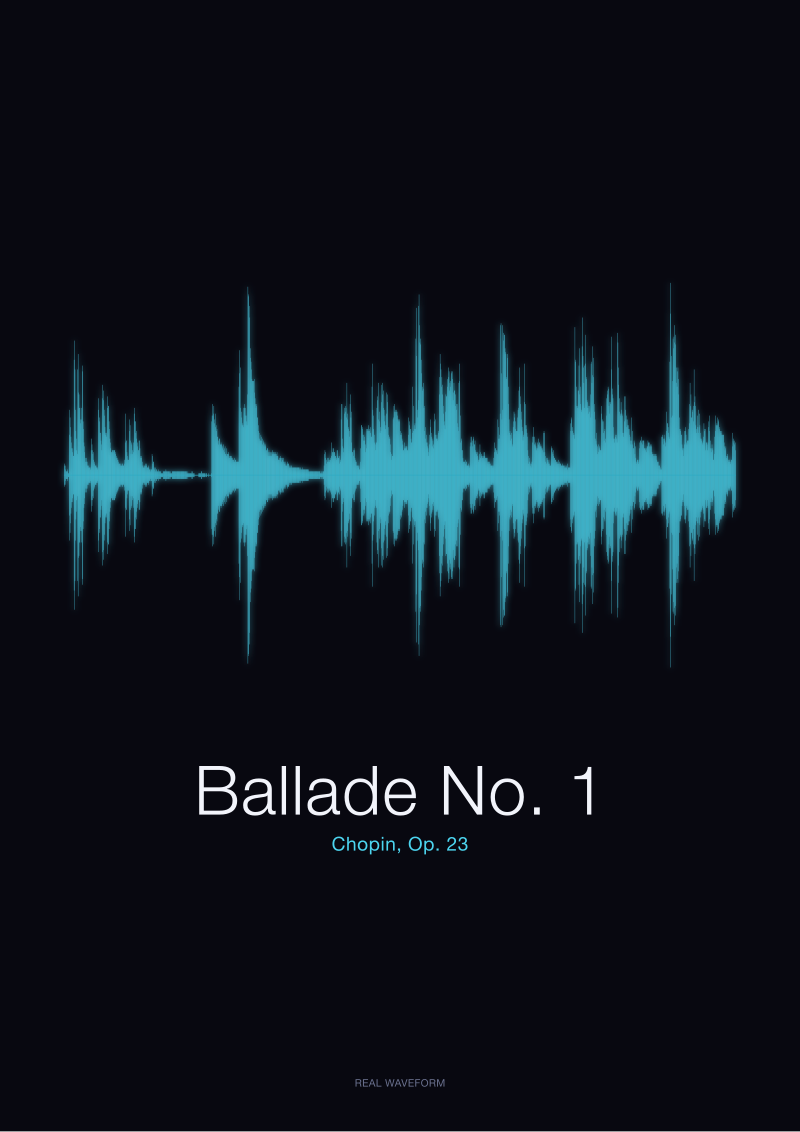 Ballade No. 1
The print from this article · from €29.95
View the print →
Ballade No. 1
The print from this article · from €29.95
View the print →
Question 3: Will the QR Live on the Face of the Print, or Behind It?
The third question is aesthetic, and it is the one couples argue about on the phone with our studio for twenty minutes. A QR code is a very loud graphic — a dense black-and-white square that reads, at any distance, as *technology*. A waveform is a very quiet graphic — a thin, uneven, almost calligraphic line that reads, at any distance, as *drawing*. Putting them on the same face of the paper puts them in a fight the QR always wins.
We have seen thousands of these prints. The ones that age well solve this fight by moving the QR out of the composition entirely.
If Yes
You want the QR visible on the front of the print — because the recipient is a child who will scan it constantly, because the piece is meant to be interactive, because you like the honest maker-y look — then commit to it and design for it. Put the QR in a corner, at a fixed inch-square size, in the same ink as the waveform. Do not tuck it awkwardly under the caption. Do not shrink it below 25 mm on a print larger than A4 — small QRs fail scans, and a scan that fails once is never tried again. Give the code its own quiet gutter of white space; it needs about 4 mm of margin to read cleanly. The waveform stays the hero; the QR sits in the corner like a footnote that happens to sing.
If No
You want the print to read as a drawing when it hangs on the wall, and the audio to arrive when the object is picked up — then move the QR to the back of the mount, or the back of the frame, or a small card slipped into the sleeve. The recipient discovers it once, learns the sound, and after that the shape on the wall carries the memory of the sound on its own. This is the arrangement most of our returning customers land on after their first order. The front of the print is the piece; the back is the mechanism.
There is a third route on this branch worth naming: printing the QR at the very bottom edge, small, in a low-contrast grey, so it functions as a maker's mark rather than a call to action. This is what we do on the studio's own prints when a client commissions a piece from a Chopin recording in our catalogue — a small monogrammed square, matte, quiet, off-white against off-white, next to the credit line for the Musopen source. It reads as provenance, not as interface. If you look at how our shop presents the finished pieces, that is the register we mean.
If You Answered Everything: The Route-to-Recommendation Table
Eight combinations of yes and no, eight versions of this project. The table below is the whole flowchart collapsed into one grid. Find your row.
| Q1: Own the audio? | Q2: QR must play exact file? | Q3: QR on the front? | Recommendation |
|---|---|---|---|
| Yes | Yes | Yes | Host your file at a personal URL, render waveform from it, put a 25 mm QR in a corner in the same ink. |
| Yes | Yes | No | Host your file at a personal URL, print the QR on the mount back or an insert card. |
| Yes | No | Yes | Point the QR at the streaming page, caption the code, keep waveform rendered from the same take. |
| Yes | No | No | Streaming-link QR on the back; caption the front print with piece title and recording source only. |
| No | Yes | Yes | Do not print. Get licensing or switch to a public-domain recording, then re-enter at Yes/Yes/Yes. |
| No | Yes | No | Do not print. Same route: license the audio or choose a public-domain performance instead. |
| No | No | Yes | Streaming link is fine, but disclose it on the front and treat the waveform as portrait, not receipt. |
| No | No | No | Streaming link on the back; the print is decorative and honest about it — the sound is elsewhere. |
Two of the eight rows are stop signs. The five that survive are the versions of this gift that will still be in the recipient's home a decade from now. The remaining one — Yes / No / Yes — is the one most tutorials produce and most people regret; it is legal and functional, but the QR argues with the waveform on the wall until someone eventually takes it down.
None of this tells you which recording is worth printing, and that is the question that starts once the mechanics are settled. Whether the object earns its wall depends on whether the shape you chose is a shape that will still mean something in ten years — the long swell of a Ballade the giver first heard on a specific evening, the flicker of a Fantaisie-Impromptu that played at a specific dinner, a spoken *Bonjour* recorded on a specific morning. That is where the real work of this gift starts, and it is not a QR-code problem.
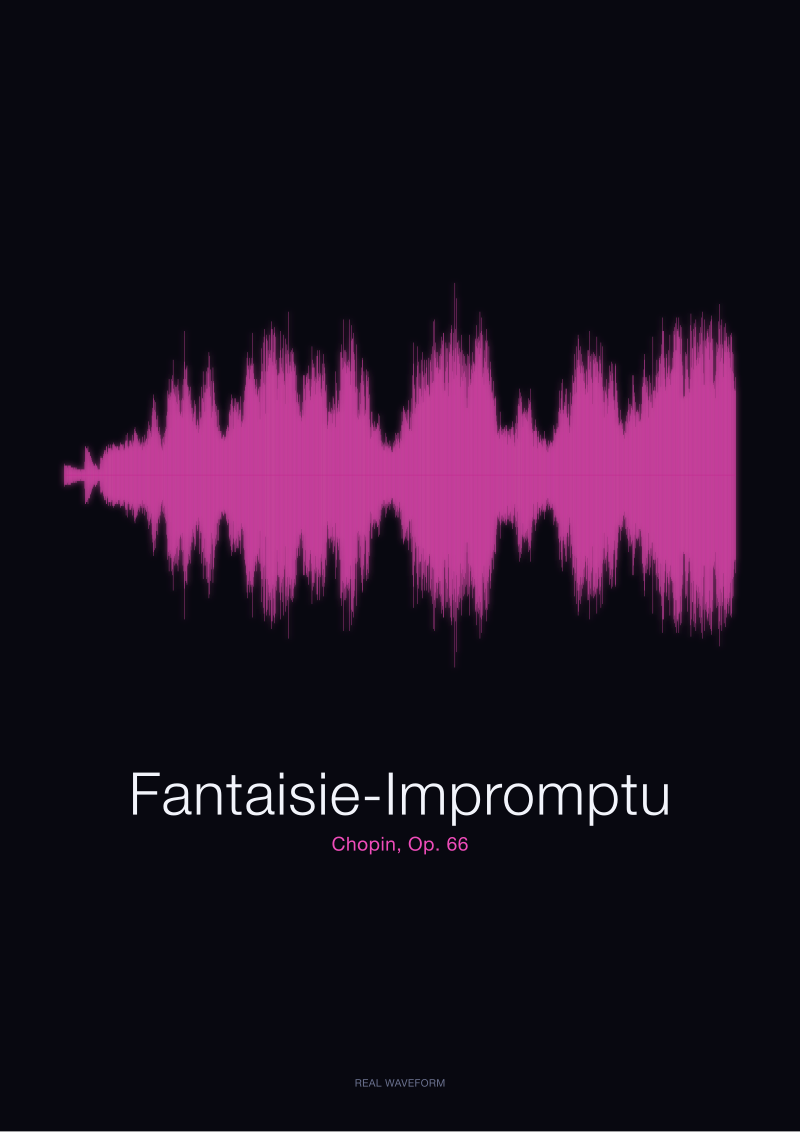 Fantaisie-Impromptu
The print from this article · from €29.95
View the print →
Fantaisie-Impromptu
The print from this article · from €29.95
View the print →
FAQ
Can I use a Spotify link inside the QR code on a wall print?
You can, and the code will work, but be honest about what you have made. The waveform you draw from a Spotify-streamed track will not match the amplitude profile of Spotify's normalised playback, so the picture and the sound will drift apart. If the QR is meant to be a shortcut to the recipient's own listening experience, label it as such on the print. If it is meant to play the exact take the shape was rendered from, you need to host the audio yourself at a URL you control.
What audio file format should I host for a scannable waveform print?
MP3 or M4A, served over `https://` from a domain you renew, is the pragmatic answer. Both play natively in mobile browsers on iOS and Android without extra apps. FLAC and WAV are technically superior but inconsistently supported on phones and dramatically larger to download over cellular. Wrap the file in a small HTML page with a visible play button — iOS Safari will refuse to autoplay audio, so a raw file link often looks broken to the recipient even when it is working.
How small can the QR code be before it stops scanning reliably?
On a print larger than A4, keep the QR at 25 mm square minimum, with roughly 4 mm of clear margin around it. Below that, scan failures rise sharply — especially indoors, under warm lighting, at the awkward angles people actually hold their phones. A code that fails the first scan attempt is almost never tried a second time. The corner-QR approach only works if you commit to the space it needs.
Is a public-domain recording really a legitimate substitute for my favourite song?
It is a different gift, not a lesser one. The Musopen Chopin collection (CC0 1.0) contains real performances of pieces like the Ballade No. 1, Op. 23 and the Fantaisie-Impromptu, Op. 66, free for any use. The waveform of a Ballade rendered from a real recording carries its own weight — the uneven swell, the pauses, the way one performance's silhouette is unrepeatable. If the recipient's connection to the piece exists, the shape means something. If it does not, no licensed pop song will fix that.
What happens to my QR code if the audio host disappears?
The QR itself is permanent — it is a printed drawing of a specific URL — but the URL behind it is only as durable as the host. Free cloud services rotate their share links, get acquired, or shut down. A personal domain you already renew is the most durable option most gift-givers realistically have. If longevity matters, budget for a decade of domain renewals when you budget for the print; the framing is the smaller line item.
Does the QR code need to be black, or can I match it to the print's ink?
It can match, within limits. QR scanners need high contrast between the code and its background — roughly a 60% luminance gap works reliably. Deep navy on cream, charcoal on off-white, oxblood on ivory all scan cleanly. Two mid-tones together (grey on beige, dusty rose on stone) start to fail. Test on three different phones before you commit; older Android cameras are more forgiving than the current iPhone camera, which is stricter about contrast than most designers realise.
Can I add a QR code to a waveform print I already own?
Yes, but treat it as a physical addition rather than a redesign. A small printed card tucked into the frame's mount, or a sticker on the back, keeps the front composition intact and gives you the audio linkage. Retrofitting a QR onto the visible face of a finished print almost always looks like an afterthought, because it is one. The framer can help you build a discreet back-of-frame pocket for a card at a cost of a few pounds; that is the intervention that ages well.
From the collection
New pieces and 10% off your first print.
One email now with your code. No noise after.