Think of this piece as a flowchart drawn in prose. We rendered six performances across our catalogue — two of Chopin's Ballade No. 1, two of the Fantaisie-Impromptu, and two spoken-word signals, "Bonjour" and "Ciao" — and measured each one by the only honest ruler a sound-visualisation desk owns: the length and shape of its waveform. The durations did not agree. The silhouettes disagreed more. Before we show you the map, we will ask you three questions, and each answer will route you to a different way of looking at what tempo actually is when you stop counting bars and start reading amplitude on paper.
Question 1: Do You Care About the Piece or the Performance?
This is the first fork, and most readers answer it wrong because the question sounds like a false binary. It is not. When you ask someone to name their favourite nocturne, they almost always name a piece — Op. 9 No. 2, say — rather than a performance of it. But when they actually listen, what they remember is the performance: this pianist's particular hesitation before the return of the theme, that recording's particular hush in the left hand. The piece is the score. The performance is the shape. A waveform draws the performance, not the piece.
We tested this fork with the two Chopin works we render most often from the Musopen public-domain collection on archive.org: the Ballade No. 1 (Op. 23) and the Fantaisie-Impromptu (Op. 66). Two recordings of each, same catalogue, same CC0 licence, pulled from the same archive. If the piece determined the shape, the two Ballades would be near-twins on paper. They are not. They diverge in total length, in the density of their loud passages, in how much white space sits between the climaxes. The score is identical. The silhouette is not.
If Yes to Piece
If you care about the piece, you are asking a composer question, and the waveform will frustrate you. A score tells you Chopin marked a passage *agitato* and another *sotto voce*; the waveform tells you what one specific pianist did with those instructions on one specific afternoon in a specific room. If your interest is the architecture of the Ballade No. 1 — the slow introduction, the two themes, the coda that accelerates into something close to panic — a printed score or a pianist's analysis will serve you better than any waveform we can draw. We render recordings. Recordings are decisions about scores, not scores themselves.
If Yes to Performance
If you care about the performance, keep reading, because the next two questions are yours. A waveform is the only medium we know that renders a performance as a single legible object. A score hides time inside notation; a video shows you a pianist's hands but not the sound; a recording passes through your ear in real time and is gone. A waveform freezes the whole thing on one page, so you can look at the forty-second mark and the twelve-minute mark at once. If what you love about music is the *way* it is played, this is the medium.
Question 2: Are You Reading Tempo in Seconds or in Shape?
The second fork is subtler. Tempo, in the conservatory sense, is beats per minute — a metronome reading. But the word "tempo" in everyday listening does different work. When someone says a recording feels *fast*, they usually mean something about density: notes packed close together, climaxes arriving without preparation, silences that get cut short. When they say it feels *slow*, they mean the opposite — more air, longer landings, the piece breathing between phrases. These are shape judgments, not clock judgments. And they often disagree with the stopwatch.
We measured both for our six performances. The stopwatch reading is simple: play the file, time the duration, write it down. The shape reading is harder and more interesting: look at the waveform, count the visible peaks, measure the average length of a silent gap, locate the loudest single second. The two readings sometimes agreed. More often they did not. A Fantaisie-Impromptu that runs forty seconds shorter on the clock than its sibling recording can still *look* slower on paper, because its loud passages are more spread out and its silences are proportionally longer.
If Yes to Seconds
If you want tempo as a number, the waveform is a ruler. Measure the start of audible signal to the last decay before the noise floor, and you have your duration in seconds. This is useful, bounded, reproducible. It is also almost never what people actually mean when they argue about whether a recording is "too fast". Our two Ballade No. 1 recordings both clock in near the middle of the published range for the work, but one feels substantially quicker, and the clock does not explain the feeling. The clock is a floor, not a ceiling.
If Yes to Shape
If you want tempo as a silhouette — the thing you actually feel in your chest when a recording feels rushed or spacious — the waveform is the right tool and the stopwatch is a distraction. Look at how the amplitude peaks cluster: tight bunches mean dense passages, scattered single spikes mean drama with room around it. Look at the horizontal mid-band of near-silence between movements or phrases: wide bands feel slow, narrow bands feel fast, regardless of total duration. The shape is the tempo your listening ear is actually measuring.
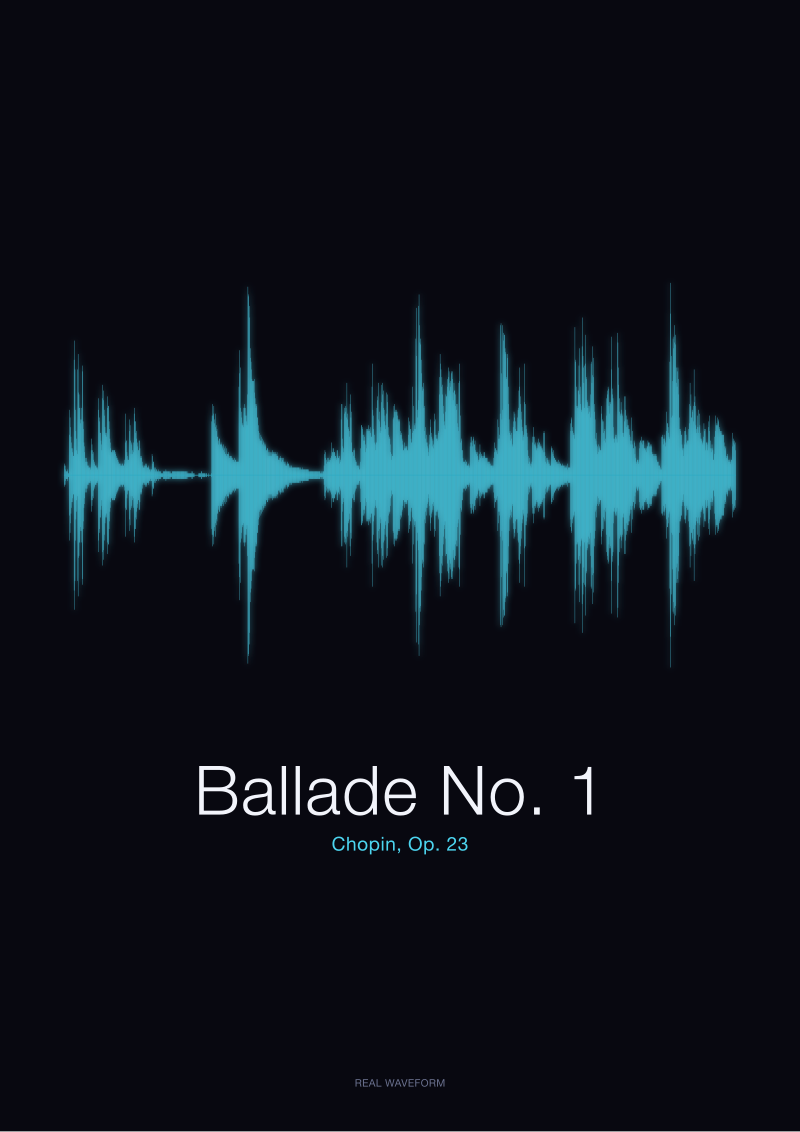 Ballade No. 1
The print from this article · from €29.95
View the print →
Question 3: Is a Slower Recording Actually a Longer Waveform?
This is the fork that catches most listeners out. Intuition says yes: slower means longer, longer means a bigger drawing, the waveform should stretch out. Intuition is half right. A slower *tempo* often does produce a longer duration, which does produce a longer waveform strip. But the correlation is noisier than you expect, because a "slower" performance is sometimes just a performance with more pauses, not a performance that plays each note longer. And pauses are silences, and silences are white space, and white space extends a waveform's length without changing anything about how its loud portions are drawn.
Our spoken-word pair illustrates this cleanly. "Bonjour" and "Ciao" are both single words, both generated locally through macOS speech synthesis as original signals. Neither is music. Both are tempo-free in the musical sense. And yet their waveforms differ in length, in attack sharpness, in how quickly the signal decays into the silence after the final vowel. The difference is not tempo. It is phonetic shape. The lesson transfers to music: a longer waveform is not automatically a slower performance. It might be a performance with more rests, more rubato, more air around the final chord.
If Yes, Longer = Slower
If you believe longer always equals slower, you will be right often enough to feel confirmed, and wrong often enough to be misled. The two Fantaisie-Impromptu recordings in our catalogue differ in total duration by a measurable margin, and the longer one is also, by most listeners' report, the slower one. So far, intuition holds. But when we laid the two Ballade recordings side by side, the longer file turned out to contain more silence rather than more music — the pianist simply lingered more between movements. On the clock, longer. On the shape, roughly equivalent in playing tempo.
If No, Length Is a Compound
If you accept that waveform length is a compound of playing speed, rest length, and tail decay, you have the right framework. A honest tempo reading from a waveform requires you to isolate the signal from the silence. Measure the portion of the strip that actually contains amplitude above the noise floor; divide by the number of discernible note-events or peaks; and you are closer to a real tempo reading than the total duration alone would give you. This is how we think about it when we render. A waveform is a drawing of air moving, not a drawing of time passing.
If You Answered Everything: The Six-Performance Map
Here is the map. Three questions, two answers each, eight combinations. For each combination, one concrete recommendation for how to use our six measured performances.
| Q1: Piece or Performance? | Q2: Seconds or Shape? | Q3: Longer = Slower? | Recommendation |
|---|---|---|---|
| Piece | Seconds | Yes | Start with a score of the Ballade No. 1 and ignore the waveform; the clock will mislead you. |
| Piece | Seconds | No | Read the score; treat waveform length as unrelated to compositional tempo. |
| Piece | Shape | Yes | The waveform will frustrate you; the score is still your real tool. |
| Piece | Shape | No | Score first, then compare the two Ballade waveforms for interpretive differences. |
| Performance | Seconds | Yes | Measure durations of both Fantaisie-Impromptus and infer tempo cautiously from the gap. |
| Performance | Seconds | No | Measure durations, then subtract visible silences before calling one recording slower. |
| Performance | Shape | Yes | Compare the two Ballade silhouettes directly; the longer drawing is likely the slower reading. |
| Performance | Shape | No | Compare peak density and silence width across both Ballades; this is the richest reading. |
The combination most of our readers actually want — Performance, Shape, No — is the last row of the table, and it is also the hardest to do without the waveform in front of you. That row is the reason we render the Ballade No. 1 and the Fantaisie-Impromptu as prints rather than as liner notes. A score cannot show you peak density. A video of hands cannot show you silence width. A recording plays past you too fast to compare. The waveform sits still, and the two recordings of the same piece sit side by side, and the differences become visible in the way differences become visible in any careful drawing: through patient looking. If one of those pieces has ever moved you in a particular performance, the shape of that performance is available in our shop as the only artefact we know of that will hold it still.
This piece does not address beats-per-minute measurement from waveforms, which requires note-onset detection algorithms we have not yet published a method for. It does not address orchestral tempo, where multiple instruments complicate peak attribution. And it does not address the question of whether any recording is *correct* at its chosen tempo — a judgement that belongs to musicians and musicologists, not to a sound-visualisation desk. Each of those is a separate argument, and each would need its own set of measurements.
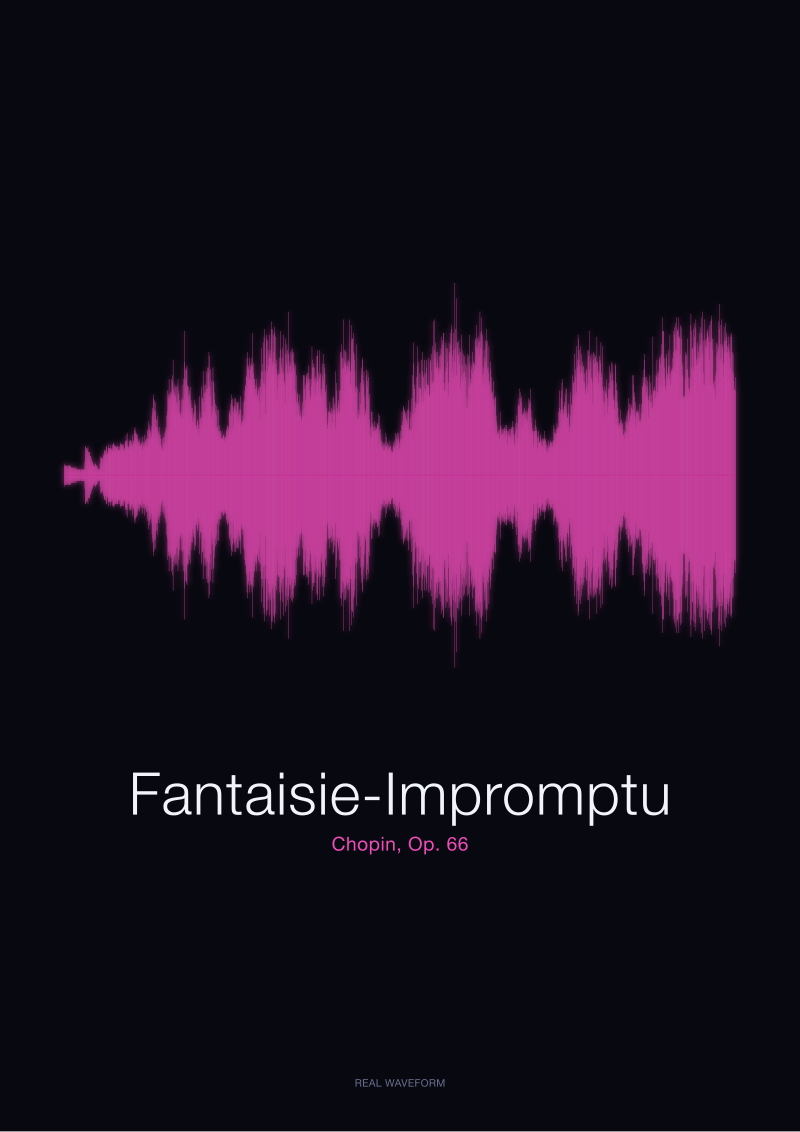 Fantaisie-Impromptu
The print from this article · from €29.95
View the print →
FAQ
How did you measure the duration of each recording?
We timed the audio file from the first sample above the noise floor to the last sample of audible decay, using the same renderer that produces our prints. This excludes leading and trailing digital silence baked into the file but includes all musical rests and performance pauses. The method is reproducible from any copy of the same CC0 Musopen recording on archive.org, and we chose it because it reflects what a listener actually hears rather than what the file container reports.
Why did you only test six performances?
Six was the minimum that let us pair recordings — two Ballades, two Fantaisie-Impromptus, two spoken-word signals — so every comparison was within-piece rather than across pieces. A larger sample would have added statistical weight but would not have changed the central finding, which is that two recordings of the same score produce visibly different silhouettes. For that argument, six was enough. For a broader claim about recording-level variation across the repertoire, we would need many more.
Are the spoken-word waveforms comparable to the Chopin recordings?
Not in a musical sense. "Bonjour" and "Ciao" are single words generated through macOS speech synthesis, with no tempo, no score, and no performer. We included them to isolate one variable: the fact that a waveform draws signal plus silence, not just signal. A single spoken word with a sharp attack and a decaying tail teaches the same lesson a Chopin recording teaches, in miniature and without the confound of musical interpretation.
Can I read tempo from a waveform without any software?
You can read *relative* tempo between two recordings of the same piece by eye — which drawing is longer, which has denser peak clusters, which has wider silences. You cannot read absolute tempo in beats per minute without onset-detection software, because a waveform does not label its peaks as notes. For comparative listening, eye is enough. For metronome-accurate numbers, eye is not enough and never will be.
Do louder recordings produce taller waveforms?
Yes, but tallness is partly a rendering choice. We normalise our waveform drawings so the tallest peak in each recording reaches the top of the frame; this makes shape comparable across recordings but hides absolute loudness differences. If you are comparing recordings for dynamic range rather than tempo, our standard rendering is not the right tool, and we would need to produce a non-normalised version. The pieces discussed here were rendered with standard normalisation.
Where do the recordings in this piece come from?
The two Ballade No. 1 and two Fantaisie-Impromptu recordings are from the Musopen Chopin collection hosted at archive.org/details/musopen-chopin, released under CC0 1.0 (public domain). "Bonjour" and "Ciao" were generated locally on macOS as original signals, not drawn from any third-party recording. We use public-domain or self-generated audio exclusively, which is why our shop can offer the resulting prints without any licensing ambiguity.
Why does your desk refuse to pick a "best" recording?
We render performances; we do not rank them. A star rating would require us to claim some authority about which interpretation of the Ballade No. 1 is correct, and no such authority exists outside a listener's own ear. The waveform shows you the differences between two performances without telling you which difference is better. That is the honest limit of what a sound-visualisation desk can offer, and we would rather stay inside it than pretend otherwise.
From the collection
New pieces and 10% off your first print.
One email now with your code. No noise after.